

Leading Argentine director Lucrecia Martel (Holy Girl; The Swamp; Zama) takes the plunge into documentary with her latest feature, Nuestra Tierra (Landmarks). This is a complex and hard-hitting story about the murder of an Indigenous community leader and the community’s subsequent fight for justice on his behalf.
The film, sold by Cinetic and The Match Factory, works both as gripping courtroom drama, and as a very probing look at racism and the toxic legacy of colonialism.
At the outset, Martel throws us into her narrative with an extraordinary sequence. The camera seems to descend from outer space towards Argentina before finally closing in very closely in on Chuschagasta women playing football on the community’s ancestral lands (which are today so bitterly contested). “The space views, they are free. It’s very easy to get them. The idea of starting from space comes from something very peculiar to the Argentinian culture,” the director muses.
“When we say ‘we’ in Argentina, we do not know exactly what this ‘we’ means…” Martel continues. The nation, she points out, only ever unifies over football. “Everybody is proud of Messi and Maradona. But apart from that, we do not know what we share…everyone in Argentina knows that the only ‘we’ is in football.”
The Spanish word ‘tierra” has a double meaning in Martel’s film, she adds. It refers both to the planet Earth and the problems the Indigenous community faces regarding land rights. “Our ‘land’ and ‘our planet’ is the same expression,” the director notes.
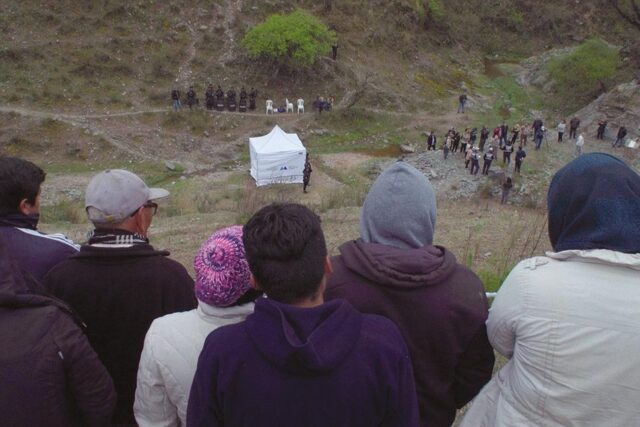
Indigenous leader Javier Chocobar was murdered in October 2009 by three men. They claimed they were owners of the land. The incident was caught on camera, but what ought then to be an open and shut case is riven with complexities and problems. Martel films the public trial of these men, who try to argue they were acting in self-defence.
In the documentary, an elderly member of the Indigenous community points out that whenever his people enter into “dialogue” with the white settlers, things always end badly for them. They will be tricked and double crossed. How, then, did Martel herself earn their trust?
“The relationship with the community was not easy at all,” Martel admits. “When I started all the investigation and my contact with the community, the families hoped this film could help them in the trial. What they wanted was justice for the man killed and those injured. When I told them I wouldn’t be able to finish the film until the trial started, they got a little bit angry with me…it was very difficult for me to understand fully their problems – and was the same the other way round, for them to understand me and my vision.”
At that point, Martel had no funding in place and hadn’t yet established a clear vision for the film. Nonetheless, she researched the project thoroughly, delving deep into the history behind the dispute.
“Those were the moments when you have to decide whether to go on with the project or to leave it…I decided to go on.”
Argentina is a Mestizaje (‘mixed race’) culture whose people have many different roots. Some can trace their ancestors back to the pre-Colombian era, others to the Spanish conquistadors. There has been widespread exploitation over the centuries. As the documentary reveals, that exploitation continues today.
“Those who wrote the history of Argentina do not belong to that [Indigenous] community,” Martel explains one very obvious reason why large parts of the real history remain unchronicled.
Martel was well aware that her own status could be problematic. What gave her the right to take on this assignment? “Every time there is an Indigenous community in a film, you wonder, you ask yourself, is the director using that community for his or her own benefit. That is a difficult question to answer.”
There’s a striking moment midway through the documentary when the defence lawyer suddenly draws attention to the filmmakers in the courtroom. She tells the judges she didn’t know that they were there, and implies they are compromising the trial. Martel says this was a “petrifying” incident. She suddenly went from being an observer to a participant.
“Two hours before the trial started, the judge asked me what the cameras were doing there. They were allowed in because it was a public trial but the judges wanted to know why we were there…”
Martel responded that she wanted to shoot the trial because it was a historic event and she was determined for there to be a proper record. She was asked not to use the courtroom material until the final sentence had been passed.
“But I think our presence meant something for those who were part of the trial and for the judges,” Martel reflects. “It is very important to convey to young people that filmmaking and cinema can have a huge power. They can use it for good or bad reasons but it has a huge power – and I’ve never felt it so much as in this film.”
Nuestra Tierra premiered Out of Competition in Venice and is also screening in Toronto, at the New York Film Festival, and at many other festivals. The documentary has already been shown first to the Indigenous community in Argentina. “It was a beautiful moment for me…and for them I think.” Martel hopes the film might re-open the case and that the community might finally receive some proper justice.
When Martel began her career in 2001 with La Ciénaga (The Swamp), her portrayal of a corrupt and crumbling middle class, Argentinean society was in economic crisis. It was the middle of what was called the country’s great depression. A quarter of century on and Argentina is still in crisis, under its controversial President Javier Milei. Public spending has been cut savagely and the National Institute of Cinema and Audiovisual Arts (INCAA) has faced very tough times.
Is Argentina condemned always to be in this kind of economic upheaval? Martel laughs ruefully at the question. “Like other Third World countries, we don’t have a proper economy,” she says. “Everything revolves around the eternal debt…the economy depends on the economy of other countries. You can say that about other countries too but, in our country, the level of dependency is huge.”
“We always talk about independence but our time as a colony has not ended…we are not able to look at history as a sovereign, independent country. We do not have a history as a community that has managed to integrate all its different people. This film is evidence of that!” she ends emphatically.
Landmarks was put together as an international co-production. Partners included Rei Pictures in Buenos Aires, Louverture Films (Joslyn Barnes), Piano, Pio & Co, Snowglobe and Dutch outfit Lemming Film.





