

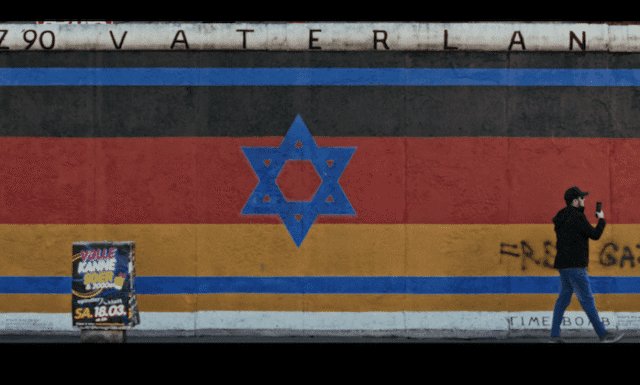
Ron Rothschild’s A Jewish Problem probes into very uncomfortable areas both in his family’s history, and that of the state of Israel. Its central figure is his grandmother, Ruth, whom he interviewed at length before she died. She had survived the Holocaust in Germany but after the ‘Nakba,’ the mass displacement of the Palestinians following the 1948 Arab-Israel war, she and her partner slept in Palestinians’ abandoned homes in Acre. This was a period when, as she put it, the Israeli army “didn’t behave nicely at all…our soldiers ruined everything and they stole.”
Rothschild himself later became a military cameraman in Israel, shooting footage of the arrest of a young Palestinian on his private camera. Now based in Berlin, he has made A Jewish Problem (screening in the German competition at DOK Leipzig) while still enrolled at the Deutsche Film-und Fernsehakademie Berlin (DDFB)
The director’s grandmother is filmed close up and in deliberately shaky fashion. “It’s also what it was. I was just sitting in her living room, talking to her, and I took my small, private camera for this. I was interviewing her while sitting behind the camera. The reason why I took it in my hand and did not put it on a tripod was that I wanted it to be more of a dialogue and less a testimony from my grandmother,” says Rothschild.
In the documentary, the director was also able to draw on family drawings, photographs and letters. “I had a lot of archive material that would normally cost money.”
Ask him to sum up his feelings about his grandmother today and he sighs. “It’s a difficult question…she was a complex figure. She was involved in actions that are morally dubious and she is testifying about this. I myself had the same kind of history [so] I am not in the position to judge her.”
As a young man, Rothschild had no desire to serve in the Israeli army but his father warned that he “would not find belonging” if he quit. He followed his father’s advice but soon wished he hadn’t.
“I can still understand why I went into the army because I couldn’t know…but after a year and a half, and particularly after 2009 and the time in Gaza, three days in total, I had a conversation with my father because this was the moment when I realised this is wrong. I was already quite deep in…in the sense I had been a soldier for a year and a half and was part of the system.”
Rothschild knew that if he had quit the military, it would have meant turning his back on everyone around him and possibly even facing jail. “I don’t want it to sound like an excuse because I think I should have [quit] but, of course, I regret it a lot.”
In hindsight, he concludes he “lacked the courage” to leave but doesn’t blame his father for advising him to stay. “He just wanted to protect his son.”
For well over a decade, Rothschild has kept the footage of the young Palestinian being arrested and bundled into a military vehicle.
“I was trying to shoot what I found important. In this way, you see how [Israeli] soldiers are most of the time oppressing Palestinians,” the director observes. “I knew I was shooting shots that were not supposed to be shot and that if I handed them in, no-one would use them. That’s also why I did it on my private camera and took it home.”
Rothschild left Israel a few years after his military service ended. At the time, he didn’t have any specific career plans – he just knew he needed to get away. At first, he went to France, then moved on to Berlin, started an MA in Jewish studies at the University of Potsdam, and eventually joined the directing course at the DFFB. It helped he had a German passport and enough savings to tide him over for the first few years.
Structuring A Jewish Problem was a formidable challenge. This was a deeply personal story and yet also dealt with big political issues.
“We started the film before the 7th October [the horrific 2023 Hamas attacks on Israel]. The original idea was just to connect the Holocaust and the Nakba through my personal family story, to show the responsibility for what is happening in Palestine with the people I live among in Germany. I felt like a lot of my friends in Berlin didn’t even know why this is part of their history.”
After October 7, though, the trajectory of the documentary changed. It became more of a film diary. “I figured out that I wanted to focus on the personal and just to echo the big events, not necessarily to show them.”
The director realises his film is likely to “get a lot of negative responses” in certain quarters.
“There is a very big, painful discussion within the Jewish community in Germany at the moment. It is really divided,” Rothschild suggests. “Of course, Jews are still very much the victims of anti-Semitism but they are not the only victims. You see more and more that Muslims, and sometimes other minorities, are becoming even bigger victims of the fight against anti-Semitism. This creates a very complex situation in which it is very hard to talk without making enemies.”
The film school provided Rothschild with cameras, editing equipment and a “little budget.” His crew was made up of fellow students, for example producer Yusuf Çelik. He and Çelik are still students and are developing further projects together along with their editor, Astrid Hohle Hansen.
In the meantime, the director is steeling himself for whatever controversy the documentary might spark. “Yes, I am trying to prepare myself. I assume I will say something wrong at a certain point that I will regret saying. About the shitstorm that will come? It’s a very personal thing for me. Because I didn’t stand up for what I believe in when I should have done, I feel like I can’t keep thinking about this all the time…whatever will come will come.”





