

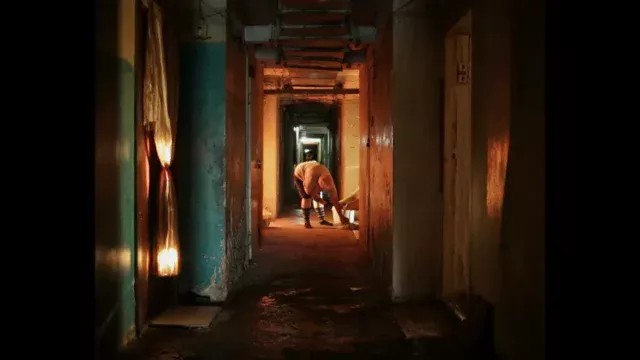
Filmmakers Tamar Kalandadze and Julien Pebrel spent seven years making their new feature documentary, The Kartli Kingdom, an intimate epic set almost entirely within the confines of the ex-Kartli sanatorium in Tbilisi, Georgia. This is a rambling Soviet-era building named after Georgia’s medieval kingdom, but which became home to 200 families of displaced people who moved there following war in the region of Abkhazia in the 1990s.
“We discovered the place in 2018 and the last shot was in 2025,” Kalandadze says. “We had the feeling we also lived in this place, because we were so welcomed by the inhabitants themselves. We also had our room where we could sleep and rest. We had big freedom to wander around, oversee and talk.”
As the film (world-premiering November 16, and sold by Square Eyes) reveals, the building elicited a wide range of different, even contradictory emotions among its residents. It was only ever supposed to be a temporary resting spot. The refugees wanted proper homes. The crumbling infrastructure of the sanatorium wasn’t great for their health either. But there was huge camaraderie among the Kartli dwellers.
“We are very sorry to tell you the dog is dead,” Pebrel jokes of another of the long-term inhabitants of the building, filmed over several years, sitting at the bottom of the stairs, taking life easy, as the Kartli cats threaten to disturb his peace. The filmmakers confide with amusement that they filmed so much footage of the animals they could have made a separate documentary about them.
Reflecting the feelings and experiences of its subjects, the tone of the film frequently changes. There are dark, tragic moments, for example when one of the residents jumped off a high floor to his death below. This was in the period of protests against broken promises from the government which had failed to find the residents alternative accommodation.
Earlier during shooting, Pebrel remembers, the residents’ perspective was that they wanted to stay in Kartli. That changed after Zurab’s death. However, when opportunities arose to find new homes, many found it a very big wrench to leave behind all their friends in the building.
What was it like living in the sanatorium? “The young girl [Tamuna] you see in the film was basically our door opener. It was her who embraced us and gave us her room,” Kalandadze remembers. “And living there was, for us, inseparable from the filmmaking. From the very first day, we understood that if we wanted to make something really precious and meaningful about this place, we should somehow live like them [the residents], be very close to them, feel what is happening in their minds and memories…this film in itself now seems to be a documentation of our life with these people.”
The aftermath of the suicide is shown early in the documentary – but happened a few years after the filmmakers arrived. Pebrel describes it as among the toughest sequences to film. Intrusive TV crews turned up on the scene. Outsiders were coming to join the demonstrations and some were “suspicious of the camera.” The Kartli residents always made it clear that Tamar and Julian were “one of our ours.”
The filmmakers didn’t know Zurab well but had met him several times. By then, they were so close to their other subjects that it was like “mourning with friends” after he died. In the wake of the suicide, they took a break from making the documentary. “Everybody needed to be silent I think,” Pebrel says.
The documentary includes archive footage, belonging to the National Georgian broadcaster, of the displaced people on an epic march across snowbound hills and forests after they had to flee Abkhazia. This was filmed by mountain walkers who were helping them cross the pass. They’re frail and vulnerable, not dressed for the cold, and clearly traumatised at leaving their homes behind.
Within the Kartli building, they managed to rebuild their lives. Some are hypochondriacs. They’re shown continually taking their blood pressure, using equipment that seems to be left over from the days the sanatorium was still functioning.
At times, there are echoes of horror movies where the buildings take on sinister lives of their own. The Kartli residence is full of long corridors and steep staircases.
“We had this feeling of the building as a personality with its own character and mood,” Kalandadze says. “The key to understand how these people live and what they do all day was also to study the building itself, all the stairs and balconies.”
There is a crack in the building which was itself beginning to look old and tired, a bit like some of its inhabitants. At first, when all the families set up home there, everyone was working hard to keep the place spruce. As time passed, though, and more and more residents found accommodation elsewhere, less attention was paid to its upkeep.
“You can see now the real state of the building…now that almost nobody is able to maintain it,” Pebrel says.
The people who are left behind are those waiting for one-room apartments, which are more difficult to find, or those who (as Kalandadze puts it) “emotionally can’t move out.”
The Kartli Kingdom has been invited to various prestigious festivals after IDFA. It’s yet to be determined when the film will screen in Georgia itself. There are ongoing protests involving many within the Georgian film industry against state body, the Georgian National Film Centre (GNFC), which has been accused of censorship, and against the ruling pro-Russian Georgian Dream Party. Several, leading industry figures including actor Andro Chichinadze remain under arrest – and he is facing a two-year prison sentence.
The documentary itself didn’t receive state support. The filmmakers suggest that the outside world doesn’t really know what is going on in Georgia in terms of political repression.
“But let’s talk about the bright side,” says Kalandadze. “Now, as a community, not only the documentary makers but all of the cinema [field] are really well connected, really sympathetic to each other…”
In essence, they have a camaraderie and resilience matching that which used to be found among all the families in the Kartli building.





