

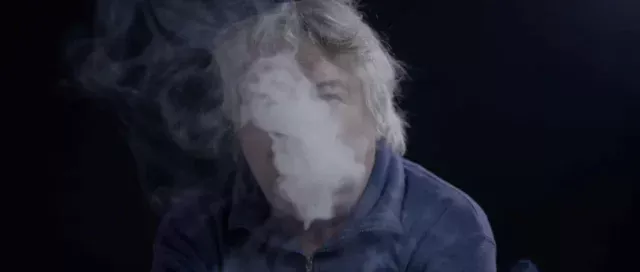
Luuk Bouwman is on a hot streak, back in official selection at IDFA for the third year in a row. He was at the festival in 2023 with the rural doc Gerlach, which he co-directed with Aliona van der Horst; returned last year with winning film The Propagandist, about Dutch Nazi filmmaker Jan Teunissen, and is in the official programme again with The Desert of the Real (a world premiere in Frontlight). The documentary was produced by Marc Thelosen and Koert Davidse for Serious Film. Dutch distribution is handled by Cinema Delicatessen.
This is one of several Dutch documentaries at the festival this year probing into the worlds of the psyche and mental illness. Bouwman’s six protagonists have all suffered episodes of psychosis. They’re also intelligent and articulate figures who are able to talk very eloquently about the very fine line between sanity and madness.
Bouwman has spent almost a decade working on The Desert of the Real. He started shooting the first interviews in 2016. “It has taken me a long time to make the film, and also I didn’t know at first how to make it. I was interested in the subject. I knew I wanted to try and make a film that was mostly about the inner world of psychosis, and not so much looking at it from the outside. But how to do that I didn’t know for a long time.”
The key turned out to be conversations with several of the protagonists who mentioned to him that, during their periods of psychosis, they felt “as if they were in a movie.”
Dutch philosopher Wouter Kusters told the director that, when he was psychotic, he felt like the lead character in his own film. Other characters had similar experiences of being in a reality that felt staged.
This insight gave Bouwman the idea of using reconstructions in which his characters could tell their stories within a studio setting.
“I thought that was interesting because it was showing how, in a way, fiction, media and movies not only reflect on reality – they also structure it and help generate the terms through which we understand reality,” the director notes.
The Desert of the Real is intended both to explore “existential, philosophical” themes as well as a human experience familiar to far more people than might be expected. In the film, philosopher Kusters, psychologist Eloy Vos, and artists Ine Poppe and Jan Gerrit Schuurman, reflect on language, the brain and the nature of time.
“These were all just people I found very interesting to converse with. I’d read the books of Kusters, and Ine Poppe has written about madness in art. You could say that is how it started,” Bouwman suggests. “In the end, it [the film] is also about empathy for people that you might not understand – a reminder of the humanity of persons that you cannot connect with.”
The film, which world-premieres November 17, includes references to the Wachowskis’ classic sci-fi movie, The Matrix, with its famous scenes of Laurence Fisburne telling Keanu Reeves, “welcome to the desert of the real.” Bouwman was also inspired by French author Albert Camus’s The Myth of Sisyphus, about human beings’ attempts to find meanings in their own existence, within a silent universe.
Certain details are intriguing. For example, we learn from Ine Poppe that psychotic people like to go to airports. “I’m not an expert but I think stations and airports are also maybe where you end up when you’re looking for shelter,” the director suggests.
Some of the subjects’ insights are also subversive. They suggest that during their moments of psychosis, they’re experiencing life in a heightened fashion, and that going back to “ordinary reality” seems monotonous and anticlimactic by comparison. “Euphoria and deep insights can be part of psychosis,” says Bouwman. “The protagonists talk about getting caught up in an idea or train of thought, such as the love that Calypso Marengo describes for author Alice Walker. They pursue creative paths with unwavering single-mindedness.”
They also point out that family members and loved ones can sometimes suffer more because of their illnesses, than they do themselves. “Psychosis itself is, I guess, elusive for most people, but when you look at these people and hear them talk, it’s quite close to things that most of us have experienced. The line seems thin and the world itself is quite mad,” Bouwman muses.
The new film, which world-premieres November 17, might be described as an intimate and personal work when set next to another of the prolific director’s current projects, the hugely ambitious The Eighth Continent, presented at the recent NLWave, and concerning humanity’s quest to colonise the moon. “Both are odysseys, one into inner worlds – the other into outer worlds,” Bouwman ends.
A version of this article was first published in SEE NL, a collaboration between Eye Filmmuseum and NFF.





