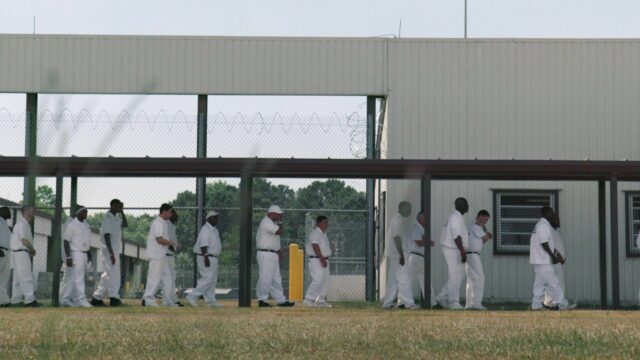
The Alabama Solution took seven years to complete – and in that time filmmakers Andrew Jarecki and Charlotte Kaufman assembled a devastating indictment of the prison system both in Alabama and across the US. Using footage shot by inmates themselves on cellphones, they have shown how squalor, violence and degradation have become commonplace in American jails.
At the heart of the documentary is Robert Earl, a long-term prisoner with little chance of parole who has become a leader and spokesperson for the other inmates. His nickname is Kinetic Justice and he is a man always on the move, filing new lawsuits, taking on new strategies, reaching out to journalists. Despite the brutality around him, he remains an advocate of non-violence.
“Because he has such positive energy considering what he has been through, he is incredibly inspiring to everybody else…and I do feel when we talk to him it’s as if we are talking to Nelson Mandela when he was on Robben island,” Jarecki says.
His activism has come at a very high price. At one stage, Alabama prison officers beat Earl so badly that he almost lost his eye.
“If he were out in the free world, he would be getting very different treatment for his eye, consistent treatment, and he’d be able to put drops in it all the time,” Kaufman observes of his lack of proper health care. “He made a miraculous recovery but he is going to live with the consequences of that assault for the rest of his life.”
The documentary opens with the filmmakers attending a picnic at Easterling, one of the main Alabama prisons. This was an event put on as a PR exercise by the authorities. The filmmakers were told not to speak to the prisoners. “But the minute we went inside, we felt much more comfortable with the men than with the guards or the wardens. The men started to say to us they’re letting you see this barbecue, but …”
Within the actual prison buildings, the situation was grim. “We knew there were problems. We just didn’t know how bad they were. Then, when we left, and the men started reaching out to us, we realised there was a network of people inside the prison system who had access to contraband cell phones – and that we might be able to have them to tell the story,” Jarecki remembers how the documentary flickered into life.
Many of the prisoners emerge as heroes, not just Robert Earl but also his fellow inmates and activists Melvin Ray and Ricardo Poole.
Another major figure is Sandy Ray, mother of Steven Davis, the prisoner brutally stomped to death by a rogue guard, but whose killing has been hushed up. From the outset, she welcomed the filmmakers in, telling them that she didn’t want any other mother to have to suffer what she did.
Kaufman and Jarecki were right in the middle of the evolving story, not reporting from a distance or after the event. They were there when campaigning lawyers talked to corrupt officers, or when Sandy Ray Brough her suit against the prison service.
In advance of their Sundance premiere in January 2025, the two directors were still trying to keep the project firmly under wraps. Both knew that if details leaked out too early, the men featured in the film would be put at risk. After all, the prison administrators in Alabama have a long history of brutality against inmates who have tried to become whistle-blowers.
“But if we could get the film widely seen quickly, then there would be some pressure on the administration of the prisons,” Jarecki explains why it was so important to launch the movie in the glare of the media. The publicity would then help protect the men.
Both filmmakers knew if they got it wrong, their protagonists could be beaten up, put in solitary confinement, or even worse. (Killing of inmates is relatively common within the system.)
One by-product of the film’s success is that the retaliation against the men seems to have stopped, at least for now.
“The conditions they [the prisoners] are in is still terrible, but they [the authorities] don’t seem to be going after them based on their involvement in the film at this moment,” Jarecki notes.
A defence committee of lawyers now visits the prisons and carries regular wellness checks on the men. Open letters have been sent to the prison administrators telling them that “the world is watching.”
Another reason for keeping the documentary secret was that filmmakers were determined to ensure the participants had the chance to see it before the first public screening in Park City. Kaufman talks of holding up her phone during a zoom call so they prisoners could watch the entire film, which is just under two hours long.
“Their reaction was very positive. The men had taken such great risks and had worked so hard to have a voice and be heard,” Kaufman sums up their relief and sense of vindication. Jarecki and Kaufman had given them the chance to tell their own story in their own words – not to have it told on their behalf by well-meaning lawyers or media representatives. They are the ones talking directly to camera. At last, they have “agency,” as Kaufman puts it.
Watching the film, many viewers will be startled by how Alabama governor Kay Ivey and attorney-general Steve Marshall ignore the violence and suffering happening on their watch. Whenever they’re criticised over the penal system, they fight back, deny anything is wrong, or plead ignorance.
“I think they know exactly what is happening in the prisons.” Kaufman insists. “It’s convenient for them to continue to have a captive population.”
As the documentary makes clear, prisoners have a huge economic value and are used by big business as cheap labour worth an estimated $450mn a year (prisoners themselves talk of getting paid only $2 a day).
Politicians can also curry votes by pursuing ‘tough-on-crime’ policies. Come election time, they’ll often tell voters they’re going to lock yet more people up because they “care about public safety and the victims of crime.” The politicians bank on the fact that the public doesn’t have much sympathy with the suffering of convicts.
“There is a culture of a certain level of tolerance with cruelty and allowing certain populations to suffer,” Kaufman states.
Governor Ivey is often referred to by the public as ‘MeeMaw,’ a term of endearment that people use for their grandmas. She looks like a sweet little old lady, but her policies toward the prisons in her state are vicious in the extreme.
“I think people see her as harmless but she’s not harmless,” Jarecki says of the Governor. In the documentary, she reacts to complaints about the prison system by announcing plans to build three vast new facilities. They’ll cost a fortune – but that will enable the companies involved in their construction to benefit. This is the so-called ‘Alabama solution,” namely to deal with any problems in the penal system simply by building new gaols.
“It’s so clear that’s a fundamentally corrupt reaction…they’re going to spend billions of dollars and it is not going to fix overcrowding,” Jarecki says of a programme already running hugely over budget. “The first prison is already [costing] above $1.2bn. The minute they opened the door, the money train started to drive everything – and at the end of the day they’re going to have a giant facility that is going to damage human beings the same way the smaller facilities did.”
Jarecki and Kaufman’s documentary, made as an HBO Original, is now a leading awards contender – and already has a life beyond the screen as an important tool in the ongoing campaign for penal reform.