

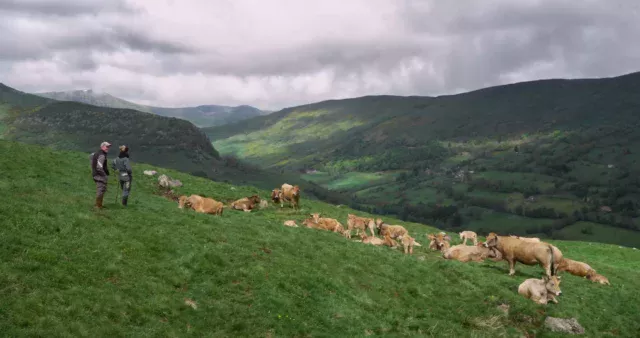
Didier, the central character in The Echo Of The Herd (La voix du troupeau) is like one of those sad-eyed clowns you see in old silent movies. Deaf since birth and still mourning the loss of his brother Claude, he looks for solace in his work on a cattle farm in Auvergne. Now well into middle-age, he still takes a child-like joy in tending the animals and building fences – but when the cattle suffer, so does he.
“We met Didier almost 10 years ago,” remember Matthias Joulaud and Lucien Roux, the two young Swiss filmmakers who both come from families with experience of farming. (Their earlier short Ramboy (2022) followed an Irish teenage boy growing up with his grandfather on a sheep farm).
Joulaud’s father had rebuilt a house close to where Didier lived. “We spent our vacations as adolescents next to Didier’s house.”
Later, during the pandemic, Joulaud and Roux spent four months living in the region and got to know Didier well. “Before, he was a little shy [with us] and we were shy as well because we were quite young,” Joulaud says.
“But he was running round fixing fences, doing stuff with the cows, and we started to help him,” Roux recalls. “That’s how we learned his language. We got closer to him and he started to tell a lot of stories about his village and the cows etc.”
At that stage, Joulaud and Roux were studying photography and beginning to make short documentaries. It seemed natural to film him.
Didier communicates in signs and gestures. He’s a highly expressive figure but has never learned to read or write.
“He wasn’t shy at all in front of the camera. He started to speak in front of the camera and we had this revelation that it was beautiful on the screen [to watch him],” Roux states.
Didier’s home is full of pictures. He loved watching himself on screen. “The pictures have a lot to do with his memories. Also, Didier is someone who dreams a lot. He has a lot of images in his dreams that he wants to talk about.”
Didier grew up in a very protective environment. His mother didn’t want him to continue with school. Now, he works for the Maury family on their farm, tending the cattle.
The duo shot certain sequences with thermal cameras, among them, the opening sequence showing Didier seeming to walk through a snowy blizzard. “We took the liberty of trying to imagine what kind of symbols Didier would see in his dreams,” Joulaud says of these expressionistic interludes which sit alongside the verité footage of daily life on the farm.
The directors get down and dirty with their footage of the agricultural work. We see the cattle being pregnancy-tested and giving birth. The filmmakers aren’t shooting from a distance but are in the middle of events, in among the mud and straw.
“We shot for a bit more than three months. It wasn’t like linear shooting…we really wanted to show the special intuition that Didier has with the cows.”
Didier was not a straightforward character to follow. He doesn’t work regular eight-hour days. Instead, he might get up in the middle of the night because he has a sense that one of the cows is about to give birth.
There is a terrible moment midway through the documentary when many of the cattle are diagnosed by the local vet to be suffering from Infectious Bovine Rhinotracheitis (IBR). This is an invisible disease which doesn’t have obvious symptoms and which doesn’t spread to humans. Nonetheless, the medical authorities now require that animals that have the disease must be culled.
You can’t miss the poignance in the footage of a huge barn that was once full of cattle but is now nearly empty. “It’s an incredible amount of work that is now reduced to nothing,” the filmmakers say.
“What is really painful for Didier is that he doesn’t see anything [wrong] and it is really complicated to explain to him that the cows are sick and that they have to go to the abattoir.” Joulaud notes of Didier’s feelings of loss and bereavement when the animals are taken away.
Somehow, seeing the animals removed also evoked thoughts of the loss of his brother, Claude. “For Didier, the film was really a way to speak about his brother. His brother is a legend of this village,” Roux observes.
Roux and Joulaud took the decision early on that they were not going to “subtitle Didier.” The audience is therefore challenged to adapt to his way of communicating. “That was sometimes hard to defend [to financiers] but as soon as people see the image, it’s evident that it has a theatrical aspect.”
It helps that Didier is a natural storyteller who can communicate his ideas even without words.
The documentary was being made when memories were still very fresh of the farmers’ protests in 2024. The filmmakers wanted to show how much the farmers cared for their cattle. It’s not just Didier but the Maury family too who were deeply upset to see the cattle slaughtered.
The Echo Of The Herd is produced through Akka Films (who also produced Ramboy), Les Films du Tambour de soie and RTS Radio Television Suisse.
The filmmakers pay tribute to their producer, Juliana Fanjul, from Akka, for having the courage to support a project that took such a lyrical and offbeat approach to the material. “She had a lot of confidence in the story of Didier. She was really interested in the fact that he is turning his disability into a strength,” Roux says.
Roux and Joulaud have known each other since high school. Both went on to study fine arts – but at different schools. “We met when we were teenagers on the soccer field!” Roux remembers.
Their production company is called Maison Momo, named simply because the two young directors made the decision to work together when they were in Roux’s family house and, as Roux explains, “Momo is the name of my father.”





