

The logistics sound daunting: 40 cinematographers and more than 300 people filming in 64 locations combined to create the “collective portrait” of a single July night in Ukraine.
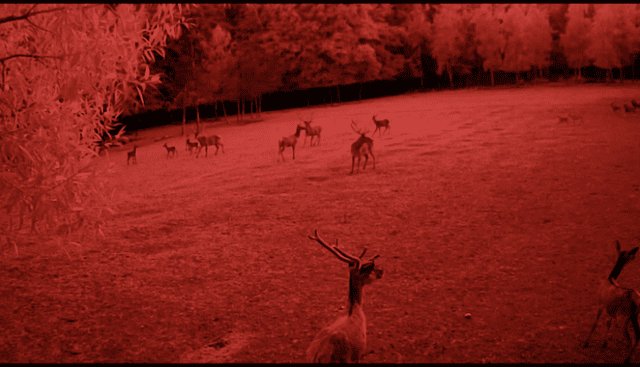
In her epic new film, The Illusion of a Quiet Night, Olga Chernykh draws together imagery of everything from nightclubs to air raids, from soldiers on the frontline to women giving birth, from passengers aboard a train about to head east to wildlife coming out after dark.
This is a portrait of what the director calls ‘parallel lives.’ “It’s about resilience and strength, of course, and about love – love for each other and love for the country,” she states.
Was pulling together the documentary (screening in Visions Du Réel’s Burning Lights Competition) a little like herding cats?
“You’re totally right. It was a challenge,” the Kyiv-based filmmaker says of the organisational challenge. She and her team also had to deal with the curfews and restrictions enforced in night-time Ukraine since the full-scale invasion. They were trying to include every part of the country including the occupied territories, for instance Donetsk and Crimea. (There was also footage from Luhansk but this didn’t make the final cut).
When the project was launched, one of the first steps was to issue a national call (“from radio to television,” on social media and in newspapers) for potential participants across the country.
During the night itself, 27th-28th July last summer, the process went remarkably smoothly. The date was chosen partly at random. “I really wanted to make it an ordinary night. Not to link it to any events, national holidays or dates that are significant,” the director says.
Instead, the idea was to portray a typical summer night in wartime Ukraine. The scene of all the clubbers dancing away until dawn was shot at a music festival in Kyiv.
As for the birth sequence, “the couple agreed immediately to be filmed. They were very open. We were very lucky with them in terms of shooting but also in a personal way because they are a very nice couple.”
The joy of that moment is contrasted with the extreme tension as armed members of the Azov Brigade scope out a ruined house in which an enemy might be hiding. “They sent us this video. It was in the Donetsk region but we don’t know the exact locations because of safety measures.”
Chernyk was working on the project with Tabor, the production company also behind a series of other films that have screened at major festivals, among them last year’s Cannes selection, Militantropos (part of an envisaged series called The Days I Would Like To Forget)
Her creative partner was visual artist, Maryna Brodovska, On one level, this was a “happening” as much as a conventional documentary. The production team had a “command centre” in Kyiv from where they could monitor the filming as it went on all over the country.
Instructions to the cinematographers were straightforward. Chernyk advised all the participants to shoot “horizontally.” The professional DoPs were working with the same kind of cameras, but public participants were allowed to shoot on whatever format they chose. Some used cellphones, others were shooting on VHS or rickety old night cameras.
The director asked the professionals for static shots that lasted a decent amount of time even if they were handheld. She wanted “calmness.”
This was conceived as an original idea (“at the moment we were developing it there was no reference for the film”) but Chernyk did later look at other examples of other documentaries and dramas set over a single night or portray cities. This was partly to give inspiration to the professional cinematographers. Titles she cites include Geographies of Solitude and Gianfranco Rosi’s Sacro Gra that also includes night time scenes, and combined humans and nature. Anirban Dutta and Anupama Srinivasan’s Nocturnes, about secret the world of moths, was another film she looked at.
There was an obvious contrast between the footage shot by the professionals and that submitted by the amateurs. Chernykh had more than 200 hours of footage.
“It was a lot to go through and we had a pretty short time to edit the film because of the contract of the grant that we received,” the director recalls.
Although the film shows Ukrainians defiantly carrying on with their lives, there is a chilling undertow to the storytelling. As we learn over the end credits, the majority of Russian attacks targeting Ukrainian infrastructure take place at night time. In July 2025 alone, 286 civilians were killed. Over the last three years, more than 15,000 civilians have been killed.
This is one of many documentaries made during the war – and unusually it was entirely funded within Ukraine and not with international backing. Financing came from Ukrainian broadcaster Suspilne Kultura. “They had the idea to make an independent author-driven documentary with a focus on some experimental form,” Chernykh says of the commission which she won against strong competition.
The hope now is that the film will have its Ukrainian premiere at Docudays in Kyiv in June. The TV broadcast should follow later in the year. Another idea being floated by the filmmakers is to have a special one night only screening, possibly on the date the documentary was shot. In the meantime, the hope is soon to find a sales agent.
Chernykh’s earlier film A Picture to Remember opened the IDFA Festival to 2023. This looked back on her childhood in Donetsk and explored the predicament of her grandmother who stayed behind in the city after the full-scale Russian invasion. Now, she is developing another project with Maryna Brodovska. “But it’s a completely different project…for now, I will take a small break after dealing non-stop with The Illusion of a Quiet Night,” she sighs.





