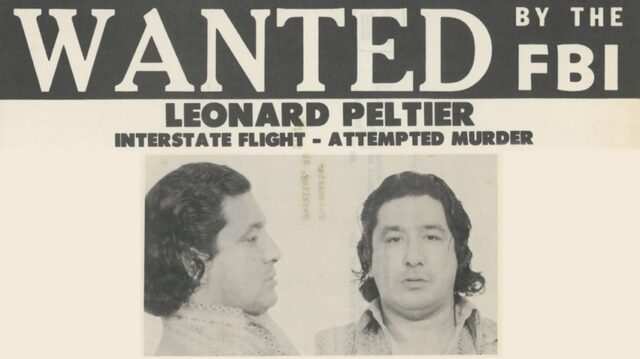
Free Leonard Peltier, now in the running for the Oscars, is a documentary that has had two lives. It premiered in Sundance in January 2025, but a few days before its screening, President Biden, in one of his last acts as US president, commuted Peltier’s double life sentences. At the time, Peltier had been in prison for half a century, charged with murdering two FBI agents on the Pine Ridge Settlement. He was one of the leaders of the American Indian Movement.
After Biden’s decision, the film’s two directors, Jesse Short Bull and David France immediately set to work making a new cut of their movie. It is this version that recently premiered on Netflix and is now up for awards.
“I became aware of his story when it was unfolding. I have to admit I am old enough to have been watching the news in 1975 when the shoot-out happened at the reservation, and then the FBI set out on what is still the country’s most massive manhunt in history to try to find Leonard,” filmmaker and reporter France (whose other award-winning documentaries include How to Survive a Plague and Welcome to Chechnya) tells Business Doc Europe.
When France (born in 1959) was a teenager, the hunt for Peltier was covered exhaustively on the TV news every day. No-one then seemed to pay much attention to the question of whether he was actually guilty of the double murder. It took a year or so to find the fugitive who was then extradited from Canada in very murky circumstances.
By that point, many were already questioning his conviction and the very rough justice he received. Many subsequently called him “America’s Nelson Mandela” not just because of the years he spent in captivity but because of his stoicism and political astuteness.
The documentary has unearthed some extraordinary archive footage.
“It was certainly a lot of work,” France says of the challenges he and Jesse Short Bull faced in pulling the material together. “These historical events have been studied by filmmakers, historians and writers for decades and we wanted to see what else was out there. Our dive into the archive was very deep and we were able to produce footage that people had never seen before.”
In his films, France likes to use archive “to build scenes,” as he puts it. In this case, the filmmakers were helped by the fact that members of the American Indian Movement understood the significance of what was happening and had been filming the events themselves. “That makes them one of the very early movements to do that kind of self-documentation. For us, it was just a matter of patiently swimming into archives and family histories to be able to bring viewers to the 1970s and to allow them to understand what it felt like – the texture and nature of life on the Pine Ridge Reservation at the time all this was happening.”
Peltier himself emerges as immensely likeable figure. He had been eligible for parole since the early 1990s but the FBI were determined that he would not receive it. Nonetheless, he shows little bitterness about all the lost years.
“He has plenty to be angry about – and still to be angry about. He was not exonerated at the end of the Biden administration. He was just sent home to serve the rest of his sentence there. He would love to be exonerated, to have the kind of justice he has been looking for for five decades,” France reflects on his subject. “But he has been able to maintain this equanimity, that most people would not have the strength to do.” Right from the outset, when he first started serving his never-ending sentence, Peltier was determined not to allow himself be broken by the system.
France rhapsodises about his co-director who, like Peltier, is a member of the Oglala Sioux Tribe. “Jesse is much younger than I. This is a story that he grew up with almost in his genes. The story of what happened at Oglala and the story of the travesty in the FBI’s campaign against Leonard Peltier runs in his blood. He was the perfect collaborator for me, but he is also an intensely deep researcher.”
Books and films in past years have often asked the question: who killed the FBI agents if Peltier didn’t? “Jesse said that is not relevant when we are talking about what happened to Leonard. What is relevant is why that happened to Leonard. What we did was change from a whodunit, a standard approach, to a whydoneit and that set him off in a deep dive into the documents to understand what the FBI was doing.”
As the documentary reminds viewers, the US Government has broken every treaty it has signed with the American Indians. As we learn here, the Indian lands were coveted by the Government in the 70s because they were so rich in uranium and this was still the middle of the Cold War.
“That was what was at stake for the FBI, and that is what was at stake for the US Government,” France explains how Peltier became caught up in the geopolitical cross currents of the time. “We were able to prove that was the precipitating event that got those two agents and one member of AIM (American Indian Movement) killed.”
Netflix came aboard the project after the directors had re-made it and held another world premiere (a “re-world premiere” as France calls it) in late 2025 after all the material releasing to Leonard’s release and the Biden clemency had been incorporated.
Even today, widespread public ignorance remains about the US Government’s continuing betrayals of American Indian groups. Ask France if he has any optimism that this may change and he pauses.
“I am not a big student of the legal battles around those [broken] treaties except to say that the two people who animate Leonard’s struggle for freedom in the film, Nick Tilsen and Holly Cook Macarro, work for an organisation called the NDN Collective and their main political agenda is to get back land. They’re working on multiple reservations with multiple tribes to try to secure the return of at least the most spiritually significant portions of the reservations that have been taken away by the US Government.”
It has been acknowledged that, for example, the Black Hills of Dakota were illegally taken. Cash has been offered in recompense but it hasn’t been taken because the money will never make up for the expropriation of such sacred lands.
France is a distinguished author and filmmaker, but Peltier had suggested at the outset that a condition of his being allowed to take on the story was that the film should be “an indigenous-led production.”
“I am not indigenous but I knew there was a strong bench of indigenous filmmakers and storytellers. Finding them and pulling together a team was both a wonderful challenge but also a wonderful opportunity to learn from collaborators and to go to the reservations with them,” he says. “It taught me just how much I didn’t know about the cultural differences between us and them. Jesse, for example, had to explain to me that in Indian culture, you don’t look elders in the eye. You don’t ask them direct questions. There are certain body language things he had to instruct me in. Jesse took on the role of interviewer in the film because he knew how to comport himself.”
Thanks to the indigenous team making the documentary, France believes, elders were far more revealing on camera than they had ever been before. “I think Leonard knew that…and it made a huge difference to the film.”