When Peabody award-winning documentary maker Yoruba Richen was making her biographical documentary The Rebellious Life of Mrs. Rosa Parks (2022), about the celebrated civil rights activist, one part of the story dealt with Parks’ campaigning against sexual violence toward Black women.
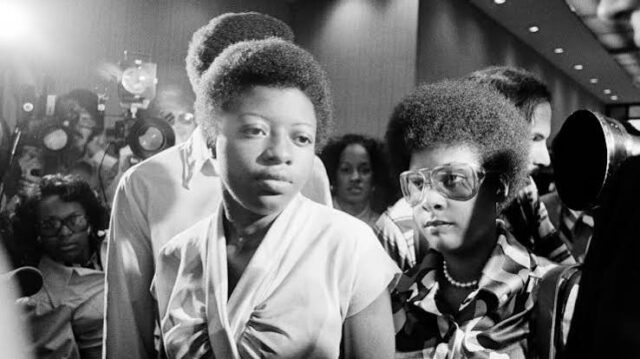
In the 1970s, Parks had taken up the case of Joan Little, a young woman facing the death penalty for killing a jail warder who tried to rape her in Beaufort County Jail in Washington, North Carolina. The odds were stacked against Little, but she was to become the first US woman acquitted for killing a man while defending herself against sexual assault.
Joan was a poor young woman who had been in jail on petty theft charges at the time she was attacked. In 1975, she was a cause celebre. Half a century later, when Richen began making the film, she had faded from memory.
“I was pretty amazed that I had not heard of the Joan Little story,” Richen says of the court case in 1975 and of the massive campaign on Joan’s behalf that it sparked, attracting prominent activists north at home and abroad.
Although the Joan Little case was just a small part of Richen’s Rosa Parks movie, she was determined to return to the story. That is what has led her to make her Oscar-contending short documentary, Free Joan Little.
“I always knew that I wanted tell the story through the archive if possible. I initially had the idea because when I had done the research for the Rosa film, I saw how much archive there was.”
Further pieces of archive material also later emerged. For example, a Black Panther volunteer had video tapes in his ex-wife’s basement that had lain untouched for years. Richen got hold of them. She also discovered audio interviews from a book about Little that had been written during the 1980s.
Free Joan Little had its world premiere at Doc NYC last year. Since then, it has travelled widely on the festival circuit, picking up Best Documentary awards at the LA Shorts International Documentary Festival, and Best Short Documentary at the Hot Springs Documentary Film Festival in Arkansas among other prizes. It will be broadcast by PBS in February. In the meantime, the filmmakers have been organising impact screenings with women and prison rights organisations including California Coalition of Women’s Prisoners and Survived + Punished.
As the film makes clear, Black female inmates in the US penal system are still frequently subject to sexual assault. In 2022, a bi-partisan investigation into Sexual Abuse of Women in Federal Prisons conducted by senator Jon Ossoff and lasting eight months, uncovered “deeply disturbing” findings into such abuse.
“Just in California and in New York, there were recent lawsuits of sexual assault survivors suing and winning,” the director notes. “This is an ongoing issue. Joan’s legacy is that she spoke out.”
Back in the 1970s, it took considerable courage for Little to turn herself in and go to court. She had been offered the chance to leave the country, but stayed to face justice and tell her story.
Little is still alive but didn’t take part in the documentary. “We reached out to her, and her participants in the film have reached out to her and encouraged her to participate, but she has not spoken publicly in 30 years, which is her right.” Richen knows that Little is aware of the film and still hopes one day to meet her.
The film is intended to be an “immersive” experience for viewers. It lasts just over half an hour. The director says that time frame suited “what we had to work with in terms of the storytelling.” She points out that this was never conceived as a full-scale “biography” of its subject but was “very specific” in what it focuses on. “I really wanted to look at the impact of the trial.”
Ask Richen if she feels her film can make a difference and she responds that she “makes social issue films that we hope have some kind of impact. I am not one of those people who say that films will change the world, or will change everybody’s minds, but I do think they have the power to open up the conversation and give visibility to the issue.”
She talks of “some amazing screenings in North Carolina,” close to where Little was imprisoned. At one, three women walked in, spoke to Richen and told her that their father had been on the trial jury. “He was the first one to vote not guilty.” Meanwhile, at a screening in California, former Black Panther Erica Huggins told the director of her excitement about spotting herself as a young woman in the footage.
Back in the mid-70s, those involved in the movement to support Little included musicians, artists and students. For many, it was an exhilarating time. A song was written on her behalf and participants clearly relished the “passion and solidarity” of a protest movement that built up such enormous momentum that it affected the court case.
Now, the Joan Little case is being rediscovered by a new generation.
“When I make films that are historical, I am always thinking about how young people will take this,” Richen states. Alongside her filmmaking, she is also a professor, heading up the documentary programme at the Craig Newmark Graduate School of Journalism at the City University of New York. She says that her students there are “hungry” for films like this.
Financing for Free Joan Little came mainly from grants from, among others, the InMaat Foundation, the Jonathan Logan Foundation, Catapult Film Fund and Southern Documentary Fund. It is produced by Promised Land in association with Retro Report. Sabrina Schmidt Gordon, director of the Oscar-shortlisted film Seeds, and actress Danielle Brooks (The Color Purple) recently joined the film as executive producers. (Brooks also voices Joan in the film’s reconstructions). It qualifies for its Oscar run by winning LA Shorts.
One phrase we hear in the documentary is that “Black women’s lives matter.” Richen argues that Black women are still not getting “the prominence and attention” of their male counterparts.
“It is not just women who are sexually assaulted in prison, and it is not just Black women,” she adds. “But this was a Black woman who was courageous, spoke out and told her story – and inspired so many others to do so as well!”