

Docs are at the beating heart of this year’s BFI Flare: London LGBTIQ+ Film Festival (17-28 March). This is the UK’s longest running queer film event. It began life as Gay’s Own Pictures in 1986, later rebranded as the London Lesbian and Gay Film Festival and then, in 2014, changed its name to BFI Flare. Programmer Brian Robinson talks to BDE.
Brian Robinson was an audience member at the very first festival and has been involved in BFI Flare as a programmer since the late 1990s. He has witnessed at first-hand how the documentary footprint has grown at the festival.
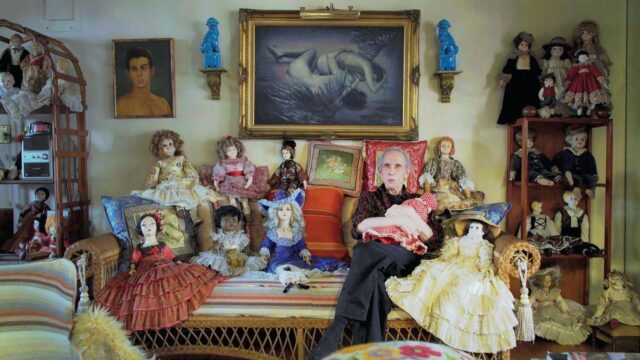
Speaking this week, Robinson highlighted two docs in the 2021 programme which have a very special resonance for him. The first he cites is P.S. Burn This Letter Please (pictured) from directors Michael Seligman and Jennifer Tiexiera (and sold by The Film Collaborative).
“It enables viewers to be transported back into the lives of drag queens in New York in the 1950s. At the time, it was not only illegal to take part in homosexual activity. It was also illegal for a man to wear women’s clothing in public. These drag queens were absolutely marginal figures in society and there is almost nothing that survives that documents their lives apart from club photos and a tiny bit of film footage,” Robinson tells of the story behind a doc which casts new light on a hidden world.
Producer Craig Olsen stumbled on a cache of letters written by the drag queens. Over a period of six years, Olsen and his collaborators did some “astonishing” research, enabling them to track down several of the surviving drag queens, now in their 80s and 90s, and interviewed them on camera.
“It’s just one extraordinary [piece] of detective work and archaeology from a scene which has been pushed to the margins of history and society but which is brought back triumphantly on screen with these incredibly resilient survivors who are still with us and lived to tell the tale,” the programmer enthuses.
Another documentary which he feels equally impassioned about is Cured (directed and produced by Bennett Singer, Patrick Sammon and sold by Drive) which he describes as “another great moment of excavation in LGBTIQ+ history that also has an extraordinary range of interview subjects, meticulous research and amazing footage.” The film focuses on the campaign by lesbians, gay men and their allies to change the American Psychiatric Association’s definition of mental illness.
“Taken as a pair, they are among the best documentaries I have seen in many, many years.”
The two films take their place among the many other docs from Kenya, Hungary and elsewhere in this year’s selection.
“But documentary has been very important right from the beginning of what was then the London Lesbian And Gay Film festival,” the veteran programmer notes. He can cite many documentary gems exposed for the first time to UK audiences through the festival, among them Wild Combination: A Portrait of Arthur Russell (2008) from director Matt Wolf; I Am Divine by Jeffrey Schwarz (a director whose work has regularly screened at BFI Flare) and Dancing In Dulais (1986), about the ‘Lesbians and Gays Support the Miners’ movement during the long running strike of the mid 80s.
“AIDS has been consistently a part of the festival, right from the very beginning,” Robinson continues. Stand-out docs on that subject which have screened at the festival include We Were Here (2011) by David Weissman and Silverlake Life (Peter Friedman and Tom Joslin, 1993), which Robinson describes as “an absolutely devastating portrait of a man on his journey to death from AIDS at a time when things were pretty bleak for anyone with HIV.”
Among Robinson’s many personal favourites among the docs that have screened at the festival over the last 30 or more years are Isaac Julien’s Derek (2008), about filmmaker Derek Jarman, and Sébastien Lifshitz’s Les Invisibles (2012), about older French lesbian and gay folk. He has also has very vivid memories of the world premiere of Kate Davis and David Heilbroner’s Stonewall Uprising (2010). The directors didn’t know much about the festival, thought it was “one step up from a porn” festival and were “surprised and delighted when they presented their film for the first time at NFT 1 [National Film Theatre 1].”
In recent years, as feature documentaries have gained more traction in the marketplace, the number of docs submitted to BFI Flare has risen sharply.
“The joy of documentaries, I think, is that they give a voice that the mainstream – for most of the life of the festival – hasn’t been interested in,” Robinson suggests. “They’re a very precious record of life, history, as it has been lived, and often very moving, empowering and inspiring.”





