

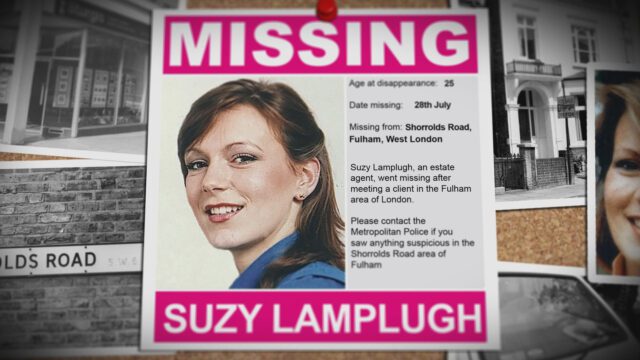
Suzy Lamplugh used to sit at the window desk of the west London estate agent where she worked. She was in her mid-20s and the “most attractive female” on the team. Her managers were effectively putting her on display, hoping that she would bring in clients.
This small but telling detail is included early on in Stuart Urban’s new two-part documentary The Mystery Of Suzy Lamplugh, which premieres in the UK on Sky TV next week.
Urban is best known for his dramatic work. He directed tragicomic Falklands war drama An Ungentlemanly Act (1992) and award-winning drama series Our Friends In The North (1996), which both won BAFTAs. However, he has made documentaries before, including the deeply personal Tovarisch: I Am Not Dead (2007), about how his father, Garri Urban, survived both the Holocaust and the Soviet Gulag.
Lamplugh vanished on the 28th July 1986 after leaving the office to show a client a property. Thirty-five years later, no definitive explanation has been provided as to what happened to her. Witnesses saw a young woman fitting her description meeting a well-tailored man carrying a bottle of champagne. Her work diary that day had an appointment planned with “a Mr Kipper.”
The film draws on Lamplugh’s diaries and includes an extensive interview with her brother, Richard.
“I think it’s important to portray the character [of the victim] in these stories and not just to focus on the killer or the possible culprits,” BAFTA-winning director Urban explains why the doc includes so much material about Lamplugh and her family.
“It wasn’t easy straight away. We approached the sisters, Lizzie and Tamsin, as well as the brother. We wanted the sisters’ perspective,” Urban notes. Lizzie and Tamsin, though, remained wary after previous negative experiences with the media.
“We had a long list of ‘no’s’ but some very important ‘yes’s,’ the most important of which were Richard [and] the police officers, only one of whom declined because he was the one criticised in the [subsequent] review.”
“It was also quite difficult in practical terms. We were shooting during the pandemic. We sent a separate unit in Scotland that did [the interview with] Richard.”
Most of the other interviews were conducted face to face or, as Urban puts it in acknowledging Covid protocols, “mask to mask.” The director and his team spoke to police officers involved in the original investigation and leading media figures (including the BBC’s Nick Ross, who fronted BBC crime show Crimewatch). “People were reticent, particularly her own estate agent colleagues, her flatmate, her boyfriend at the time.”
Urban could understand the reluctance. Amid Covid restrictions, people were ‘not particularly keen to have somebody trample into their house.” For those directly involved, the Lamplugh case is still very harrowing. Some did not want to rake over painful memories.
This was a missing person case that shocked the British public. “The disappearance of Suzy Lamplugh sent a shiver down the spine of every young woman because people thought that could be me,” Anne Ashworth, former editor of The Times’ Bricks & Mortar property section, tells the filmmakers.
The case featured prominently on Crimewatch, which had an audience of millions. Celebrity mediums Doris Stokes and Uri Geller tried to help with the investigation. Suzy’s mother Diana went out on the streets to look for her, campaigned tirelessly for justice for her daughter, and she and her husband Paul set up the charitable foundation, The Suzy Lamplugh Trust, in 1986.
As time passed, though, it became apparent Lamplugh would never be found. She was declared dead in 1993.
Plenty of evidence, all circumstantial, pointed to the guilt of John Canaan, a rapist and killer. Several detectives involved in the case believed Canaan was responsible.
“It is quite remarkable how the police didn’t really go after him,” Urban says of the main suspect, who remains in prison today for murder and rape, and who vigorously denies that he was responsible for Lamplugh’s killing.
The documentary hasn’t been made to tie in with any anniversary. However, public interest in the Lamplugh story remains as strong as ever.
“The reason I think there has been more focus on her case is because of #Metoo and the awareness of the position of a vulnerable and young female situation in a work situation as she was,” Urban suggests.
Contemporary commentators point to the prejudicial nature (and casual sexism) of much of the reporting around the case in the late 80s. “There was this unwarranted criticism of Suzy’s lifestyle where today it wouldn’t be appropriate or justified to comment in the way that they did, [in] some of the [news]papers,” Urban says. His film is respectful but probing, an attempt to ask what has been learned from the case and why more wasn’t – or couldn’t be – done to solve it.
The Mystery Of Suzy Lamplugh, Sunday 14 March, 9pm and 10pm, Sky Crime and NOW TV.





