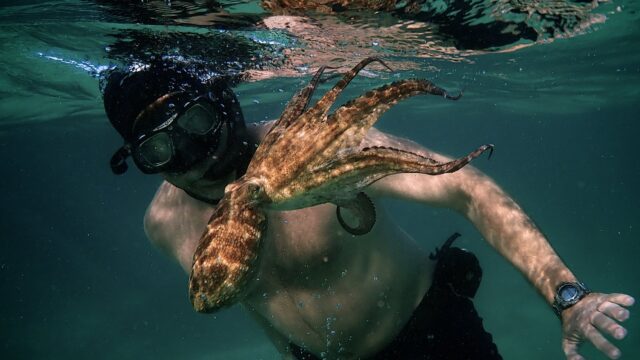
It remains to be seen whether My Octopus Teacher will get its tentacles on an Oscar on April 25, but the Netflix Original documentary, directed by Pippa Ehrlich and James Reed, is already a phenomenon.
It has won awards everywhere, from Jackson Hole in Wyoming to Guangzhou in China. Netflix is reticent about sharing viewing figures but, since the documentary launched on the platform last September, the filmmakers have been told that it has been performing well above expectations.
“It is definitely something that took us by surprise…we didn’t see it coming at all” co-director James Reed says of the Oscar nomination. “Back when we were making it, and I came on quite late in the process, the film had no platform. It didn’t have a broadcaster. Netflix wasn’t on board. We were confident in it and thought we had a special story and were doing a good job trying to tell it, but we had no idea of the trajectory it was going to go on.”
Boiled down to its essence, this is the story of a burgeoning friendship between a man and a creature with eight legs. South African naturalist and filmmaker Craig Foster strikes up an unlikely bond with a young octopus he encounters in the underwater kelp forest where he dives every day. The solitary, secretive and highly intelligent invertebrate learns to trust him. He, in turn, becomes attached to her, sometimes literally.
Audiences have been rhapsodising over the film’s extraordinary underwater photography and emotive storytelling. However, the documentary is as revealing of the man as of the soft bodied mollusc he dotes on. Foster acknowledges early in the documentary that he is close to burn-out. “I went through two years of absolute hell,” he says. Overworked, he hasn’t been sleeping properly. His family is suffering. His mood is so low that he can’t even bring himself to pick up a camera. That is when the healing begins. Almost as therapy, he takes to the ocean, snorkelling in a bay not far from Cape Town. It is here he discovers the underwater kingdom in which the octopus dwells.
“Craig is in quite a good place now. At the time of filming, he was able to sit down and reflect on a period when he was not in a good place. I think that the Craig who is telling the story is somebody who has come through that period in his life, to a degree,” Reed says.
The film doesn’t delve too far into Craig’s personal circumstances but viewers will be well aware of the difficulties he had been having before he made his new underwater friend. Most will sympathise with his vulnerability and sense of isolation.
“We decided not to be too specific about it. In the end, I think that was the best way to treat the film as well. By coincidence, the film came out in the middle of a global lockdown. I think some of those more general mental health issues he was having, everybody could relate to in some way because everybody was cut off from relationships they had had previously. They were feeling not quite sure what they should be doing with their lives.”
Reed conducted the key interview with Craig which provides the film with its narrative backbone. No, he didn’t previously know either Craig or co-director Pippa Ehrlich (BDE interview). He is based in the UK. They were in South Africa and were very well advanced on the film before he came aboard. They contacted him through Off The Fence (BDE interview with founder/CEO Ellen Windemuth), an Amsterdam and Bristol-based company they had been working with. “They had seen a couple films I had made previously and thought they needed a new perspective and that my experience might be useful.”
When Reed saw their early cut, he realised immediately that this was “very special” material. “You could see that something really extraordinary had been captured and it had the potential to be a really fantastic film,” he remembers. “The thing that it needed was to have Craig tell his story in person. It is his interpretation of what happened that year, his account and the personal details of his experience throughout that year.”
Having Craig speak, Reed adds, also helped elucidate “her” story too, that of the octopus, he clarifies.
The phrase which reviewers have most commonly used to describe My Octopus Teacher is “crowd pleaser.” Viewers have responded in a strong emotional fashion to the documentary. What, though, have scientists thought of it? Often, they can react sternly to projects they regard to be too sentimental. “Largely…the scientific community has been incredibly impressed and delighted by the behaviour that was observed by Craig. He’s not a scientist but he is incredibly experienced and knowledgeable as a naturalist. What he observed were things scientists hadn’t seen before…they were really intrigued and incredibly positive.”
In natural history documentaries, filmmakers invariably struggle to resist attributing human traits to their animal subjects. Reed doesn’t necessarily feel this is unhealthy. “When you work in nature films, that is something you are constantly aware of and are cautious about over-using. At the same time, you know that audiences respond to thinks they can relate to,” the director reflects.
In the documentary, it is very clear the octopus is as drawn to Craig as he is to her. The trust between them is what grabs audiences: “There is a fine line to be walked there always. [But] with this film in particular, it really was about how Craig saw these things and how he interpreted them. He was relating to them in a particular way – it was his experience. That was how he understood what was happening.”