

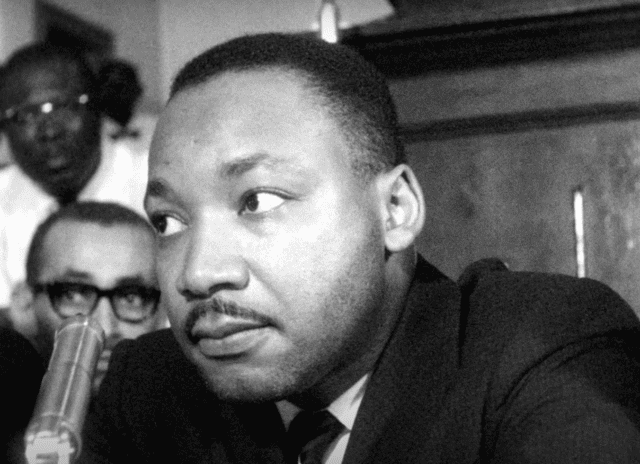
One documentary predicted to be a strong awards contender in coming weeks is Sam Pollard’s MLK/FBI, which tells the story of how the FBI harassed and eavesdropped on Dr Martin Luther King Jr. Under J Edgar Hoover, the agency tried very hard to discredit King, tarnish his reputation among his followers and expose dirty secrets in his private life.
The film (which will be released in the UK by Dogwoof early next year) draws on transcripts of the FBI recordings of what was allegedly said and done by King. It is suggested the revered Civil Rights leader and Nobel Peace Prize winner had affairs and that he was even present during a rape.
For veteran filmmaker and editor Pollard, who edited several of Spike Lee’s films and has a side career as a professor at New York University Tisch School of the Arts, this was subject matter with a very strong personal resonance.
“Here it goes. 1963 I was 13 years old and one day my teacher comes to our junior high school class and she says to us ‘class will be suspended today because John Fitzgerald Kennedy has just been assassinated in Dallas, Texas.’ I was in shock. I couldn’t believe that the President of the United States had just been shot. That changed my whole sense of what America was. In my household, we had three pictures on the wall in 1963 – John Fitzgerald Kennedy, Martin Luther King and Jesus Christ. Then, on April 4th, 1968, I was watching television and the news comes on that Dr King had been assassinated. These are two similar moments in my life. My attitude about those two men back then was that they were god-like.”
“I believed very sincerely then in the notion of the American melting pot – that if you did your things right, you could blend in,” Pollard continues. “As I have gotten older and more wise, or more cynical, the complexity of the world has grown. Everything to me is very nuanced. I don’t see things in black and white. That’s probably why, in some ways, I am a documentary filmmaker.”
MLK/FBI reminds audiences of Dr King’s courage, power as an orator and his essential decency. It also touches on aspects of his private life that his admirers will find disturbing. When historian David Garrow (who contributes to the film) first wrote about King’s alleged sexual misconduct, many reacted with rage. They felt that King, having been besmirched by the FBI, was being vilified all over again.
“It raised a lot of hackles in America. There were people who really attacked him (Garrow) [saying] ‘how dare you try to destroy Dr King’s reputation, how dare you dig into this stuff about his private life. There was a lot of controversy,” Pollard observes. “Quite honestly, Ben [producer Benjamin Hedin) and I were nervous about the material, saying should we even deal with that thing about the rape allegation or should we stay away from it.”
In the end, they decided that as responsible filmmakers and journalists, they had to use the material but that they needed to “give it context.”
“It was always a delicate dance dealing with material, knowing how far to go with it so it didn’t become, you know, exploitative,” the director says.
An added challenge was how far to accept testimony that came from the FBI agents who (in this case at least) were hardly to be trusted. There was a danger the filmmakers themselves were being manipulated by the Feds into presenting a distorted vision of King.
“King was a much more complex human being than people want to remember, like all of us are,” Pollard reflects. “That was what we wanted to present. Here was a man who, like many of us, had a multi-tasking existence. He’s not just the leader of the Civil Rights movement but he’s a family man with a wife and four kids. He’s also a man dealing with his own personal, whatever, peculiarities…he had to know he was being constantly surveilled by the FBI.”
Formally, MLK/FBI is a tour de force. It tells a very complex story using archive and interviews but without resorting to talking heads.
“Normally, when I am doing these documentaries, the normal stylistic approach is to have archive and interviews on camera. In this particular case, I had seen a documentary done a few years ago called The Black Power Mixtape 1967-1975. In that case, it was all archival and just voice-over. That stuck with me,” the director explains. The interviewees, who include such distinguished figures as former FBI Director James Comey and Yale history professor Beverly Gage, are not seen on camera or are only shown fleetingly at the very end of the film.
“We wanted the audience really to be engaged in the archival material, really to feel that they’re inside the story,” Pollard says of a film which takes in such key historical events in the Civil Rights movement as the 1963 March on Washington, the Montgomery bus boycott of the mid 1950s, the Selma to Montgomery marches and the campaign in Birmingham, Alabama. Much of the archival material may be familiar but Pollard and his researchers have also found photographs and footage which you will almost certainly never have seen before.
Comey was keen to take part because he still believes that the FBI can be an instrument of good. “Do I believe that myself? Not really,” Pollard states. “But that’s his philosophy.”
The irony, the director continues, is that during the Trump presidency, the agency rose in many people’s estimation. “He (Trump) was denigrating the FBI so badly that [many felt] they can’t be all bad.”
“Americans believe that the rule of law will win out – and it’s not true,” Pollard adds of what he has learned over many years as a filmmaker. “As you can see, it doesn’t always win out.”
Quite apart from what it tells us about racism and FBI skulduggery, MLK/FBI is also very topical on another level. In the 1960s, Martin Luther King was being eavesdropped on. In today’s digital era, so are we all.
“Everything we say and do, somebody is recording out somewhere! Listen, the internet world has become a place where I am surprised that anybody can have any secrets,” Pollard says of our snooping, data-scraping society. “It’s a scary time.”
As for finding that your heroes have feet of clay, that, Pollard suggests, is simply part of growing up. “It would be hard for me to say a child shouldn’t be able to have fantasy and heroes and heroines…hopefully, when young people become adults, we will learn that life is much more complex and nuanced.”
Pollard cites his own childhood worship of movie star, John Wayne. When he grew up, he learned about Wayne’s “horrific” right wing, anti-communist politics. “I could have said to myself I am never going to watch a John Wayne movie again, which some people did…but there’s a part of me, the little boy in me, that says OK, he wasn’t the righteous good guy in real-life but I can still watch those movies. It’s complex. Do you disown all your heroes and heroines? Sometimes you do. Sometimes you don’t. Sometimes you look at it in a more nuanced way…”





