

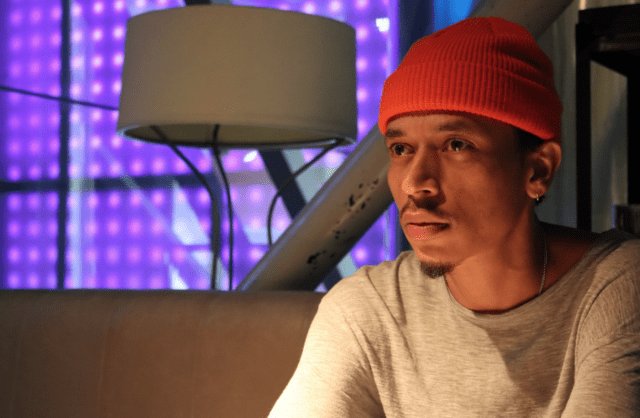
Young director Stephan Pierre Mitchell was at home in north London when he heard a knock on the door. “I opened and there was this wonderful, interesting-looking man,” Mitchell remembers. It was Ahmed Sadiqqi Hussein, later to become the subject of Mitchell’s heart-breaking short documentary Deleted.
“He asked if I had some bread and milk. I was very shocked by how well-spoken he was.”
Mitchell gave the man the food, who apologised for approaching him out of the blue. “I kept seeing you all the time, coming in and out,” he explained to Mitchell. “I wasn’t sure if you were mixed race or if you had an Asian background.”
Ahmed was comfortable in Mitchell’s presence and opened up about his precarious circumstances. He had just had his payments from the Department for Work and Pensions suspended for missing an appointment. His benefits had therefore been cut off and the bottom was about to fall out of his world.
Over the following weeks, Mitchell got to know his enigmatic neighbour. Ahmed was a fiercely proud man with a family, but he had separated from his wife and was now living on his own. He was soon to be evicted from his flat. Mitchell decided to make a film about him based around an interview conducted just a few hours before the eviction.
“I looked at it psychologically. Even though he was born in this country, he [Ahmed] came from a culture [in India] where the man is the head, the provider. He had had a divorce. They had had kids very late so they were under the age of 18. Therefore, the wife had to stay in the house and he had to move. I think that was, for him, a slap in the face.”
Suddenly, in his late 50s, Ahmed, a hard-working, well-educated man, found himself in severe economic difficulty. He was deeply embarrassed by his own plight and was trying hard to get back on his feet – but didn’t want outsiders to know how badly he was suffering or that he was reliant on government support, which was drying up.
One Friday evening, Ahmed dropped by. He told Mitchell that he would be moving out on Sunday and that he had come to say his goodbyes. Mitchell scrambled to get hold of his film crew and to borrow a 4K camera in order to be able to shoot an interview just before his eviction.
Deleted was intended as a tribute to its subject. Mitchell made sure Ahmed’s face was shown in big close up and that audiences would be able to properly assess the subject. “Let’s look straight into his eyes, look into his soul because we do not do that with the homeless on the streets.”
The director also wanted viewers to listen carefully to what Ahmed had to say and to pay him the attention that he had been denied by the authorities who cut off his benefits.
After his eviction, Ahmed lived on the streets and he slept in buses but in spite of his situation, he always managed to keep himself clean and tidy. Passers-by would never realise he was homeless. However, he fell ill, contracting cancer and pneumonia. Without accommodation or proper health care, he died last year.
“The final time I met him was in February [2019]. By that time, I had finished editing the film. He stayed the night with me. We watched the film together. We laughed, we cried and he said, excuse my French, ‘you made me fucking beautiful Stephan!’”
After Ahmed’s death, Mitchell tracked down his wife and kids. They were “mad at him [Ahmed] for his stubbornness and pride.”
Deleted has screened at many festivals. Now, the documentary is available on Amazon with half of the proceeds donated toward fighting homelessness in the UK.
“I really rooted for him [Ahmed] to make it – to come back and get his job. I think his death really affected me. He was somebody I had known,” the director explains why he is using profits from the film to help those on the streets.
Mitchell is an actor as well as a director. He talks about the importance he places on his work having “a social impact.” He is not naive enough to think a 20-minute documentary can change the world but he does believe that filmmakers have a social responsibility. “As a filmmaker, you have a very powerful tool to give back [to society]. I know the career that I am heading to,” Mitchell says.
Through one of his next films, the director will be raising money for mental health charities that deal with suicidal awareness among young men.
Mitchell is close to completing a new fictional short Reshaped, starring Vicky Knight (who played the lead in Sacha Polak’s Dirty God). It’s about a couple who meet on Tinder, have a child but whose relationship comes under strain.
He has another new project too, a culture clash comedy set in Scotland about a white Scottish male who falls for a preacher’s daughter from Nigeria. Mitchell also recently took part in ‘Who We Are’, a series of online events and film programmes designed by the BFI to celebrate and spark debate around Black British film.
Although he may now be directing fictional shorts, he is determined to continue making documentaries as well. “Absolutely I am going to return to documentaries – absolutely!” he declares. One project he is planning is a doc which will explore how social media is affecting life and culture in Africa, “from Mali to Ghana and all the way to northern Africa.”
His long term goal is to make features but, the young director insists, he will continue to direct documentaries whenever the opportunity arises.





