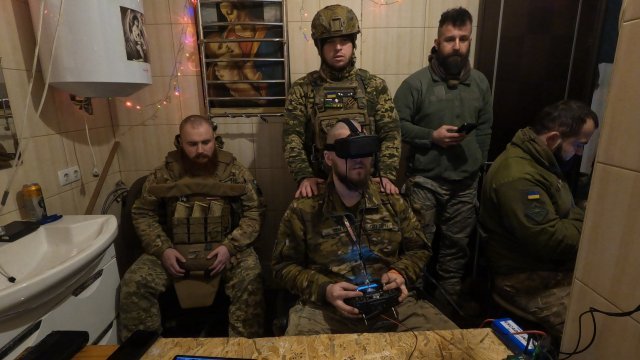
In Ukrainian Yevhen Titarenko’s I See No Death, currently in early post-production and selected for Baltic Sea Docs, a year after Russia’s full-scale invasion of Ukraine, separate FPV units began to form on the front line. These are units of the new era of unmanned warfare.
The story begins with the fighters of one such unit. Over the course of a year, the camera stays by their side – from their first combat sorties in the Donetsk region to the Kursk operation on Russian territory.
Gradually, war becomes their everyday reality. They learn to kill from a distance, grow accustomed to death on screen, and themselves undergo subtle changes.
The Ukrainian-Latvian co-production is produced by Natalia Khazan of the Ukrainian Braha Production Company, responsible for, among other projects, the Generation 2014 doc series (2025). Latvian Ego Media takes a co-pro credit. The film has received support from the European Solidarity Foundation and the Latvian State Film Fund, and will world premiere at one of the key European docfests this autumn.
“The uniqueness of I See No Death lies first and foremost in the fact that we began filming the protagonists at the moment when FPV drones were only beginning to become one of the main instruments of this war,” Khazan tells BDE. “So we do not simply have access to an FPV unit. We have effectively documented the emergence of a new way of waging war through the experience of several specific people. But the drones themselves are not the main subject of the film for us. What interests us is a simple question: what happens to a person when they kill another human being but do not physically see their death?”
“Our protagonists can spend hours sitting in a basement. They eat, sleep, joke, watch videos and call their loved ones,” she continues. “Then one of them sits down in front of a monitor, puts on goggles, finds a target and attacks it. He sees a person as a small figure on a screen – sometimes literally as just a few pixels. A minute later, it is over; he takes off the goggles, and life in the room continues.” A duty that initially provoked strong reactions from the operators gradually becomes professional routine. The film marks “a year in the lives of people who are mastering a new way of waging war and gradually becoming part of it.”
I See No Death constitutes director Yevhen Titarenko’s first film about the war, although he has been filming since hostilities erupted in 2014.
“Yevhen’s main advantage in making this film is that he does not enter the protagonists’ environment as a journalist or a director whom the military has temporarily allowed to stay close,” producer Khazan tells BDE. “He himself has been inside this war for more than ten years. In 2014, Yevhen went to Donbas as a volunteer and worked as a medic with the Hospitallers while documenting what was happening. After the beginning of the full-scale invasion, he returned to the war again. As a result, there is none of the distance between the camera and the protagonists that usually exists between a civilian film crew and soldiers.”
“They do not have to explain basic things to him. They do not have to perform the role of soldiers in front of the camera,” she continues. “He understands their everyday life, black humour, fear, exhaustion and those moments when people simply do not want to talk. This is fundamental to this film, because the most important thing often happens not during the combat episode itself, but ten seconds afterwards.”
“The camera can remain on a person’s face after someone has just died on the monitor. Sometimes we see emotion. Sometimes we see nothing at all. And that absence of reaction can say more than an interview.”
Yevhen’s previous feature documentary, Eastern Front, made together with Vitaly Mansky, had its world premiere at the Berlinale and was subsequently screened in more than 50 countries. “So we already know that Yevhen is capable of turning a very local and personal experience of war into cinema that is understandable to an international audience,” Khazan adds of her director.
The Ukrainian producer further describes the visual look of the film, noting the paradox of how, in a film about war, we never directly see the battlefield. The film’s protagonists will likely be in a basement or another enclosed space several kilometres from the target. The war plays out inside the screen.
“The film therefore constantly exists between two points of view,” she says. “The first is our camera. We see the operators’ faces, hands, eyes, cramped rooms, cigarettes, food, sleep, waiting and jokes. Most of the time, from the outside, it may appear that nothing dramatic is happening.”
“The second is the machine. FPV cameras, reconnaissance drones, thermal imagers. Through them, we see what the operators see,” she continues. “In this reality, a person very quickly stops looking like a person. First, it is a small figure. Then a silhouette. Sometimes, literally just a few pixels. And these two realities constantly collide. We may see an attack through the FPV camera and then return to the face of the person who controlled it. Sometimes that face is more important than the explosion.”
Khazan highlights another important visual contrast of how, when the protagonists leave the front, the world suddenly opens up. “Instead of basements, there is space. Instead of monitors, there are the sea, fields, roads, families and children. The light, sound and the very pace of the film change. But the person who walks out of the basement into this beautiful, normal world is no longer quite the same person who entered it.”
In Riga, the producer is looking for a sales agent, distributors, broadcasters and platforms that will recognise the film’s potential after its autumn world premiere…and beyond.
“For a partner, the main risk inherent in documentary production is no longer there, ie the question of whether access can be secured, whether the story will happen and whether there will ultimately be a film,” Khazan notes. “The material exists. The story happened. The film exists. The premiere is confirmed. Now the question is how far it can go.”
“For us, a successful Baltic Sea Docs would mean leaving with strong new professional relationships and a clear path for the international distribution and promotion of the film,” she adds.
“We believe the subject of the film extends far beyond Ukraine. Drone warfare and the technological transformation of modern conflict are already becoming a global reality. Our goal is therefore for the film not to remain exclusively within the festival circuit after its premiere, but to reach the widest possible international audience.”