

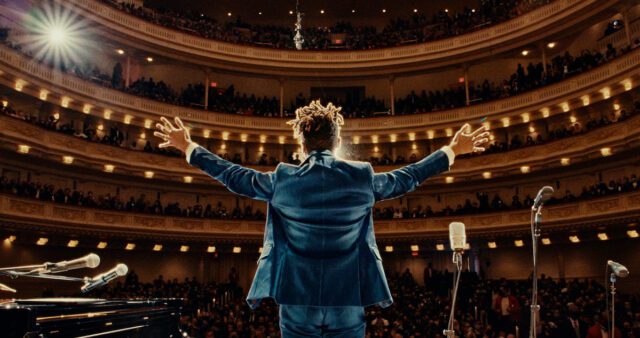
US director Matthew Heineman (Cartel Land, The First Wave) was in Amsterdam during IDFA this weekend. He gave a Q&A following a Soho House screening of his new feature doc American Symphony (available globally on Netflix on 29 November) that follows the Grammy and Oscar winning musical maestro Jon Batiste as he composes a major new work [called American Symphony] that will be performed at Carnegie Hall.
At the same time that his career is soaring, his partner, the author and motivational speaker Suleika Jaouad suddenly has to deal with the return of her long dormant leukaemia.
“I definitely didn’t want to go into this wanting to make a music film. I don’t even know what a music film is,” Heineman commented of the new documentary for which he shot a staggering 1500 hours of material. “I wanted to make a film about two human beings confronting obstacles – these two amazing people navigating highs and lows.”
The director never starts a new documentary with a pre-set idea of how it might turn out. “It’s all a process of discovery. This film evolved and changed numerous times before we even started shooting.”
The collaboration between Batiste and Heineman began when the musician composed the closing credits song Breathe for the director’s Covid doc The First Wave (2021).
“We were having dinner afterwards and he [Batiste] was telling me about American Symphony. We thought, yeah, we should probably film this,” the director remembers what was originally conceived as a film about the bandleader, pop star and singer-songwriter taking on his most ambitious assignment yet. Just when Heineman was beginning to film, and at around the same time Batiste received 11 Grammy nominations, Suleika was diagnosed with cancer. At this point, the project began to “morph.”
“One of the things that really drew me to make this film was that Jon has been so misunderstood for so long,’ Heineman notes of his subject. Classical music critics tended to dismiss him as a jazz or pop musician. “That’s not how he views his own art or his own life. He is really trying to break away from the shackles forever.”
The documentary reaches its climax with the performance of American Symphony at Carnegie Hall. As the director revealed, the concert, for which he had spent months preparing and which was shot with multiple cameras, almost never happened. The evening before the show, Batiste had a positive Covid test.
“The whole show was cancelled and it was unclear whether it would ever get rescheduled.”
In the end, the show was held two months later. Midway through that performance, though, there was a power outage. Lesser artists might have thrown in the towel at this point but Batiste reacted by playing a blistering, deeply personal piano solo as he waited for the electricity to be restored. The audience was mesmerised.
By his own admission, the director is “stubborn.” He was determined to get his way over how he filmed the concert and “won” that argument. When the Grammy organisers refused to allow him to film independently, he smuggled himself into the awards as part of Batiste’s entourage.
The splendour and scale of the concert scene contrasts with the intimacy of much of the rest of the film which is shot verité-style in the hospital where Suleika is receiving treatment, or in their home, or on the road as Batiste is on tour. The director explores the idea that, for both his protagonists, art “is a survival mechanism” at the most daunting moments in their lives.
“We were filming 12, 16 or 18-hour days for seven months and so the depth of the access and the depth of the trust increased with time,” Heineman explains how he was able to film intimate footage of his subjects at such private moments. “My goal always is to make you feel you’re there in that room with the person you’re filming with.”
The price the director pays is in his own life. He is so immersed in the lives of others that he has very little time for himself. “I don’t have children. I am not married. I have a girlfriend who I love but these films definitely take a toll on those around you. But I also don’t know another way. For me, if I am not this immersive I am not doing my job.”
Heineman reveals there were moments during shooting when he took his foot off the throttle “for a couple of weeks…and it just didn’t work.”
Early on, Jaouad hadn’t wanted to appear in the film. “She didn’t want to be the sick antidote to Jon’s success. It took a lot of trust building, convincing and dialogue to get her on board with the film.”
It was daunting and very risky to shoot on a cancer ward in the middle of Covid with patients who had no immune system. Jaouad is onscreen less than Batista for obvious reasons but American Symphony is as much about her as about him. Heineman shows how she turns to art to give her strength, making exquisite paintings of animals as she undergoes treatment for her illness.
“To some people, their relationship doesn’t make sense. Why is Jon out on the road playing concerts while his wife is on a hospital bed battling cancer? Why isn’t he staying home with her? But that is who they are. She didn’t want him to sit around and be there. She wanted him to be himself and to do what he needed to do both for himself but also for their family.”
Heineman is extraordinarily prolific. Since Cartel Land in 2015, he hasn’t stopped working. One moment he’ll be filming the evacuation of Kabul airport (for Retrograde) and the next chronicling the ups and downs of Tiger Woods’ career as a golfer, for the HBO series Tiger. Projects bleed into each other. He’ll be editing one film while doing press on another.
“It’s certainly not something I would wish on anybody,” the director says of his massive workload. “But look, at the end of the day, I am unbelievably lucky to be able to tell stories and to be able to do what I want to do. It’s something I take very seriously but also that I love very deeply.”
Heineman was producer as well as director of American Symphony. As he recounts, the project was “rejected by almost every person out there.”
Neither his track record as a filmmaker nor the prodigious achievements of Jaouad and Batiste was enough to attract financiers. “It was one of the most confounding things of my career. I didn’t understand what people weren’t seeing.”
To keep the project afloat, he and his producer partner paid for the production themselves in time-honoured fashion by using their credit cards.
“Obviously, our industry is in flux. Budgets are shrinking. It is hard for people to come on board early on a film, especially a verité film where we might have a very clear first act but I can’t tell you what the second or third act will be.”
Eventually, Mercury Studios from the UK came on board. “Up to that point, we were doing [it] independently.” After the film’s Telluride premiere, it was acquired by Netflix and Higher Ground Productions (run by Michelle and Barack Obama) and is now an awards contender.
The director has some influential friends and mentors. Paul Thomas Anderson gave him feedback on American Symphony. He was also in touch regularly with the late DA Pennebaker, one of the giants of verité filmmaking, and his partner Chris Hegedus. They used to give him notes. “He [Pennebaker] was as sharp as a tack to the very end.” One piece of advice was that the camera never lies. “That’s why I love shooting in foreign languages because you’re shooting based on emotions rather than on dialogue…I’ve developed the technique of really holding on reaction shots and holding on faces. Faces don’t lie. People lie…if you just hold long enough, you can find the truth in the moment, just in the face.”
Heineman repeats again that there can never be shortcuts. “You have to spend the time to capture those moments of beauty, of vulnerability, of love, of heartache or humour… you can’t just parachute in.”





