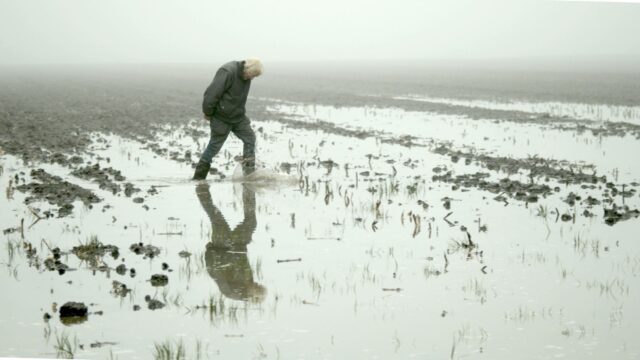
The first scenes of Gerlach immediately tell of the love the makers have for their subject. We see the eponymous hero, warped by rheumatism, walking with seasoned strides across the fields he loves so much. An almost sensual close-up shows his furrowed hands caress the earth and the crops upon it. His light, tender eyes, reflect the value the land holds for him.
This sets the tone and the framework for this beautiful portrait of a steadfast man, one of the last crop farmers living a simple and valuable existence against the delusion of the day and the craziness of money, testifying to everything that is forgotten but which everyone still craves: authenticity, respect for all that lives, love for each other.
Aliona van der Horst is a master of cinematography. She can, like no other, tell a story in which image, sound, music and – often sparse – conversations complement and reinforce each other. She finds beauty in places where you wouldn’t expect it, like on that austere Gerlach farm with its wooden house, bare barns and drab yard. Gerlach is filmed for a year, through the changing seasons, always heralded by drone shots of his fields. But not shot solely from above, we also see Gerlach’s shadow gliding over land that is sometimes replete with waving corn, sometimes covered in snow, sometimes undulating due to the abundance of water upon it.
There is even beauty in the carefully framed shots of the neo-liberalism that threatens him: a petrol station, a fast-food chain, one of the thousands of planes that fly over him noisily. The threats are negated by images of the sign for Gerlach’s potato paradise, a shop built out of crates full of home-grown food. The big red sign that stands proudly above everything else is a thread throughout the documentary; an example of unparalleled attention to detail and the understated humour that lies beneath the entire film.
In conversations of few words, Gerlach (with gleaming eyes and a perennial cup of coffee) talks about his life (he started farming when he was 14 and his father fell ill) and about his rheumatism (discovered when he was 27, but only revealed to others when he was 40 ). And yes, he is always in pain. He talks about Rinus, his best friend who works side by side with him in the fields, tends the strawberries with dedication and always sits at the table with a big smile and relatable words. We see a table in the tiny kitchenette that is always populated by passersby: men Gerlach’s age watching and commenting on how he serves his customers, remarking about life in general and farmers in particular. And then there are Gerlach’s brothers, one also afflicted by his love of the land, the other a lawyer who proves invaluable in the fight against the forces trying to get Gerlach off his farm – the corporate businesses, the money-hungry municipalities, the foreign project developers.
The whole film is a beautiful composition, superbly edited, in which each scene stands alone but at the same time is an indispensable link within the whole. A seemingly meaningless scene of Gerlach walking through his country, with the camera filming him first from above and then from behind, ultimately shows how dangerously close the enemy is. On all sides, his land is surrounded by highways, distribution centres and international corporations. This scene is framed by guitar music, not too emphatic, but enough to instill an atmosphere of melancholy, reminding us that this moment in time will inevitably pass.
Like Gerlach himself, the film is a model of self-restraint, relatability and love for people, but unlike Gerlach, the film is also lyrical and poetic. One of the most beautiful sequences concerns Rinus, who is told he has an aggressive form of cancer. After intensive therapy, he returns to the farm, where he enjoys being outdoors after tending strawberries from a plastic garden chair. The next scene is a low shot with the farm cat in the foreground, in the vigour of his young life. In the background, out of focus, Rinus comes out the door, steps into his clogs and walks away. That is the last image we will see of Rinus.
Gerlach, though, is the focus of the film. You want to share this rare gem of a man, his philosophy and life, with as many people as possible, but at the same time keep him to yourself, cherish him and guard him. You want to keep watching and hear this unflappable farmer explain in one sentence how subsidised globalisation works: we have the money so we can buy beans from Kenya, even if we have to eat from someone else’s platter.
At times Gerlach is a film about the destructive impact of what we understand to be progress, where beauty is forced to yield in the face of bland anonymity, and where crops fail due to climate change. But at heart it is a film about one man and about everything: the importance and power of love, friendship and family.
The Netherlands, 2023, 76 minutes
Director: Aliona van der Horst, Luuk Bouwman
Production: Ilja Roomans for Docmakers
Cinematography: Luuk Bouwman
Editing: Luuk Bouwman
Sound: Aliona van der Horst
Sound Design: Mark Glynne
Distribution for the Netherlands: Cinema Delicatessen
Sales: Syndicado Film Sales
Screening copy: Docmakers