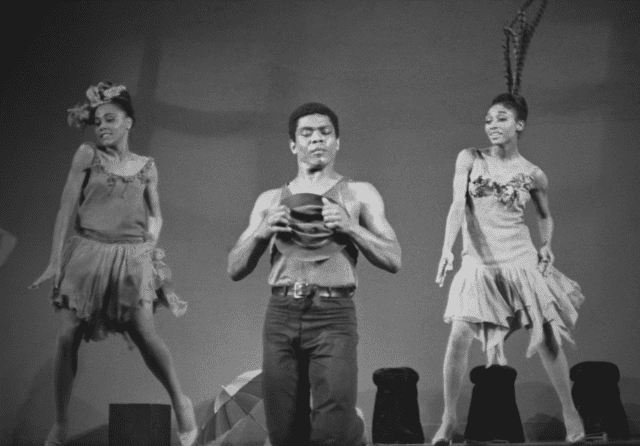
He was called the Pied Piper of American modern dance. His ballet troupe, Alvin Ailey American Dance Theater, achieved international renown. However, as Jamila Wignot’s new feature documentary Ailey reveals, Alvin (1931-1989) was a troubled and private figure.
Born in Texas to a poor family, Alvin grew up in a deeply segregated and racist society. “Choreography was his catharsis,” one observer in the documentary notes of how Ailey dealt with the hardship and suffering he endured.
“We knew we wanted to create something very immersive and very set in his [Ailey’s] point of view,” Wignot (whose earlier films include The African Americans: Many Rivers to Cross and Walt Whitman) says of her approach to the legendary dance figure. “We took as a jumping off point…his notion of blood memories and this idea of seeing his work and himself as part of the continuity of the African diasporic experience.”
Ailey makes exhaustive and ingenious use of archive material to bring its subject to life. “There’s a host of archives across the country, largely university and public archives, that we were able to access,” she ticks off institutes like The Library Of Congress and the National Museum Of African American History and Culture, Duke University and the Ailey Archive itself.
Having spent so long telling his story, Wignot acknowledges that Ailey still remains an enigmatic figure to her. “I think he is a complicated man with a kind of duality that is just in him, largely shaped by his mental health,” the director reflects. Ailey was diagnosed as bipolar. He would show extraordinary generosity in his manic phases but would then become very reclusive and remote.
“He really struggled with creating intimacy in his life…I think he was very caring, very generous and very embracing, as all the dancers attest to, but I think in some way a shield to allow him not to have to let anyone in. He didn’t seem to be open to the possibility of reciprocity in love.”
Wignot believes that Ailey expressed himself most freely in his work. “When he was a dancer and when he was choreographing, I think the stage is the place where he can at least access the emotions that were coursing through him. It was a way for him to be all that he was.”
Ailey was once asked what his dance company stood for. “A place of beauty and excitement,” he replied.
What about the politics? Wasn’t he also dealing in his work with the effects of racism and oppression? “I think it’s a question of how we define politics,” the director responds to the question. Some of Alley’s work had an obvious political dimension. For example, ‘Masekela Langage’, a piece set to the music of Hugh Masekela, was inspired by the shooting of Black Panther activist Fred Hampton. However, there was a political subtext to everything he did.
“For me, when I first saw the company in the 1990s in college, I felt there was a very strong political counter-narrative that his dance works offer.”
If you are raised in the United States, in a country that despises you because of the colour of your skin, the director continues, you can’t help but be politicised.
“He [Ailey] also chose almost to ignore the outside world. There is no engagement with the dominant culture in his dance works. The social and cultural themes of black life are enough. He is actually asking you to embody the black experience. There is something to me that is political about saying ‘you will embody my experience.’”
The life of the professional ballet dancer and choreographer as depicted here is tough: a relen
tless round of rehearsals, performance and touring, at home and abroad. You have little time to yourself. As Ailey notes in old interviews, you don’t get rich either.
Thirty years after his death, Ailey’s company is (as Wignot puts it) “in a great place.” The group receives proper funding and its members can support themselves. Nonetheless, they still lead “incredibly nomadic” lives. The Covid pandemic has stopped some of their travelling but they often seem to be touring almost all the time.
“Many of the dancers have partners, have children – I don’t know how they do what they do,” Wignot says. “It makes no sense to me. It is a very demanding practice. As he [Ailey] says at the top of the film, it is demanding in every way. It is physically demanding, demanding on your time; it is mentally demanding.” Some of the pieces the performers dance are very intense emotionally – and they have to perform them every night.
In 2008, Wignot made a film about 19th Century American poet Walt Whitman, famous for his free verse collection ‘Leaves Of Grass.’ Whitman may have been a white author from the Civil War period but Wignot sees some overlaps between his career and that of Ailey.
“That film is one of my other favourites. There are actually some very interesting similarities. Both Whitman and Ailey were clearly, from the very youngest age, open and curious but also very tactile…they seemed to be the kind of individuals who really felt their surroundings, felt their environment,” the director suggests.
Both were also trailblazers – self-made figures who transformed their arts. Whitman introduced “a totally American vernacular – a complete break with what poetry had been before.” Ailey, meanwhile, revolutionised modern dance, bringing “something new and wholly American.”
The dancer and choreographer sometimes struggled to deal with his own success. He was from a humble background but ended up dancing in front of wealthy audiences in some of the most prestigious venues all over the world. “I think he was a man who just loved to hang out with regular people,” Wignot observes of how uncomfortable Ailey would become in the grander locations in which he found himself.
“So much time was spent serving this massive institution and where is the space for you to be creative?” the director questions of the pressures that the company’s growing success placed on its founder. “He started as a dancer and choreographer and then he became an institution leader and racial representative. I think all of that is too much for a person who is struggling with mental health issues.”
In Ailey, Wingot doesn’t just tell the story of the visionary dancer. She also shows Alvin Ailey’s Dance Company today, rehearsing a new production, and interviews many of the choreographer’s old collaborators. (“They are all really happy that the film is out there and that Alvin Ailey, as the man they knew, lives again!”)
The documentary wasn’t as straightforward to finance as might have been anticipated given Ailey’s huge reputation. “We would tell people we were setting out to make this film and they would say, oh my God, Alvin Ailey, no brainer! Of course you’re going to get funds. But it was a real slog…”
In the end, organisations and outfits like The Ford Foundation, American Masters and Black Public Media threw their support behind the project.
Ailey is sold by Dogwoof who will also be releasing the documentary in the UK January 7. The film was picked up by Neon following its premiere in Sundance last year.
“We have had a really amazing run,” Wignot says of her film, which is due to be broadcast in the US on American Masters in January 2022. “You can have your dreams but it doesn’t mean they will come true. We are very lucky that they have.”