

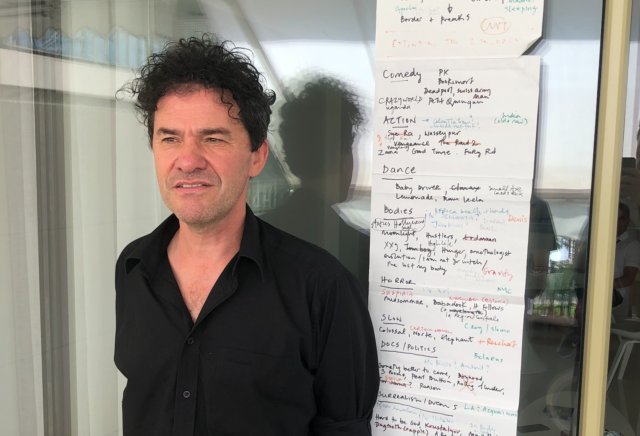
It’s a blazing hot Cannes afternoon. Mark Cousins is on an apartment terrace in a building off the Croisette, wearing his kilt. It’s a few hours after the premiere of his latest documentary, The Story of Film: A New Generation, screening in the Cannes Classics section (and sold by Dogwoof).
The Edinburgh-based filmmaker is in typically ebullient form. Ask him why he began his documentary with footage of Joaquin Phoenix at his most flamboyant and confrontational in Joker and Disney’s Frozen edited next to each other and Cousins argues that the two films have far more in common than might be supposed.
“You know, David Lynch says you should float into a story but another way of starting is to plunge in. With The Story Of Film: An Odyssey (2011) the very first clip was Saving Private Ryan where you literally plunge in. I thought, why don’t we start with something really bold. The Joker was a very contentious film about toxic masculinity and many of the themes of contemporary life. I thought, start with that!”
When he watched Joker, Cousins claims he was immediately reminded of Frozen. One may have been a very adult film, the other one aimed at kids and the family audience. Nonetheless, he spotted “unexpected connections” between the movies. Frozen is about an angry girl who feels she isn’t being taken seriously – and that is more or less the dynamic in Joker too.
Cousins is an inveterate cinema goer. (He goes three or four times a week.) Whenever possible, he sees movies on the big screen. He might like sitting on his sofa and watching series on streaming services but he also craves the “epic” sensations you only get when watching a film in a theatre.
He’s no snob either. He is as enthusiastic about Deadpool and Spider-verse as he is about the kind of films screening in Cannes competition this week. In the new doc, his breadth of reference is enormous. He riffs about Indian cinema one moment and about Jonathan Glazer’s Under the Skin the next.
“I feel that when cinema came along way back in the 1890s, the surprise was that it was like thinking. Our minds work like shots and cuts. We see an image and then it’s gone and then another image. So I think cinema, of all the art forms, is most like how our brain works. That puts it at the front of the line, in a way,” he suggests.
If certain films aren’t easily available, he’ll track them down. “Some of the films from the Arab countries that are in this [the new documentary] definitely didn’t come to us [in the UK]. That’s where you have to put in the work and go and find the stuff…I haven’t seen many great films in the Arab language in the last five months. Does that mean there are none? No…it means the delivery system is malfunctioning.”
He will “hunt films down.” Archives are now willing to help him. They’re aware of his documentaries on cinema and of their influence on a younger generation of film lovers. Every day, Cousins gets messages from admirers all over the world. “Three or four times a day, a person in their late teens or early 20s comes up to me and says ‘you really helped me, I got into cinema because of you.’”
Cousins can’t help but be moved when he hears such words. “Imagine what that does to me, the fuel it puts into me. Young people and old people as well, they’ve begun to trust my glance.”
It remains to be seen whether Cousins will add to the Story Of Film series which has now sold all around the world. He has plenty of other projects on the go. One is a completed film about a major figure in contemporary cinema – but he’s not allowed to say which one. Meanwhile, he also has a second new film, The Storms Of Jeremy Thomas, (about the producer of Crash and The Last Emperor) also premiering in Cannes Classics later this week.
Ask about the current health of documentary and you receive another blast of Cousins’ showmanship and optimism. “Documentary is half of cinema!” he declares, sounding like a fairground announcer. “Half of all films made are non-fiction and so it is not a genre. It’s 50% of cinema….Something happened around 1990. Before that, documentary was the ne’er do well. It didn’t really occupy the big screen. Then, as a result of Buena Vista [Social Club], the Madonna film, Michael Moore etc etc, suddenly documentary occupied the big screen – and it has continued,” he pauses before concluding. “Documentary is getting its dues in a way it didn’t when I was young.”





