

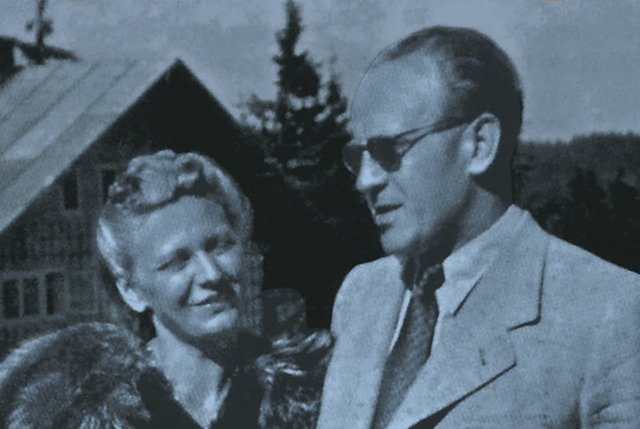
“Schindler got everything, but women also deserve to get at least something, some recognition,” Russian producer/sales agent Raisa Fomina says of her new documentary Bitter Taste Of Love or Frau Schindler’s List – and of a perceived injustice it is seeking to right. Fomina explains more to Business Doc Europe.
The new film (which is on Intercinema’s Cannes slate) tells the true story of Oskar Schindler’s wife Emilie, a character largely left out of Steven Spielberg’s Schindler’s List (1993), about the German industrialist who saved more than a thousand Polish Jews during the Holocaust.
The real Emilie (1907-2001) appears at the very end of the Spielberg, shown in a wheelchair, but she is not identified. History is yet to give her the recognition she deserves.
The film, which Fomina executive-produced through Intercinema, is directed by Igor Volosetsky and Larisa Maximova (who had previously collaborated on a film about composer Dmitri Shostakovich). It includes interviews both with some of the few remaining survivors rescued by the Schindlers and with Thomas Keneally, the author of ‘Schindler’s Ark’, the Booker Prize winning non-fiction novel which inspired the Spielberg movie.
“She [Emilie] was there in the worst places. She fed them, she washed them, helped them with the doctors,” Fomina says of the many survivors assisted by Frau Schindler. Her husband’s factory, where they were employed, was built with her money. The famous list was drawn up with her co-operation. Nonetheless, her contribution has been overlooked.
The Intercinema boss insists the documentary does not harm Oskar Schindler’s reputation. He still emerges as “a great guy.” Nonetheless, it offers a different perspective to that found in Spielberg’s famous film.
Volosetsky and Maximova originally developed the project on their own. They travelled to Poland, Germany and the Czech Republic to research and shoot footage. The filmmakers also tracked down Erika Rosenberg, the woman who had been secretary to Frau Schindler in Argentina, where she lived after the war. Fomina then came on board and was able to help them find the money to complete the film.
The doc includes remarkable footage of two old people now living in Israel who met as teenagers in Schindler’s factory. “They give a fantastic interview about Frau Schindler, about Schindler, about the factory, the conditions and how they were saved.”
In the film, 90 seconds or so from Schindler’s List are used. Fomina contacted Universal to license a short extract. At first, it appeared this would be straightforward. However, Fomina said that Amblin, Spielberg’s company, has refused to approve the use of the material (including the footage of Emilie which appears in his movie).
“Suddenly, in January, I got a message from Universal that it is very difficult now to get the permissions as Amblin changed completely the management. They became very hard to deal with,” she says.
A week later, Fomina received another letter saying that Spielberg and Amblin were now forbidding the filmmakers from using any of their footage whatsoever, she alleges.
It is also alleged that Spielberg didn’t at first realise who Emilie was when she turned up in Israel for the final moments of Schindler’s List. Fomina also believes that Emilie asked Spielberg for money, a equest he declined. Whatever the cause, relations between the great American director and Frau Schindler clearly seemed to have hit a rocky patch.
Fomina is at the Cannes Marché with a completed 52-minute film she can’t sell as intended.
“Now we are stuck because we don’t know what to change,” Fomina acknowledges. One potential solution is to draw footage which can replace the material from Schindler’s List. It’s not at all clear, though, whether this will be permitted.
“It is stuck! We have to cut probably, but the film will suffer. I cannot subtitle it because I don’t know what will be inside.”
Whatever happens, Fomina is determined that audiences will be given the chance to discover the true story of a woman who was heavily involved in one of the most extraordinary stories of the Second World War and who, she believes, deserves recognition in her own right.





