

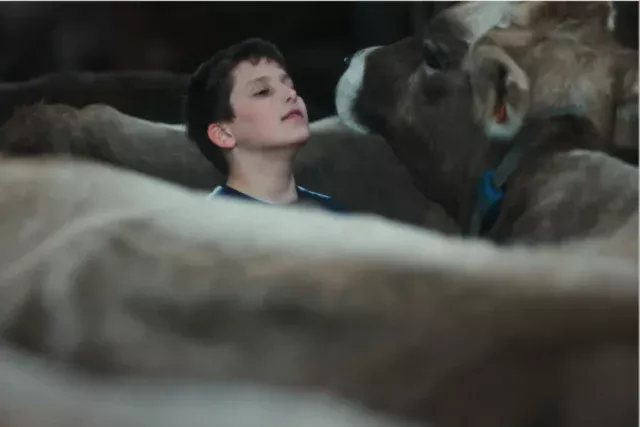
In Maxence Voiseux’s Gabin (a world premiere in Quinzaine), the director follows a precocious and sensitive boy from a rural background in northern France, over an entire decade of his life, from 8 to 18. The film (sold by Lightdox) is one of a handful of documentaries that Voiseux has made with the same family, the Jourdels.
“It has been a long journey with the Jourdel family. I have shot two movies previously with them…I have a huge and a deep trust with them,” the director explains.
We see Gabin and his family at difficult and private moments, for example when the boy is in dispute with his disciplinarian and hardworking father, or in sessions with a therapist or even when doing exams.
“For me, the father is a powerful character because he has two parts, a deep and sharp love for his son but, at the same time, he is quite strict and violent. But actually, he is repeating what his dad did to him,” Voiseux reflects.
As we see in the film, Gabin loves animals and has a tender, trusting relationship with the cattle on his mother’s farm. When he is sad or angry, he finds it cathartic to spend time with them.
No, Voiseux doesn’t share his subject’s love of cows – but he respects Gabin’s passion. “What I think about animals has changed because of the shooting with Gabin. I didn’t have any pets when I was a child and I didn’t have any special relationship with animals…but for him [Gabin], it was pretty natural to live with them, to work with them, to share feelings with them.”
Some of the challenges facing the family are a result of socio-economic forces beyond their control. The director has talked of how globalisation and neglect have ravaged French rural communities. He is from the same region as Gabin – his family used to live in a small village only 12km or so away.
“I am quite familiar with that area of the north of France and I do have a special relationship with working class families from that area,” he says.
Gabin fascinated the filmmaker because of the different aspects of his character. On the one hand, the boy is fiercely proud of his roots and very loyal to his family’s way of life. On the other, he wants to “do something different” and this quickly puts him in conflict with his father.
“For me, he is a strong cinema character because has to deal with these two sides of his life.”
As we see in the documentary, Gabin has to fight hard to make his father accept his choices. Voiseux expresses his admiration for the sure-footed way in which the boy has dealt with the conflicts in the family. He has tried to “find his own path” without leaving bitterness and recrimination in his wake.
The documentary was shot in a period of around 100 days over close to a decade. The director also saw much of the family when he wasn’t actually filming.
“I spent a lot of time with them discussing what we were going to shoot, how and with whom,” he says. “They share their secrets and what they think in the movie, sometimes even without telling others.”
The director organised the schedule around important moments in his subject’s life, for example when Gabin began high school. He would stay for a week or 10 days at a time, working out how to build scenes with them.
“For the financing, it has been a long journey also,” Voiseux adds. He was working with Alter Ego Production, by now regular partners for him. They pulled together financing in different instalments over the years. In order to access extra support, they built a co-production structure with partners from Germany and Switzerland (Ama Film and Rita Productions).
And, yes, the director is an admirer of Richard Linklater’s Boyhood, another (albeit fictional) film which follows the same character over key formative moments in his young life.
“I do love Richard Linklater. The process of shooting and mise-en-scène is a bit different, but [in some ways] it is quite close. We spend so much time with people. I don’t care if it is fiction or documentary…to be honest, I do love his work but what I had in my mind when I began Gabin was not that close from cinema, but was from literature…”
One author who inspired him in particular was French novelist Roger Martin du Gard whose book The Thibaults follows two brothers over many decades. “We share their whole life…it’s a huge family saga,” he says of the book.
The documentary may immerse viewers in the daily life of its subjects but this isn’t a film shot in grungy naturalistic fashion. Voiseux pays strong attention to framing and to music.
“I do make documentary but, for me, mise-en-scène and the way we shoot is as important as the story of my characters,” the director reflects. “Everything for me needs to be like a picture…”
He also observes body language very closely. “The way the father behaves with Gabin, the way he walks and talks, is as important as what he says.”
Swiss composer Nicolas Rabaeus’s score has an elegiac quality and makes plentiful use of saxophone. “He came on the project two or three years ago and so he had a lot of time to think about the music with me….”
As a musical reference, Voiseux suggested Korean director Lee Chang-dong’s movie Burning. The sax is used to bring out that melancholy sense of yearning and loss that Gabin feels as he moves on from his childhood.
Gabin’s two siblings, who’ve featured in the director’s previous work, don’t feature in this documentary. Instead, the focus is on the boy and his two parents.
Does the director identify with Gabin at all and did he experience similar tensions with his own father?
“I have an identification with Gabin because of his spirit, the way he talks to people, his maturity, and the way he behaves with friends and also with his parents – but we have different stories,” the director reflects.
His own parents are from a humble background. His mother is the daughter of Polish immigrants while his father is the son of a cleaning lady. They worked hard and built new lives for themselves away from their northern French roots. Gabin and his family are all expected in Cannes this week for the film’s presentation.
“We are middle-class. My mother is a speech therapist and my dad, who is retired, used to manage a private hospital…but we are not that rich,” Voiseux ends.





