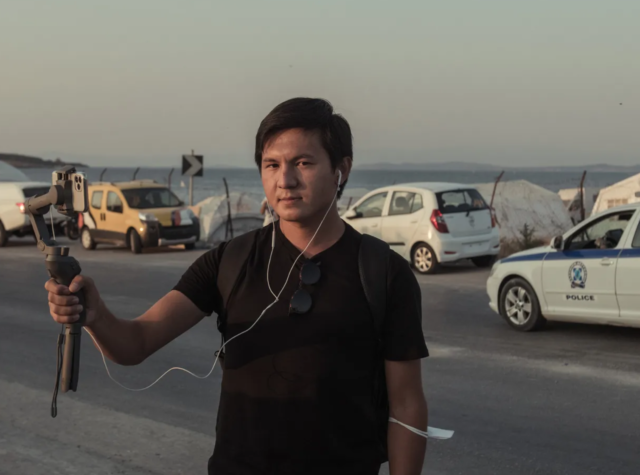
Young Afghan multi-media journalist and documentary maker Mortaza Behboudi has been in Cannes to present his new film Moria, Beyond Hell, about the enormous refugee camp on the island of Lesbos. Behboudi spoke to BDE ahead of its broadcast on Arte.
To make the film, Behboudi spent several months living with refugees at the notorious Moria camp in Greece.
There were obvious reasons why the filmmaker identified so closely with his subjects. When he arrived in Paris in June 2015, seeking political asylum, he had nowhere to stay and very little money. At first, he slept rough in the streets. He didn’t speak any French.
“I left Afghanistan because of my profession. I am a journalist, a reporter…journalism is a crime in Afghanistan for the Taliban,” the 27-year-old remembers. Behboudi comes from Wardak province, two hours from Kabul, a region that was then being overrun by the Taliban.
The French embassy helped him get out of Afghanistan. “But I didn’t know anyone,” he says of his arrival in Paris.
After three months of rough living, Behboudi was put in touch with Maison des Journalistes, a non-profit organisation which helps journalists in exile with their claims for asylum. There, he met filmmakers and writers from Iraq, Syria, Afghanistan, Congo and other countries who had endured experiences similar to his own.
The next step was to learn how to speak French. After six months, he was given political refugee status.
“In the beginning, it was like a film,” he says of his surreal experiences adjusting to western life.
Now, Behboudi has a degree from the Sorbonne (where he did a Masters in International Relations) and a flourishing career as a journalist and filmmaker. He travels extensively, often reporting on the plight of refugees.
Moria, the setting of his new doc, was one of the largest refugee camps in Europe until it was devastated by fire last autumn. It is on the island of Lesbos in Greece.
“I wanted to go and listen to people – and to tell their stories…I wanted to humanise the journey of migration and to give them (the refugees) a voice.”
Together with a French Catholic priest and activist, Father Maurice Joyeux, the filmmaker lived with the asylum seekers from March until September last year. This was when the COVID pandemic was taking hold and the camp was being put under lockdown. He saw at first-hand how bad the situation was – the lack of water, the shortages of food and electricity, the hygiene problems and severe lack of doctors and medical supplies. The camp had been built in 2015 for 2000 people but, in March last year, was accommodating more than 20,000.
Behboudi wasn’t allowed to film in the camp. He therefore secretly used his iPhone to shoot much of the material and then used a camera when he was outside the camp. He follows various characters in the camp, among them a woman who tries to teach some of the kids there. (There is no classroom. She holds lessons under a tree, sometimes in terrible weather). He was the first journalist to be able to chronicle the camp dwellers’ lives in such detail.
The Cannes screening of his documentary was held in the Petit Majestic. That’s the favoured watering hole for journalists attending the festival but he was able to secure the bar for a morning event.
The director hasn’t seen his own family for well over a decade. His parents left Afghanistan to build a new life as political refugees in Iran.
Behboudi continues to specialise in stories about migration. He has reported and filmed in camps everywhere from Iraq to Niger. He has also recently travelled back to Afghanistan to report on events there as the Taliban threatens to seize power again. However, his next documentary has a different focus. It’s about an orphanage in Greenland, the alcohol problems that afflict the adults and the dangers that climate change poses to the country.
“We need to tell these stories!” he exclaims.
Behboudi started working as a journalist in Afghanistan when he was still a teenager. He has accomplished a huge amount since then. ”I was thirsty for learning because I worked in a brick factory as a kid,” he explains his work ethic and drive to succeed.