

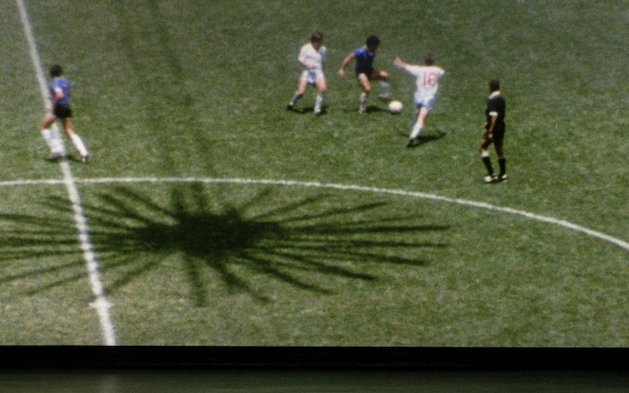
Many will feel they already know all there is to know about the 1986 World Cup quarter-final match between Argentina and England. After all, it featured one of the most beautiful goals ever scored, finished by Maradona after a long, slaloming run which left English defenders either on their backsides or grasping at thin air. It also featured the ‘Hand of God,’ arguably the most notorious goal in history, scored by the same player but breaking the rules of the game.
English striker Gary Lineker, now one of the UK’s most prominent broadcasters, thought there wasn’t much new to say about the game – but (the filmmakers say) he soon changed his mind when he saw how much new material the documentary makers had unearthed.
The Disney-backed film, directed by Argentinians Juan Cabral and Santiago Franco and which premiered in Cannes this week, is based on Andreas Burgo’s book, Partido De Match. It will be released in Argentina later this month. Goodfellas is selling.
“What I wanted was to bring together both teams. Already, I told Santi that the two voices we should have are the two philosophers, Gary Lineker [from England] and Valdano [from Argentina],” Cabral remembers the intention when he and his co-director first began work on the project.
Both of the players are very well-spoken. Valdano is often teased for bringing a suitcase full of books to the World Cup. In fact, he had three in his luggage – but that was three more than most of his teammates. “For football fans, he is so eloquent,” he marvels at Valdano’s articulacy and ability to coin a phrase.
“And Gary, I remember him from watching Match of the Day,” says Cabral, a top commercials director as a well as a feature filmmaker and who lived in London for a decade.
He knew that if Lineker was involved in the documentary, “everyone would relax.” After all, this was sensitive ground. The English players might well have been nervous about revisiting an experience that turned out so negatively for them. The Argentines might have been wary about meeting with their old opponents.
“We wanted to tell a balanced story about these two nations. It’s beyond football,” Cabral reflects.
The filmmakers sketch in the background history to the match. It was played only a few years after the war in the Malvinas (or Falkland Islands).
“A land which has no flags. That is the heart of the idea,” Cabral explains how he and Franco tried to transcend the animosity of nationalism and to make a movie of emotion and scale. “On a big screen, it is a transformative experience…you leave the cinema talking. That’s why I think it’s a cinema film.”
Cabral was 7 or 8 years old during the 1986 World Cup. He watched it in his grandmother’s house. “She used to take care of me in the afternoons because my parents were working. She was watching a football match in the middle of the day. It’s so weird because she never watches football….and my life changed!”
One reason, beyond Maradona’s brilliance, that the game has stuck in his mind since then is “that everything was done in an elegant way.” The English team reacted to Maradona’s handball goal with anger but then stoicism – they acknowledged his genius, even if goalkeeper Peter Shilton would have liked an apology for the handball.
“It’s about rivals, not enemies. That is the clear message…Gary Lineker says ‘we did the only thing we knew to do – we played.’ I think he is not talking about football. He is talking about behaviour in life.”
Franco acknowledges it was “quite a challenge” to bring the former opponents together. “Football players tend to have a very complex agenda. The idea to join these two teams together was a logistical nightmare. We chose Madrid as a neutral city because flying the Argentinean players to England didn’t feel right – and the other way round as well.”
Interviews were shot separately with each player – Lineker and Shilton from England, Valdano, Jorge Burruchaga, Oscar Ruggeri, Ricardo Giusti and Jorge Olarticoechea from Argentina. “We made sure they didn’t cross with each other.”
Shilton and Lineker were “a little sceptical” at the beginning. “But when they saw the spirit of the movie, this idea of a ‘neutral’, movie, an objective one, they were aboard right away.”
“It was like a high school reunion,” agrees Cabral. “They were like kids coming together and [remembering] old stories.”
Shilton didn’t speak Spanish, some of the Argentines didn’t speak English, but somehow they found ways of communicating through what Franco calls “the language of football.”
The film lasts 91 minutes, exactly the length of the match in 1986. It has some remarkable archive footage, for example of Maradona exchanging shirts with Freddie Mercury during a Queen concert in Buenos Aires in the early 1980s.
The film’s even-handed approach extends to the archive footage of young soldiers, one Argentine and one British, caught on camera during the war between the countries. Both express the same puzzlement and dismay about being caught up in the middle of the conflict.
The two directors are long-time friends. “It was my birthday and Juan came and gave me a present – and the present was the book [on which the film is based}. He said to me read this, you are going to love it…I was hooked right away, reading the first page.”
A couple of days later, they discussed making a film. Cabral had already acquired the rights. That was two years ago. They knew they needed to work fast to have the film ready for the World Cup – and for the 40th anniversary of the match.
The duo used the original book as their ‘bible.’
“It is so forensic and so granular,” Cabral says. The film, though, is on a broader canvas. “We wanted to go a bit space odyssey with it, and go 200 years ago, 500 years ago.”
There are references to the history of the Malvinas, to the origins of football and even why referees started using yellow and red cards after the famously bad-tempered 1966 England v Argentina World Cup match, when Argentinian captain Antonio Rattin was sent off. “Every week, we found something amazing, whether it was a rare photo or an archive thing. It took us forever to tie [up]…”
There is no jingoism in the film’s depiction of the Falkland Islands. They’re shown as just as “a piece of land” in the middle of the sea.
The filmmakers add that they made their film “for someone who doesn’t know about football.” They include humour especially in their portrayal of the two managers, Argentina’s supremely eccentric and hard driving Carlos Bilardo, and England’s avuncular Bobby Robson.
“People can experience the whole thing in another way and they can laugh,” Franco says.
“The game of football itself, the square of the pitch, is also the universe,” Cabral strikes a philosophical note. “It [the film] is a healing project in so many ways…it’s not our egos driving this thing. It’s our desire for this story to be told and have an effect. If it stays with you in some kind of way, we have done our jobs…”





