

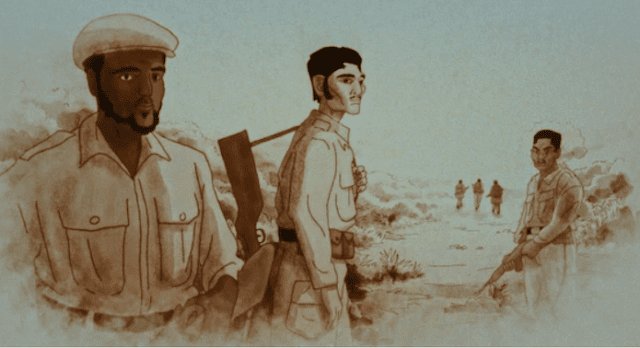
Christophe Dimitri Réveille’s partly-animated new feature doc Che Guevara – The Last Companions (an Out of Competition Special Screening in Cannes) tells an extraordinary story, one that has been strangely neglected for many years.
In October 1967, after revolutionary leader Che Guevara was executed on the orders of the Bolivian president in a schoolhouse high in the mountains, six of his trusted followers, who were hiding nearby, made a remarkable trek to safety. As they walked through jungles, over mountains, and across salt lakes, they faced hunger, hardship and the constant threat of betrayal, but some of them survived and made it back to Cuba. They had covered well over 2600 miles.
Réveille, 48, has an intriguing background for a documentary maker. He’s an actor and acting coach. Many of those he worked with in acting workshops have gone on to have substantial careers, among them Damien Bonnard, Alexis Manenti and Djebril Zonga, the three leads from French box office hit, Les Miserables. He also studied with the legendary US acting coach, Jack Waltzer, part of the Actors Studio and known for his work with figures like Dustin Hoffman and Sigourney Weaver. (Waltzer was the subject of American Film Acting: Jack Waltzer’s Masterclass, a doc that Réveille co-directed).
“What’s the connection between an acting coach in New York and the survivors of Che Guevara? It’s that they were hiding in the shadows of well-known people,” Réveille explains to BDE. “I realised that what interests me is people who are doing difficult work, but nobody talks about them. Their legacy is really precious to me.”
Réveille’s film has its roots in his friendship with Benigno, one of the survivors who made the epic journey to freedom following Che’s death. As a young Cuban peasant, Benigno had been part of Fidel Castro’s revolution. Years later, he became disillusioned with the way the revolution had turned out and had ended his life in Paris, working as a builder.
Initially, the filmmaker worked on a book with the ageing revolutionary, named Last Companion of Che. This was published in 2006. He also collaborated on Benigno’s graphic book, Memoirs of One of Che’s Survivors. But it would take far longer for him to meet the other old comrades of Che – Urbano and Pombo.
“If I had known it was going to take 22 years, I would never have started,” he sighs. “But I never give up…”
He approached the documentary as if it was a political cause that he refused to abandon. (“I don’t choose the subject – I need to do it,” he proclaims). When he met the survivors of the miraculous march to freedom, he made it clear that he wanted the film to be about all of them. Some had fallen out over the years, but he was determined not to take sides between them.
The director was also keen to speak to the Bolivians who had tracked down Che Guevara and then tried to catch his comrades too. He even managed to speak to French intellectual Regis Debray, an associate of Che Guevara. Debray had been arrested and tortured by the Bolivians in 1967, spending over three years in prison.
Half a century later, Debray was wary about co-operating with Réveille, but the director was eventually able to win him round with the support of radical French-Chilean filmmaker, Carmen Castillo. (Debray is due in Cannes for the premiere).
Réveille has material with Gary Prado, the Bolivian army captain who oversaw Che’s capture. “I just want your truth,” he told all his interviewees.
When Benigno left Cuba in 1995, he was regarded by his old comrades as a traitor. They may have been through extraordinary experiences together but they couldn’t forgive him. Reveille saw matters in a very different light. When they would say to him that Benigno had betrayed the revolution, he would always respond, “Maybe it was the revolution that betrayed him.”
Reveille has a very nuanced view of the politics of the Castro era. If he is asked what he thinks of Cuban leader, his stock answer is, “Which one?” Depending when and how you look at him, the Commandante can be viewed as either idealist humanitarian or ruthless dictator.
“If you like Fidel Castro, I give you all the reasons to hate him and if you hate him, I give you all the reasons to like him…it’s all grey.”
The documentary includes some very rare archive material of the execution of Che Guevara. Reveille fought hard to acquire this material.
“When I went there [to Bolivia], because I was introduced to military people, I was able to get pictures from them. You know, they stole pictures from Che’s camp…with the producers, we pay all the rights but there are some archives where you say, ‘OK, you own the archives but it is not yours. You stole from someone who died,’” the director states.
Then there is the animation, overseen by animation studio Les Astronautes. This is used to bring to life many moments for which no archive exists, for example the extreme and almost comical efforts the revolutionaries made at one stage to rescue their captured dog from the Bolivian soldiers.
Both sides corroborated the details of the incident. “I have got all the points of view. I don’t have just the three survivors. I found out about that, but I didn’t want to put it [in the film]. But when you meet the military people and they tell you [about it]…” He pauses in amazement that such an outlandish shaggy dog story turned out to be completely true.
Reveille admits that one of his greatest pleasures was interviewing the old revolutionaries. “For me, it is almost enough [with] the emotion they go through when they talk,” he says. The animation is therefore used relatively sparingly. “I didn’t want to do all animation, even if I had got the money. I wanted to be smart enough to distil it and to use it at the right moments.”
It helped that Reveille already had experience of working on a graphic novel. One lesson that taught him was that “memory is about close up.”
The director takes the audience on the same journey that the revolutionaries once undertook as they tried to walk to freedom. He revisits the ravine where Che was captured and follows the footsteps of his followers as they tried to escape. He has one of French cinema’s best-known actors, Vincent Lindon as the narrator. Lindon was recommended by Reveille friend Damien Bonnard).
Lucky Number is handling world sales and Paname will release the film in France in the early autumn. The documentary was produced by Baptiste Salvan and Gaëtan Trigot at Pentacle Productions.
“They are young but they are smart,” Reveille says of the Pentacle principals. “They let me do my film…they are tough but in the right way.”





