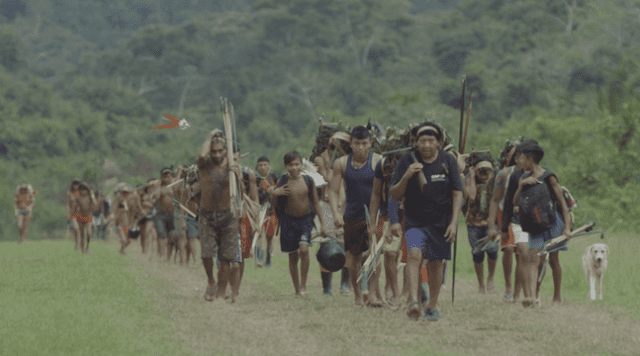
They come out of the distance, marching very slowly down the forest path toward the camera. At first, they are blurred and indistinct but as they come nearer, they move into sharp focus. They are members of the Yanomami people, on their return from a hunting trip. This is the opening shot of The Falling Sky, the new film from Brazilian directors Eryk Rocha and Gabriela Carneiro da Cunha premiering this weekend in the Quinzaine Cannes (and sold by Rediance Films). It lasts for several minutes. The passers-by are in celebratory mood, singing as they go.
The men, women, children, babies and old people are all shown walking toward the filmmakers. The road that they are walking down has now been turned into a landing strip for planes. It was originally built and opened by the military government in Brazil – the same government now seen as responsible for the genocide that happened within the indigenous land in the 1980s.
“This was almost the first shot we filmed,” remembers Rocha. “They were just arriving from hunting. All of the community, they go in the forest and spend several days there to bring meat back to the community. We opened the camera to shoot that sequence. It was very strong, this moment, beginning like that.”
This meat from the hunt will be smoked, preserved and later given to participants in one of the Yanomami ceremonies.
The filmmakers can’t help but note the irony. The Yanomami people are in joyous mood but this is “the same road that almost killed them,” as Carneiro da Cunha puts it. “The idea is that we are together with them, following in the forest and inside their houses and in their world.”
The Falling Sky is inspired by the book of the same name by shaman Davi Kopenawa and Bruce Albert. As it makes clear, the Yanomami way of life is in danger. Miners and gold prospectors, “merchandise people” as the shaman witheringly call them, are flocking to their territory. Their forests are being cut down. There really is a danger of “the sky falling,” as the old seers prophesied.
Carneiro da Cunha and Rocha read the book in 2016. Rocha, whose 2016 feature Cinema Nova won the L’Oeil D’Or for Best Documentary in Cannes, and Carneiro da Cunha, a theatre director and environmental arts activist as well as a filmmaker, were both inspired by it.
The director talks of the richness of the Yanomami cosmology. “You think you are reading about the Yanomami but, at a certain point, you understand you are reading about your own culture,” she reflects.
Davi Kopenawa turned the usual suppositions about the relationships between the whites and the indigenous people on their heads. “He really studied us,” the director says of the shaman. “It’s like seeing your own world in a completely different perspective.”
The Yanomami cosmology has a deep relationship with image and sound. “That is something very close to what we do when we are thinking about cinema and practising cinema, theatre or art,” Carneiro da Cunha reflects.
“Seeing, listening and dreaming” are at the heart of Yanomami culture and rituals. The Yanomami have a deep empathy with other animals. Unlike the whites, they don’t see themselves as being “at the top of creation” and they don’t “treat everything and everyone else as a resource.”
“For us, it was almost as if there was a hidden film inside this book, a hidden invitation to dream far and to dream of others,” Carneiro da Cunha enthuses.
The directors met Davi Kopenawa in 2017 for the first time. They don’t regard their documentary as a straight adaptation of his book. “We think of it more as a new chapter of the book but in a cinematographic language. It’s a language that we created together with Davi and the Yanomami people.”
The filmmakers spent several weeks living with the Yanomami. They were allowed to shoot the shamans’ most intimate ceremonies. “We went there with this really tiny team, five people. We understood that we couldn’t be there with a heavy team,” Carneiro da Cunha says. They put together a hybrid shooting team that also included several Yanomami members. “Also, we as producers produced several films that they [the Yanomami] have directed before The Falling Sky. This is a relationship that is continuing.”
There were some uncomfortable moments. On a formal level, this was a challenging project. Many of the rituals and celebrations took place at night – and were hard to light well enough to film. Rocha talks of the “uncertainty” the directors faced over shooting schedules. They rarely knew in advance what would happen when and often found themselves having to improvise.
“Living together with them, there were days when we didn’t know what would happen when we woke up – but we were always ready,” the directors say.
There is currently (Carneiro da Cunha suggests) “a great humanitarian crisis happening inside the Yanomami land.” In the documentary, the filmmakers don’t hide the extent of the crisis. Nor do they conceal the suspicion that the Yanomami feel toward the white Brazilians after all the betrayals they have endured over the years.
Like many Brazilian filmmakers, the two directors welcome the end of the Bolsonaro era. Under the right wing former Brazilian president, “all the structure, investments and organisation aspects of state culture were completely destroyed,” they say. “He [Bolsonaro] was pretty clear about who were his enemies.”
Now, under Luiz Inácio Lula da Silva, back as President of Brazil, the state film body Ancine is “working again” and funding from the Ministry of Culture is coming back. There are six Brazilian films in official selection in Brazil – a sign that the local industry is resurgent.
“But when something is destroyed, it takes time,” Carneiro da Cunha says of the rebuilding process underway in the cultural sector. There is also now a Minister for Indigenous People in the Bolsonaro government.
After Cannes, The Falling Sky will travel to other festivals in Brazil and abroad. An impact campaign is underway to distribute the film later this autumn in the indigenous territories. “We are raising funding for that. Hopefully, the premiere in Cannes will help us to do that,” the filmmakers sign off.