

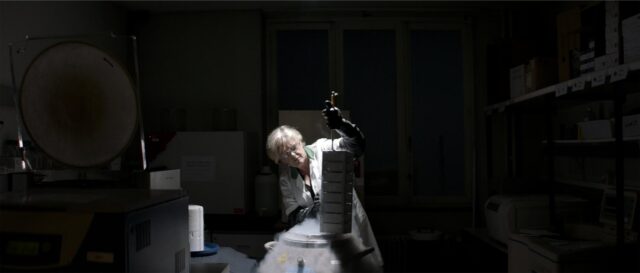
DNA by Lennart Stuyck, Maarten Stuyck
Prolific Belgian documentary outfit Diplodokus has been at CONNEXT this month with a project that promises to answer some very profound questions. The new series DNA deals with the ongoing genetic revolution – and whether advances in science might soon allow humanity to conquer diseases like cancer while ensuring that babies are always born in perfect health.
“It’s a four-part series looking at healthcare, privacy and security and the world around us – and the fourth episode is a look even further into the future regarding DNA,” explains Lennart Stuyck, one of the company founders, who is co-directing. Shooting is well underway and should be completed soon. Backers already aboard include VRT, Canvas and the VAF (Flanders Audiovisual Fund). “The main thing we are looking for now is sales agents and broadcasters.”
And, yes, the series will explore both the Utopian possibilities opened up by DNA research and peer at the darker side of the science, “the scary stuff” as Lennart calls it. “It [the series] shows the possibilities but it also raises questions about what we will do with all this information. We felt it was the right moment to make a series like this because people aren’t really aware of all the moral and ethical questions coming our way.”
There is now “CRISPR” gene editing technology available which will allow scientists not just to analyse DNA but to “cut it up and change little parts of it.” The question now is not so much whether DNA can be modified but whether it is a good idea for humanity to tamper with the most fundamental building blocks of life.
Flanders is a region known for its expertise in the DNA field – another reason why Diplodokus was so keen to start such a project. One prominent site where the filmmakers have been shooting is the Flemish Institute for Biotechnology in Ghent. They’ve also taken their camera out on location to stables and farms.
“There are a lot of horses being created using all sorts of techniques,” Stuck talks of some Frankenstein-like equine experiments that have been taking place in recent years. “It’s really interesting and it raises a lot of questions…people just don’t know. There are so many possibilities now and there will be even more in the coming years – and people have no idea!”
The project was first conceived by Lennart’s brother, Maarten, who has been reading widely round the subject.
Visually, DNA will have some of the style of a futuristic sci-fi drama. “We are also going very microscopic because DNA is so small,” Lennard says. He is promising “interesting super close-ups” and plenty of “micro-imaging.” There will be talking head interviews with some of the top practitioners in the field. The aim is to have the series finished next summer (in 2023) and then to set a broadcast date.
This isn’t the only Diplodokus project at CONNEXT. The company has also been presenting Catching The Pirate King, which Lennart has again co-directed with brother Maarten. The three-part series looks at how the Belgian police became involved in apprehending leading Somalian pirates and having them put on trial. This was presented as a new project last year in RE-CONNEXT (the online version of the showcase) and has been screening this year. The series has already been broadcast on Canvas (and is still available to watch online). The aim now is to boost its international exposure.
“There’s interest for it but it’s still quite early. The next few months will be crucial for us.”
To Lennart’s surprise, some of the Somalian pirates who’ve seen the series have given it their blessing. Even so, he very much doubts that the documentary will screen in Somalia itself.
“Phwar! It’s not that I am not interested [in screening it there]. It will be difficult…there is still a bounty out for Belgian reporters!” the director raises the alarming possibility that he himself might be kidnapped if he heads to Africa.
The filmmakers, though, are proud that Catching The Pirate King, co-produced with VRT Canvas and Belga Film Production, offers “a 360 degree” view of its subject matter. Every perspective is included. You’ll see events through the eyes not only of the victims but of the pirates themselves, the cops and the lawyers. It also works as a piece of social history about Somalia in the period when the pirates became globally known “menaces on the sea.”
“I am quite proud that we were able to do it and that we found witnesses to tell every side of the story,” the director reflects on what he clearly regards as a job well done.





