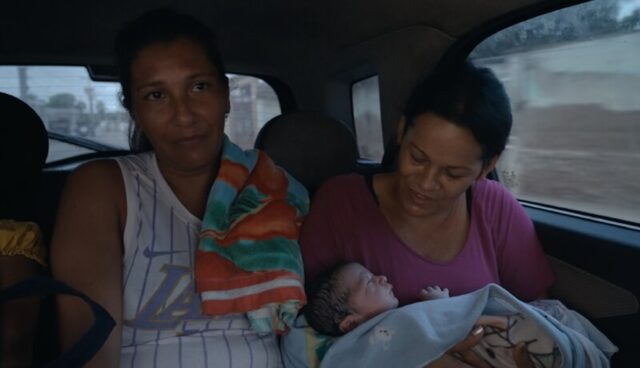
Viewers watching French director Nolwenn Hervé’s debut feature doc The Cord (a world premiere in the DOX;AWARD competition in CPH:DOX) don’t learn a huge amount about the back story of the film’s main character. What they do see is that Carolina is tough, resilient and a tireless activist on behalf of those suffering because of Venezuela’s crumbling health service.
In a society in which expectant young mothers now need to bring their own medicine and equipment to hospital, she is part of a network that gives Venezuelan women a chance of a safe pregnancy.
Carolina is from a tough and violent background. At one stage, she is shown boxing, pummelling the punch bags as a way of keeping fit and deflecting stress.
“I decided not to tell so much about her past because I wanted the audience to make their own narrative – but what I can say is that Carolina felt in her flesh the inequalities of the society. She grew up in a dysfunctional family and so she spent a lot of time in the streets…even when she was a child, she would fight against injustice,” the director tells BDE.
Working as a journalist for French TV in Latin America, Hervé had come to Venezuela in 2016 to work on a story about oil smuggling. When she arrived, she couldn’t help but notice all the women heading in the opposite direction, travelling to Colombia in search of the health care they couldn’t find at home.
“At that time, I was working with a Colombian friend of mine and she introduced me to Carolina,” the director recalls.
Carolina is based in Maracaibo, one of the biggest cities in Venezuela. She was very touched when Hervé told her that she wanted to make a film about her.
“I didn’t have a producer; I didn’t have resources to do it; I didn’t have money but I was sure I would make it,” the director describes her project’s unpromising beginnings. Carolina admired her gumption and immediately agreed to support the project. She saw elements of herself in the filmmaker. They both shared the same self-reliance and determination.
“We have a mutual admiration. She said I couldn’t do what you are doing…and I said [to her] I couldn’t do what you are doing.”
Much of the documentary is shot inside a car as Carolina ferries young women between hospitals in search of care or travels around town, trying to source medicine or equipment. At first, Hervé didn’t think it would work to film in such a claustrophobic environment. “It’s so tiring, we are sweating so much, we are in a tiny space,” she remembers the discomfort.
“And then I just realised – this is where things are happening, and where intimacy is unfolding. We spent so much time in this car that I realised it was beautiful and metaphoric because we are in the country that has the largest oil reserves in the world [but] many people don’t even have the option to put gasoline in their cars.”
She also began to regard Carolina and her team as “the motors of life because they are driving women from one hospital to another. This country has been developed in a capitalistic way by men – but who is saving life and preserving life? It is women.”
Hervé was doing the shooting and sound herself as everyone was crammed in the car together. She started shooting in 2022 – and was still filming last year. She always had her camera with her.
“I was on my own. In that sense, it was good for me because even if it was tiring, I was free. I didn’t have to take charge of a team…I lost weight and everything. It was also a physical experience but when you have something very deep inside, a project that has come from the womb, you realise that your body can do incredible things.”
The Cord is dealing with tough subject matter and was often gruelling to make. Nonetheless, there was humour and camaraderie along the way. Carolina is proud of saying that she can make even someone on their deathbed laugh. “She really has this ability…it is also the community of women, there is a lot of solidarity. The film is a lot about this, how a community of women can bring change in a time of crisis. It’s very inspiring and it’s about empowerment also.”
Partly as a result of the healthcare crisis, women are turning again to traditional “Wayúu” medicine. Hervé is open-minded about the ancestral healing practices which, she believes, allow women to “reconnect with their own bodies…we have been cut [off] from this knowledge.”
Carolina and her team are shown staging protests against the medical care neglect, stopping the traffic and insisting their voices be heard. As a news journalist as well as a filmmaker, Hervé knew how to take precautions to protect her footage.
“When you know somebody is maybe going to take your camera, obviously you don’t shoot with the same card all the time. You keep changing the card all the time just in case.”
Hervé shot The Cord very differently to how she would have assembled a news item on the same subject. “It was a very intuitive and organic way of filming. I was not intellectualising…in the way I was filming, I wasn’t thinking I need to have this close-up or this wide-angle shot as I would for a more classical journalist report.”
The director took inspiration from a range of sources – everything from 2019’s For Sama, set during the Syrian uprising, to the lyrical and humanistic films of Iranian auteur Jafar Panahi (also known for shooting inside cars).
Although Hervé embarked on the project on her own, she soon assembled a team around her. Production companies didn’t know her as a filmmaker and were initially wary about working with her, but she began to edit her material herself. However, she had already met with Estelle Robin You from Grande Ourse Films who was keen from the outset to see the footage and soon came aboard. They had a top editor, Rafael Torres Calderón, who has a Mexican background and has previously worked with filmmakers including Lola Quiviran and Matt Diop.
The film won a Rough Cut award at last year’s IDFA. Hervé remains in close touch with Carolina and an impact campaign is underway to help with the creation of a birthing centre in Maracaibo that will combine both ancestral knowledge and western medical practices. “She already has the land for the centre. Now, it is a question of finding the right collaborators.”
After CPH:DOX, The Cord will feature in the Take on Film & Impact programme at Movies That Matter in the Hague.
As for the title of the film, that has an obvious symbolic resonance. “I really felt it has to do with the baby and the cord with her mum but also how Venezuela itself has cut the cord with its population…and it has to do with solidarity. We are nothing without links!”
The Cord is one of six European documentaries selected for the EUROPE! Docs programme, devised by EFP and CPH:DOX.