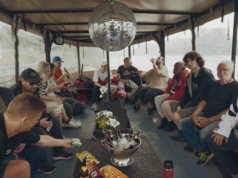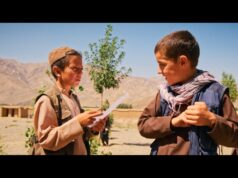
World-premiering in the main competition at CPH:DOX 2026, Rachel Taparjan’s Something Familiar is an intimate and formally adventurous debut that intertwines personal investigation with hybrid storytelling techniques. The 90-minute documentary follows the British-Romanian filmmaker as she accompanies another woman, Mihaela, returning to Romania in search of her birth mother, only to find herself drawn into the unresolved shadows of her own past.
Adopted from Romania and raised in England, Taparjan gradually turns the camera inward, launching a search for her biological siblings and confronting painful stories of abuse and exploitation that shaped her family history. Blending observational footage, staged encounters with actresses portraying different versions of her mother, and deeply personal testimony, the film explores how creative authorship can transform inherited trauma.
Speaking with Business Doc Europe in Copenhagen, Taparjan reflects on the long development of the project, the ethical challenges of trauma-informed filmmaking, and why reclaiming one’s narrative can be a profoundly empowering act.
She explains that the project did not initially start as a film about herself. In its earliest stages, the idea centred on Mihaela’s story. She admits that, “I was a reluctant protagonist, because a few people had said to me: come on, this story is about you as well as being about her.”
The turning point came during the development phase, particularly while attending workshops at the Circle Accelerator programme for filmmakers. It was during that period of writing and reflection that she began to accept that the project would inevitably involve her own story as well.
“I think during that period of development and writing was when I really accepted that actually, yes, this is going to be a feature film,” she recalls. “But also it’s going to be about both of us.”
Even after embracing that direction, stepping into the role of protagonist remained difficult. “I still struggled with being a protagonist probably right through to the end — probably through to now.”
Taparjan further emphasises that emotional safeguards were essential throughout the process. Early on, she worked with a psychological consultant while filming with Mihaela, and later collaborated closely with a qualified therapist during particularly sensitive sequences involving her biological sister.
“I was really glad that we did the pre-therapeutic work and the therapist was on set, and then she had the chance to engage with the therapist afterwards,” Taparjan explains.
Beyond professional support, the filmmaker also approached the production through the principles of trauma-informed filmmaking. That meant recognising the vulnerability of participants and giving them as much agency as possible within the process. “To be trauma-informed is to be aware that what people are bringing is a lot,” she says. “People don’t necessarily perfectly articulate how they’re feeling when they’re in a heightened state. So being sensitive, being ethical, and giving choice and control wherever we can.”
In one key moment, the film even reverses the traditional documentary dynamic. “With my sister, we turned the interview around so that she interviews me at a certain point,” Taparjan notes. “Giving your protagonist and your subjects an element of control — that’s part of trauma-informed filmmaking.”
The business of filmmaking also served as a form of psychological protection for the director. “Just the process of making the film and editing the film and curating the story felt protective to me,” she says. “It’s control again, isn’t it? Owning the story and crafting the narrative helped me on many levels, psychologically and creatively.”
The decision of involving several actresses portraying the filmmaker’s mother emerged partly from necessity. Taparjan’s mother had already passed away, leaving the filmmaker with questions that could never be answered directly. “I thought, hang on a minute — how can I ask my mum these questions that I want to ask her? My mum’s dead. I can’t ask her these things,” she explains.
Looking to therapy for inspiration, she began experimenting with cinematic equivalents of therapeutic methods such as psychodrama and constellation therapy.
The device also resonates deeply with the experience of adoptees searching for biological identity. “For an adopted person or a foster child who doesn’t know their biological family, you wonder: who do I look like?” Taparjan says. “You have this magical thinking as a child — you’re searching to see yourself in the faces of other people.”
Rather than conduct traditional casting sessions, Taparjan entrusted the selection to her producer. She deliberately avoided meeting the actresses beforehand in order to preserve genuine reactions on camera. “It was really important that my reaction was authentic and their reaction was authentic. I didn’t want to see them before we met on screen,” she underscored.
The actresses were given only minimal context. Instead of scripted dialogue, the scenes were built around real-time interaction. “I wanted them to be in the moment with me and really responding to me,” she says. “I like that porous boundary between fiction and reality. I really enjoy that space.”
For Taparjan, the creative process fundamentally changed the way she understood her personal history. “It gave me a story that I can bear to live with,” she says.
The act of shaping the narrative allowed her to reclaim agency over events that once felt overwhelming. “It gave me a sense of control, a sense of authorship, and ultimately a sense of empowerment,” she explains. “And it gave me beauty and poetry even in very dark chapters of my life.”
The entire project unfolded gradually over several years. “We filmed on and off for maybe five years,” Taparjan says. Principal photography wrapped relatively recently, following one final shoot in Romania late last year. Editing overlapped significantly with production, allowing the team to continuously refine the structure of the film.
Editor Alice Powell began working with a substantial base of material while additional footage was still being shot. The evolving production meant that new material regularly entered the edit.
The project kicked off in Romania with Manifest Film, led by producers Elena Martin and Monica Lăzurean-Gorgan, who supported it from its earliest stages. Later in the process, the production expanded to include UK partners Aleksandra Bilic from My Accomplice and Dermot O’Dempsey from Shudder Films, with support from the BFI. The funding structure required the inclusion of an emerging producer, further broadening the team.
For Taparjan, the international partnership carried symbolic significance beyond the financial and logistical aspects. “I love the fact that Romania and England are holding this film,” she says. “That’s me, after all. I’m Romania and England.”
Interestingly, the doc’s blending of documentary and staged elements initially made it challenging to communicate to potential backers. “It was difficult,” Taparjan admits. “People wanted to see it in order to believe it.”
Funders often struggled to visualise how the hybrid components would work together. “They were asking: how are these different styles matching together? How is it going to work?”
Momentum began to build once the team was able to show a short excerpt at Cannes Docs, which helped industry professionals understand the concept. “From the point at which we showed a little ten-minute clip there, I think people got it,” she says.
Early financial support came from Romania’s CNC, which awarded the project its top funding prize. Additional backing later arrived from the BFI and Doc Society, enabling the team to complete the film.
Taparjan hopes Something Familiar will open broader discussions about trauma, family dynamics and self-determination. “I’d really like people to think about how we overcome trauma — and how we do that as family units,” she says. The story explores themes of intergenerational trauma, adoption and identity, but the director believes its emotional core resonates beyond those specific contexts.
Another central theme is the possibility of transformation through creativity. “The ultimate triumph over trauma is play. It is creativity,” Taparjan says. “That’s what I believe.”
She also hopes the film will challenge stereotypes surrounding adoption narratives and Romania itself. “So many westernised narratives about adopted people are stigmatising,” she observes. “My gaze on Romania wasn’t that. I wasn’t encouraged to think like that about Romania.”
For Taparjan, the hardest part was exposing deeply personal experiences to the public. “I don’t enjoy having the darkest parts of my life exposed,” she says candidly. However, she felt that such openness was necessary if she expected the same vulnerability from others appearing in the film. “As much as it’s excruciating for me to share some of the things I’m sharing, other people are sharing big things too. And we’re all in this together.”
Despite the challenges, Taparjan remains convinced the journey was worthwhile. “It’s worth it for the conversation. I wanted to find myself in a film like this when I was growing up — one that wasn’t stigmatizing but was also honest,” she sums up.
Something Familiar is one of six European documentaries selected for the EUROPE! Docs programme, devised by EFP and CPH:DOX.