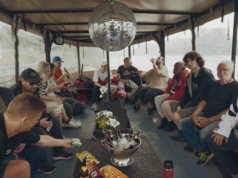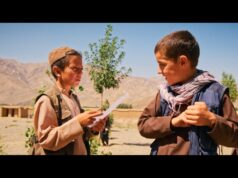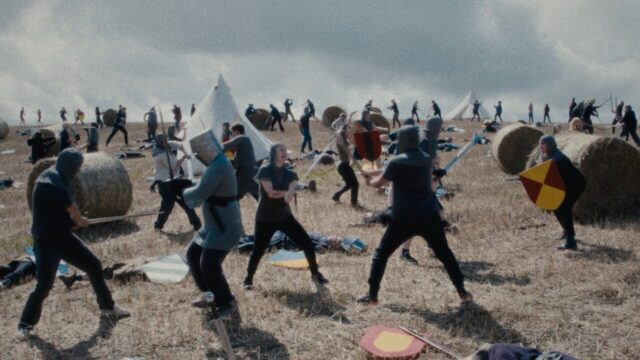
Matter Of Britain is a full-scale Arthurian epic – but one made in a tiny Sussex village. Peter Treherne’s film (which has just screened at CPH:DOX following its world premiere at MOMA in New York) features present-day residents of Mayfield playing characters from Thomas Malory’s 15th century classic Le Morte d’Arthur.
We see knights like Sir Lancelot, Sir Galahad, Sir Percival and Sir Gawain roaming far and wide in search of the Holy Grail. Treherne also includes contemporary documentary footage of rural life, such as lambing season and cattle markets, and there are plenty of church services.
This is a hugely ambitious endeavour, shot over a period of a year and involving more than 300 local collaborators. Treherne (an artist and filmmaker who founded the Slow Film Festival) remains determinedly self-deprecating about the scale of the endeavour.
One of his main intentions in making the film, he says, was simply to document the village community where he grew up. “At the same time, I felt too awkward in wanting to document people in their real lives. I felt that could sometimes be a little bit of an invasion.”
Asking people to dress up in funny costumes was a way to overcome the social embarrassment. “The idea is that if you get everybody to come together in a performative activity, people aren’t being objectified or observed in their intimate everyday…to some extent it is sort of ridiculous – and people love the idea of getting into chainmail.”
This chainmail came from The Knight Shop in Wales – and was one of the film’s biggest expenses.“ We got about 50 chainmail ‘coifs’,” Treherne says of the expenditure on the clinking headgear that protects wearers against damage from bladed weapons.
The filmmakers advertised all over the village. They called people up and went on a full-scale charm offensive. There weren’t Hollywood-level salaries on offer but at the battle scene, they offered a big hog roast.
Treherne saw his own role as being “a conveyor of happenings.” He would invite people to participate, provide the costumes and props, get them to the right locations, and then start filming in an “intuitive” way. However, when speaking on camera, performers did stick very close to the Malory text.
Knights might be carrying swords and shields but they also wear trainers and eat marshmallows. At one stage, we see Lancelot and Galahad in full medieval outfits embarking on a voyage across a very choppy sea – aboard a dinghy with an outboard motor.
The anachronisms are deliberate. “The medieval text demanded that Lancelot and Galahad go out in a ship. There was a real challenge in working out what kind of boat we need….and then it just tuned out that Lancelot had an inflatable dinghy.”
Sir Lancelot is played by Nick Walford whose day job is as a deerstalker and gardener.
Mayfield has a wide range of inhabitants. It’s within the commuter belt so some people who live there are heading up to London every day to work. The village has its share of retirees and a strong agricultural community.
“There is definitely a political message within the film but the idea was as far as possible to have a very non-judgemental gaze,” Treherne reflects.
Matter Of Britain is as much about our relationship with the land as it is about the search for the Grail. “On one side you’ve got a style of agriculture that is very intensive and can be destructive on the land…and then, on the other, you have smaller, more mixed farms which don’t produce as much food but, if they are handled well, can be these amazing ecosystems.”
There used to be many more farms in the community but numbers have dwindled. Farmers have lost their tenancies and landowners have begun to hire out farm buildings as homes to “people with a higher income.” As rents have gone up, land use has intensified. The farming that does go on has become more about short-term profits rather than the long-term protection of the land.
“The film is thinking about that and it is thinking about our very long history with the countryside. The area around Mayfield is part of the High Weald area of outstanding natural beauty – and part of the reason it has been given that label is that it is one of the best-preserved medieval landscapes in western Europe,”
Treherne adds that although this is a community-based project, it is also deeply personal. “Part of that very personal nature is that my family still live in that village,” he says. “A lot of the film is reflecting on the world I grew up in…a love letter to that community.”
His mother, who is American, loves Arthurian legend, and he grew up steeped in tales of the Round Table. He also studied medieval history and English literature at the University of St Andrews.
Matter Of Britain has some underlying humour but this isn’t really a Monty Python-style romp. The storytelling style is “very straightforward.” It treats Arthurian myth in “an innocent way” and doesn’t try to make it ridiculous.
“There is something humorous about people wearing chainmail and being in a dinghy…but it felt that the film couldn’t be just funny. It had to be quite earnest.”
Funding came “mostly from the Arts Council.” There was also support from local charity, the Lund Trust, and from the High Weald fund. Reading University provided “some amazing, delightful students” who worked on the titles.
“One of the challenges with making experimental work is falling slightly between the gaps,” Treherne suggests that this wasn’t the type of project that could easily access conventional film backing from, say, the BFI. “Funding was quite a challenge and it would be good to have a funding landscape in Britain that is able to fund the projects that fall between moving image art and more conventional narrative film.”
Treherne didn’t regard the film as a doc when he was making it (although it has clear non-fiction elements). “I didn’t really know what to do with the film once it was made, and a friend of mine said you should email Luke Moody [Head of the BFI Doc Society Fund] because the film you’ve made is actually a documentary.”
Moody suggested people who might be interested in it – which is partly how it ended up in MOMA in New York and CPH:DOX.
And, yes, the participants have now seen the film, albeit in unusual conditions. “We did a cast and crew [screening] where we just emailed everyone in the credits – over 300 people. This was both the worst screening – I was constantly embarrassed by it – and also the best.”
The screening took place in St Dunstan’s Church in Mayfield. Treherne and his team borrowed an 18ft screen from the local film club. “Just before we started, we realised we couldn’t connect to the church speakers so my brother dropped off his guitar amp. The entire film was thrown out of this guitar amp in a mono mix.” The voices became “inaudible bellows.”
“I think the village community was very puzzled by it, but there was a sense they were very proud of it…it was a very moving experience,” Treherne signs off.