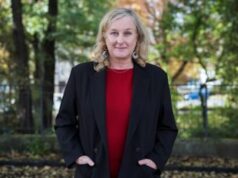
The prolific and versatile Alina Simone has been working as a journalist and radio reporter for many years. She is also an essayist, author and singer-songwriter – and now she has turned feature filmmaker too. Her documentary Black Snow, sold by Cinephil, world premiered in F:ACT Award this week at CPH:DOX.
“I had a Google alert on stories that had to do with Russian asylum seekers because my own family came to the US as political refugees from the Soviet Union,” Simone explains the unlikely chain of events that led her to Siberia to make the new movie.
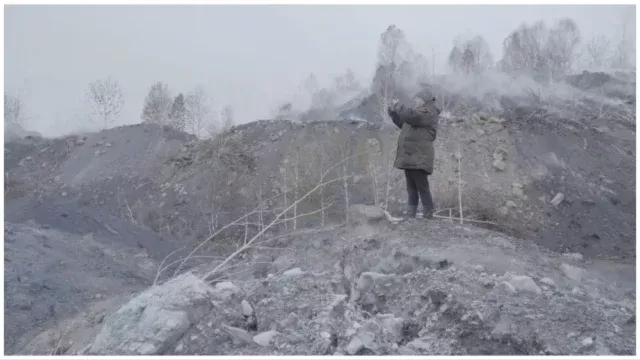
The alert beeped with a story about Siberian women from a town called Kiselyovsk, asking Canada’s President Trudeau to give them environmental asylum. The pollution and fires caused by local coal mining was making their lives unbearable.
“I was so intrigued on so many levels. Of course, I had never heard of an underground fire before. This was very mysterious and piqued my interest.”
Simone already had first-hand experience of Siberia having worked there in “international development, my first career.” She knew the region where the pollution was taking place and was intensely curious at just how someone from such a remote place had managed to get the attention of the world’s media with a video shot on a cellphone. She eventually discovered the video had been made by Natalia Zubkova, a formidable local mother who was also fast turning into a highly effective protester and campaigner.
Zubkova had her own YouTube channel on which she chronicled instances of corruption, and bureaucratic incompetence. She dealt with everything from the ongoing pollution to tragic incidents, like when a young student was killed by a falling tree (cut down on school grounds without warning by the city authorities just because a dignitary was visiting that day and they wanted to tidy the place up).
“The black snow thing had already happened and so those videos were up there too,” the director says of how even the weather was being affected by the coal mining. Simone already spoke Russian and soon made contact with Zubkova. She didn’t pitch the project or tell anyone about it at first.
Black Snow begins in harrowing fashion with footage of the activist talking direct to camera, warning the citizens of her home town that if they are watching this video, it means that she is no longer alive. She wants everyone to know that she would never, under any circumstance, kill herself. This was one of the videos Zubkova made as ‘insurance.’ She would shoot them at night and send them to friends with instructions to post them automatically to her YouTube channel unless she told them otherwise.
“I was very conscious on the need to grab people from the beginning,” Simone explains how she drew on her experience of long-form journalism in crafting her film. “I don’t want to start with a lot of historical background. I want to start with her,” the director adds. “I love films that ask a question rather than give you an answer; that draw you in…you want people to ask who is this woman, why is she in this car and who is she talking to…”
Over the shooting period, Simone became very close to Zubkova. At times, both were at risk. During her time in Siberia, Simone was taken to court, fined, found guilty and almost deported for spying.
“They had trumped up evidence. They said I was working for the New York Times,” she says of how the Russian authorities came after her. “I’ve sat in a courtroom with a cage in it.”
Zubkova contacted media outlets to highlight the case and the authorities eventually relented. She speculates that they didn’t want the attention or bad press. “I think this was the last window when Russia still cared about the west,” she says of the period in 2019 when she was under threat.
Zubkova faced far more intense intimidation. She was constantly taunted on social media and faced the very real possibility of being tortured or killed.
“We trusted each other with our lives. During that period when I was almost deported and may have been imprisoned, she was working very hard behind the scenes to protect me…it was quite scary for her. She was under a lot of pressure from the government to make a statement against me and to turn me in. FSB agents came to her door and asked her to do so.”
Zubkova stood up for the filmmaker and Simone later returned the favour by using all her contacts to help her get out of Russia when it became necessary for her to flee.
“It became an unusual and very intense friendship,” the director says of the “complete trust” she and Zubkova established with each other.
The director’s life story is as colourful as that of her subject. Her father Alexander Vilenkin was an aspiring physicist in Kharkov in Soviet Ukraine but was blacklisted by the authorities because he refused to spy for the KGB. The family fled to the US. At the time, Aline was a baby.
“My grandparents came five years later because as soon as my parents left, they lost their jobs as well and were ostracised.”
Simone was raised in a very close-knit Russian family in America, “mostly Jewish, mostly scientists.” This meant that she felt “culturally comfortable” when she came to Russia.
“I had always wanted to make a documentary, it was my dream but I just needed the right subject,” she remembers. Zubkova was ideal. Not only was her story in itself fascinating but she had plenty of film material that Simone could draw on.
The director went into the project telling herself that if she couldn’t get the documentary off the ground, at least she would still be able to pitch the story as a magazine idea. Eventually, Kirstine Barfod (one of the producers of Feras Fayyad’s Oscar nominated The Cave) came on board as a producer. By then, Simone had secured an initial grant from Doc Society.
“The ball was a little bit rolling but when she [Barfod] came on board, it really added a lot of fuel. With funders, one of their main points of hesitation [had been] that I was a first time director with no producer, trying to tackle a hugely ambitious thing in Siberia. It didn’t exactly inspire confidence.”
The presence of Barford therefore gave the documentary (made through Simone’s production company Prettier In The Dark) extra credibility. Many organisations eventually gave the doc their support, among them Catalyst Film Fund, Justice for Journalists Foundation, Andrews Berends Fellowship, Sara’s Wish Foundation, IDA Enterprise Documentary Fund, Fork Films, Redford Center, Bloomberg Philanthropies, NYC Women in Film Fund, Mountainfilm Emerging Filmmaker Fellowship, NYSCA/NYFA Fellowship in Film, Gotham Documentary Feature Lab and Film Independent Documentary Lab.
Zubkova, who is now living in Germany, was in Copenhagen for the premiere.
Meanwhile, Simone and Barfod are already in post on another documentary, Fear Zone, about the Russian attempts to “move the border of Georgia secretly in the night.”