

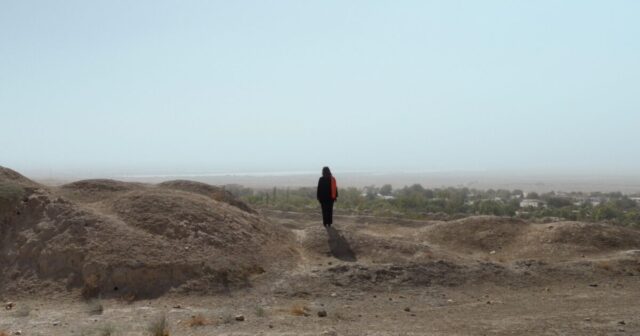
Austrian filmmaker Natalie Halla was watching the news on TV one evening when she first caught sight of Manizha Bakhtari. It was a few days after the Taliban had re-taken power in Afghanistan. Bakhtari is Afghan ambassador to Austria but she is an outspoken critic of the gender discrimination practised by the Taliban.
“I was amazed by her. I liked the way she spoke…since the very beginning, she has been defying the Taliban,” the filmmaker says of the fiery protagonist of her new feature doc The Last Ambassador, screening in F:ACT AWARD at CPH and sold by The Party Film Sales.
Halla decided to contact the Afghan embassy to see if Bakhtari might be interested in participating in a film. Back came the answer – no. “But she invited me to the embassy and that is how we met.”
The fact that Halla was a woman filmmaker who had turned up for the meeting on her own seemingly swayed Bakhtari.
“I think she really trusted me at the very beginning. Documentary filmmaking, it’s all about trust. I really liked her and I think she liked me. And I convinced her of the importance of telling her story because the film could be an additional tool for her in her fight for women and girls’ rights in Afghanistan.”
As she spent time with her new subject, the director discovered hidden parts of Bakhtari’s life.
“I didn’t know that her father [Wasef Bakhtari] was one of the biggest poets of Afghanistan. At the time I met her, he was still alive [he died in 2023]. She told me a lot about him. So I discovered him. I saw also this beautiful side of Afghanistan, the artistic side, the poetic side…this very often happens with documentary filmmaking. You have to be open to the outcome and it happens as it happens.”
One frustration was that the director couldn’t get to Afghanistan. “That would have been the biggest challenge but I cannot do that. I don’t think I would have been in danger but I would have put people there in danger who I would have liked to film.”
However, Halla did travel to Tajikistan with Bakhtari and shows the ambassador on camera staring with longing at her homeland from just a few hundred yards across the border.
“It was very touching to see her emotions. I did not expect to see that reaction anyway.”
As ambassador, Bakhtari always makes great efforts to maintain her poise and dignity. This was one of the rare moments she gave vent to her true feelings.
Another equally raw occasion was the funeral of her father. The ambassador was deeply upset that she couldn’t bring him home to Afghanistan and that, instead, he was being buried thousands of miles away. “That was very touching, very sad.”
After the Taliban banned girls from going to school, Bakhtari helped set up the “Daughters” programme through which support is given to girls in Afghanistan to help them with their education. In the film, we see the diplomat in touch by phone with a poor young woman back in Afghanistan, encouraging her to keep on learning. The director herself now has a “daughter” of her own in Afghanistan whose education she supports. (She helps pay for private English lessons for the girl).
Halla had begun work on the documentary on her own but soon took it to Vienna-based Golden Girls Film (the outfit also behind another CPH title, Girls & Gods, featuring radical Ukrainian feminist, Inna Shevchenko).
“Golden Girls are known in Austria as a really successful production company. I knew that they made documentaries especially on human interest stories and human rights, so I tried them first.”
The company watched an edit of some of the material Halla had already shot. “They were immediately interested.”
Through Golden Girls, the director found some top collaborators including Karwan Marouf, one of Austria’s most prolific and respected film music producers. “He really found the theme [of the film]. He made the right music for the pictures.”
Over the course of making the documentary, Halla also became progressively closer to Bakhtar herself, whom she now considers a close friend. “Which is something that just happened. I can’t separate me as a human being and me as a documentary filmmaker. I am one person. I am not afraid to become too close to a character because it is also a huge advantage to get close and really gain their trust.”
The director was always aware of her responsibility to her subject. Bakhtar had obvious security concerns. When she speaks out against Taliban misogyny, she puts herself under immediate threat and Halla agreed not to include any material she objected to.
“This is about life and death in a way, and it is about the reputation of a person I really admire.”
To the filmmaker’s relief, Bakhtar only asked for very minor changes. “There could be many reasons not to like one scene or the other. [But] she was really very open, she was so professional – she really understood the importance of each of the scenes.”
Occasionally, over the course of filming, the ambassador and the director were able to relax and to forget about politics. “There were moments when we were really laughing about something…but generally she always said that this [the Taliban attitude toward women] is kind of a shadow over her life; it changed her life totally, so it is something you cannot really forget.”
Bakhtar will be at CPH:DOX this week for the festival premiere. The Austrian cinema release will be handled by Filmladen.
“And in Copenhagen, we will have meetings in order to start an impact campaign. We will definitely have that because I think it is a powerful weapon, this documentary,” the director expresses her hope her film can help Bakhtar in her fight against Taliban mistreatment of women.





