German director Jens Schanze made his first documentary in Bolivia over 30 years ago. Back then, in the early 1990s, he had been studying forestry and was given the opportunity by an NGO to make a film about a group of Tacana indigenous people. “I spent almost a year living there, learning Spanish and learning a lot about the country,” he recalls.
Schanze has been back in Bolivia for his new film, Materia Prima, a world premiere this week in F:ACT Award competition at CPH:DOX, with sales handled by Taskovski. This time, his subject matter is the rush among western governments to extract lithium, vital for everything from cellphones to the car industry, from the Bolivian Andes.
The spark for the project came with the political crisis of 2019 that saw the resignation of Evo Morales as president in November 2019. Shortly before that, the Bolivian government had signed a contract that gave a German company exclusive access to the lithium for 70 years. When this contract was leaked, strikes and protests followed.
“He [Morales] tried to get out of the contract, but a week later he stepped down and left the country. That was the moment when I started researching about the interest [among] European companies in Bolivian lithium.”
Morales had talked about Bolivia becoming the “Saudi Arabia of Latin America” thanks to its gas, tin, lead, zinc, lithium etc, all of which the rest of the world was desperate to access. The question, though, remained the same as it had in earlier colonial times – would the local people really benefit, or would the politicians and foreigners have all the upside?
Schanze spent two and a half years establishing contacts with those involved in lithium, everybody from EU diplomats and politicians to indigenous Bolivians. The filmmaker was part of a field trip to Salar de Uyuni, the giant salt lake beneath which the lithium is found. This gave him the opportunity to meet all the business executives vying for the rights to extract the precious metal.
David Horgan from Clontarf Energy in Ireland was very open with the filmmakers, speaking frankly about why the Europeans needed the lithium. “Everybody is aware of the fact that resource extraction always comes with collateral damage,” the director explains one home truth that has never changed.
The Europeans argue that they have high environmental standards which the Russians and Chinese ignore. “I would agree with that but nevertheless suspicion remains,” Schanze observes. It’s clear, he adds, that the Europeans aren’t coming after the lithium just because they have the well-being of the local inhabitants in mind.
There are ethical questions for filmmakers too. What gives Schanze the right to tell this story – and to extract images? “Of course, we were aware of that [question] from the very beginning. That is one of the reasons why he spent so much time preparing the filming.”
The German team tried to set the project up as a Bolivian co-production, and even discussed having a Bolivian filmmaker as “co-author.” This didn’t prove possible. However, the director ensured there were plenty of Bolivian crew members including line producers and indigenous production assistants whose voices were heard, among them figures like cameraman Carlos Martínez, production assistant Rodrigo Mamani, who is actually based in Salar de Uyuni, and Miguel Sánchez, a La Paz-based production assistant and fixer.
Materia Prima is dealing with complex issues around land rights, mining, colonialism and corruption, but it is still full of breath-taking imagery of the mountains and salt lakes.
“Various residents of the area around Salar de Uyuni talked about the beauty and the transcendent majesty of the landscape. So those categories might be something universal and should be regarded as a value in themselves. The cinematographer Börres Weiffenbach, with whom I’ve been working for 25 years, and I tried to make room for this in the film. And we both see documentary films not only to be characterised by their subject matter, but also by the cinematic experience for the audience.”
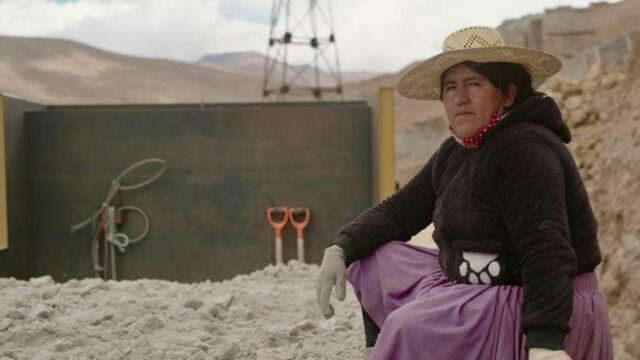
Schanze and his team have also shot some remarkable footage deep within the mines. “Conditions under which work is done in those mines is not far from conditions a couple of hundred years ago,” he notes. Risks of accidents are very high. The exploitation of the workers is one aspect of “colonial history that you can see in the present.”
Shooting with GoPro cameras, the filmmakers capture startling imagery of wagons rattling down pit shafts and of sweat-drenched workers digging in near darkness.
One young miner shown in the documentary talking about why he works in the pits has recently had a “very severe” accident. “Both of his feet were basically destroyed and so he will never be able to work in the mines again…he is recovering. He can walk again but he won’t be able to do any physical work.”
Early in the documentary, the director includes close-up imagery of the famous text written in the late 16th century by the Inca, Guaman Póma de Ayala.
“It is the only known written source from an indigenous perspective of the colonial era,” Schanze explains why this book is so important. There are plenty of other historical accounts from the era but they are all written by Europeans.
The book is kept in the Danish Royal Library and the filmmakers were given permission to take images of it.
This is a story in which other such paradoxes and ironies abound. One scene shows Bolivian kids playing with toys powered by Chinese batteries. The country may have a huge supply of its own lithium but, as Schanze points out, “you need a whole lot of other ingredients” to make batteries. These ingredients need to be imported – and that can be expensive and difficult. “That is one of the reasons other than corruption why it hasn’t happened until now…the countries that possess the technology are not willing to share it.”
Another issue the film explores is the impact on local farmers of the lithium mining. It causes water levels to fall, and that inevitably leads to problems in rural communities. So does the use of chemicals.
Schanze and his team will be working with Ben Kempas from Scottish-based outfit Film & Campaign on an impact campaign for Materia Prima. German-speaking distribution has already been secured through Cine Global.
Over the years, working through Mascha Film GbR, Schanze has made some very well received films, among them Buena Vida (2015) and Winter’s Children – The Silent Generation (2005). Even so, Materia Prima took time to finance.
“This project has been produced over almost six years,” he sighs. “When you dive into a new subject, a new location, you really start from scratch financing it. Of course, people know your name and your filmography, your awards and everything…we managed, but it is always a struggle!”