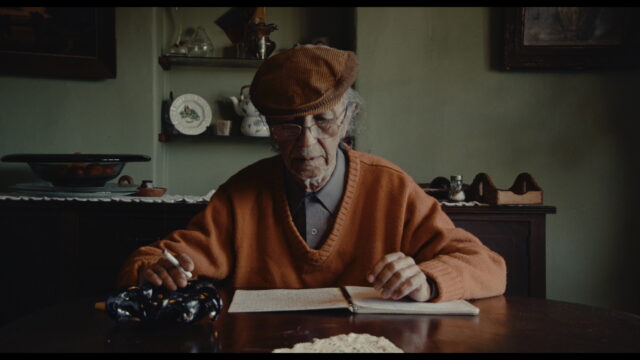
Chilean-Spanish filmmaker Gabriela Pena acknowledges that making a film as personal as Where the Silence is Heard (a world premiere in CPH:DOX NEXT:WAVE, and which she co-directed with her partner Picho García) was ultimately both healing and cathartic.
In the film, the Barcelona-based director returns to her family home in Chile. Here, she is fussed over by her elderly grandparents, who adore her, but she discovers more and more about what happened to the family during the Pinochet era. Meanwhile, her relationship with her mother, who is back in Spain, remains very strained.
Gabriela begins to renovate the old family home in Valparaíso. It has long since fallen into disrepair but is full of memories. This is where, a generation ago, her mother had been at her happiest – until she was forced into exile from Chile during the time of the dictatorship.
“We started to understand that travelling to this house and to this city was a way of wanting to connect with my mother,” Gabriela reflects. “From the beginning, we knew we had to combine the present with the past. That was the most difficult thing to do in the film.”
Her mother had enjoyed an idyllic childhood in Valparaíso: a beautiful port city. Gabriela grew up hearing her reminiscences. But there was a dark side too – one which they didn’t talk about so much. Her mother suffered considerable emotional trauma. Somehow, she now seemed to associate her own children with the loss she has endured.
This is Gabriela’s story but co-director García is helping her tell it. The creative duo run a production company together – Grieta Cine, based between Valparaíso and Barcelona – and they also have a young child, now two and a half.
“It is not easy and it was very intense. We talk about our lives. It is very personal themes…sometimes we didn’t know how much to film, what to film, why we are filming this. There is a lot of intuition [involved],” García says of the challenges entailed in making a film like this in which his partner’s private family history is laid bare.
“Also, something very important is that precisely because it is a very personal story, Picho helps to ground the film,” Gabriela suggests her co-director provides an important outsider’s perspective.
This is a story which echoes the experiences of many other Chileans affected by the Pinochet dictatorship. Its themes, the director believes, will also be recognisable to anyone who has experienced the same kind of family tensions between generations.
“One of the things that helped us find this universal path was precisely this relationship with other generations: the relationship between my mother and me and the relationship with my grandparents. I think it is something everyone can reflect on,” Gabriela says. “This is the most universal thing – a loving family and its power to overcome trauma.”
The directors draw a deliberate connection between Gabriela’s cosy intimacy with her grandparents and the chilling history they are uncovering. Her grandfather, now old and frail but retaining his sense of humour and mischief, had been arrested and tortured during the Pinochet era.
“Life has brought us joy as well as pain,” the grandparents, who were together for over 60 years, say early in the documentary.
Gabriela is shown having meals with them, helping them about the house, and basking in their affection. They share their letters, diaries and photos with her.
At certain points, she is also seen stripping wallpaper, assembling furniture and dusting staircases in the old, abandoned house. And, yes, she enjoyed the DIY. “One of the most amazing experiences in my life was to renovate that house,” she states. “After we made the renovation and started on the edit, we realised what that actually meant.”
On a symbolic level, it was a way of “repairing the relationship with my mother. The house, it was like a hug.”
“We loved that house,” Garcia agrees. “It was so special. It was our office. The film, it was about that house. We spent a lot of time there. We took strength because we felt safe in that house.”
The duo are back in Barcelona now, missing the house and figuring out what to do with it. For now, close friends are renting it but it remains “in the family.”
Backers responded warmly to the project from the start. It gained early momentum when it won an award at the Open City Documentary Festival’s Assembly Lab. “After that, everything was very organic. We started to participate in different programmes,” Gabriela recalls.
“Everything was online,” her partner points out that they were financing the project during the pandemic, “a very international moment” when it was possible to pitch all over the world without ever leaving home.
Post-Covid, the duo received a further boost when they were supported in 2022 by the Sundance Institute and also, in the same year, by (Egg)celerator Lab run by Chicken&Egg Films. Around that time, experienced Chilean producer Gabriela Sandoval came on board alongside Greek-Spanish producer-director Efthymia Zymvragak of Barcelona-based Gris Media.
Having completed the film, the two directors aren’t rushing into a new feature doc of their own although they are working as co-producers and editors on other projects. “We want to be very present for our son,” Gabriela says. “All our creative energy is drained by him,” her partner adds.
Where the Silence is Heard is the third film in a row that is deeply personal to the pair, following on from Zoila (2021) and the short, Familia (2024). “I think we’re done,” they explain their unwillingness to continue exposing the most intimate parts of their own lives on screen.
History, though, keeps on repeating itself. The two directors can’t hide their dismay at the recent turn in Chilean politics which has seen the election of Jose Antonio Kast, a new right-wing president who has spoken openly of his admiration for Pinochet, the dictator who brought so much grief to Gabriela’s family.
“This is awful. Honestly, we have been crying a lot…it’s terrible,” Gabriela sighs. “When we were making our film, we were seeing something bad was happening. From a couple of years ago, we were beginning to see the possible threat that this very extreme right-wing person could come to power…”