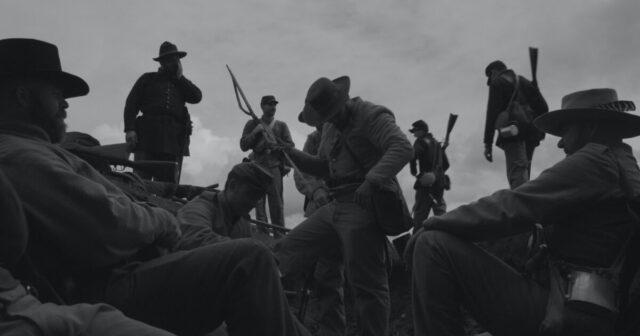
In The Great Experiment (an international premiere in F:ACT Competition at CPH:DOX), Stephen Maing and Eric Daniel Metzgar offer what they call “a kaleidoscopic portrait of life in America” during one of the more polarised periods in the last 250 years, from 2017 to 2020. Entirely shot in black and white, the film gives snapshots of different communities and generations, everything from ‘Gays for Trump’ activists to Black Lives Matter, from the so-called Stop The Steal riots in Washington to Civil War re-enactments, from kids playing in the snow to pandemic era online church services.
“It was in the aftermath of the 2016 US Presidential election. We were sitting together working on a different film and we were talking about this idea of how to process the moment,” Maing remembers how he and Metzgar first conceived the epic project (for which they ended up shooting over 1000 hours of material).
The directors saw the film as a “portrait of Americans living through particularly pivotal and tumultuous times.”
They were themselves trying to “make sense of the moment” as the first Trump administration began.
“At the back of our minds, there was this idea there would be a frenzy of news coverage on a 24/7 cycle. From the beginning, we had this idea of looking off to the side from what the news was looking at,” Metzgar recalls.
That’s where the decision to shoot in black and white comes in. “We wanted to create a way for people have a critical distance,” Maing suggests. “We wanted people to not have the familiar perhaps triggering responses that so many of us to have. The black and white was a way of creating a relationship that people might have with archival footage from much further back in time.”
He points out that had they shot in colour, even something as simple as the strident red of the MAGA (Make American Great Again) hats might have antagonised certain audiences.
Maing and Metzgar filmed all over the country. They did “the bulk of the shooting” themselves (as well as editing and producing) but had a ‘handful of key cinematographers” who also contributed.
“One of the things that was really important to us was to create a very open and spatial approach in the observational filming,” Maing observes. He and Metgar were looking for a way to “narratively map the different kinds of intersections of life in America that don’t fall into neat categories of politics and identity.” They didn’t want to focus on the conflict between left and right. The emphasis instead is on the people, the “humanity,” and how Americans find ways to “co-exist,” but, for obvious reasons, the politics are never far away.
The directors pay particular attention to the plight of immigrants who have to make huge sacrifices to reach the country and then face the threat of deportation.
During the January 6th riots, the protesters in Washington look as if they’re going to turn violently on the documentary’s cameraman (Ray Whitehouse) until he reassures them that he is a freelance. “That moment is really fascinating when the guy says, ‘if you were from CNN, it would be a different story,’ as if those guys on the right were going to control which media was allowed to be there and beat up people from the left,” Metzgar says. “It was a wild day. We were really amazed by what Ray was able to capture.”
The two directors realised, though, that protest footage is often “the lowest hanging fruit” for documentary makers (as Maing puts it). They therefore sought alternative ways of filming protestors. “We tried to push ourselves to find what on the margins seemed more interesting.”
The film (made through Chorus Of The Union Films) begins with a quote from George Washington from 1790: “the establishment of our new government seems to be the last great experiment for promoting human happiness in civil society.”
It’s six years now since the filming was done. Why has it taken so long to complete the project and where does the ‘great experiment’ stand today, during the second Trump administration?
“We took a slight step back after we finished filming because we sensed there would be a tremendous amount of fatigue with what everyone had just gone through. We didn’t have any intention to release it immediately,” says Metzgar. They had a “humungous” amount of material and it took time to work out what was there and how to structure it. One option (eventually discounted) was to make a multi-part film.
“We were both working on other films as well. We were cutting and trying to understand it,” Metzgar continues. “Time was passing and we were beginning to understand the DNA of it…and we were also reckoning what was the best moment to bring it back into the world so it was poignant.”
When Trump announced plans to run again, “it re-ignited the footage in a way. We were, of course, deep in the edit but we started to feel like we were making a film that was a historical document but was also really speaking to the present. That was something we could not have planned for in 2017 – but we are really pleased it speaks to the moment.”
Ask the two directors how they feel about America today and Maing cites French political philosopher, Alexis de Tocqueville who, in the 1830s, travelled across the country “to try to understand our functioning system of democracy and also our prison system.”
De Tocqueville concluded that the “greatness of America” lay not it being more enlightened than other nations but instead in “her ability to repair her faults.”
“I thought that was such a fascinating line because we are living at a moment where people feel really hurt and vulnerable, scared and at odds with their neighbours. There is so much repair work to do – and one of the most critical elements to being able to do that work is just being able to reflect. That’s something we wanted to offer with this film,” Maing states.
“I am really proud of the film because it really fights against the urge to reduce Americans to a binary or a single adjective…I am proud of a lot of our country. I’m really embarrassed and upset about a lot of other things happening. But what I like about the film is that it really presents a simultaneity of experience – and that’s how I experience the country as well.”
As they were shooting the documentary, the filmmakers discovered the more time they spent with different Americans, even those whose views they abhorred, the easier it became to find common ground. They learned to separate the people from the politics and not to be judgemental.
US distributors who’ve seen the film have called it “sublime” and “beautiful,” but that hasn’t yet meant they want to release it. In an algorithm driven world, a documentary as nuanced and reflective as this isn’t an especially easy fit.
“We made this film out of a belief in cinema, a kind of film we knew nobody was going to be making and maybe nobody was stupid enough to make over this number of years,” Maing jokes. “We hope that audiences will find it…”