It’s 30 years since Swedish director Viktor Nordenskiöld first visited Ukraine. He has felt a very strong attachment to the country ever since. He also used to travel in Russia, taking the Trans-Siberian railway when he was 19.
“I was very young when the [Berlin] Wall fell down and that was also a big part of my interest in this whole region. I was devastated, of course, when the war started,” Nordenskiöld says of the extreme shock he felt after the full-scale invasion by Russia in 2022. “If you grew up in the post-Cold War era, it was like, OK, there are new rules again.”
Like many others, he wondered if there was anything he could do to help. This was a period when Sweden was about to assume the presidency of the European Union – and Ukraine wanted to join the EU.
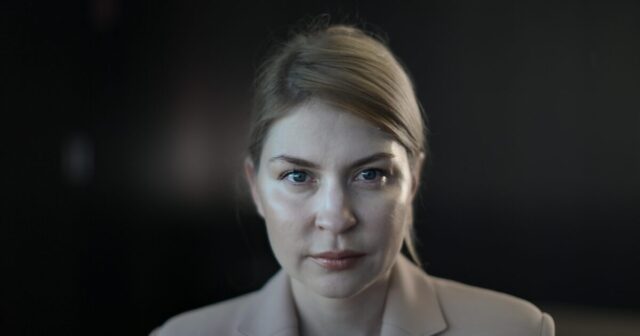
Nordenskiöld’s new documentary The Eukrainian profiles Ukraine’s deputy prime minister Olha Stefanishyna, who is the one spearheading the country’s attempts to gain EU membership.
The project is a co-production between Sweden (FreetownFilms), France (TAG Film), Belgium (Domino Production) and Ukraine (2Brave Productions), in co-production with ARTE G.E.I.E., RTBF, SVT and Umedia.
As we discover form the documentary, Stefanishyna’s life during wartime is very tough. With flights grounded, she has to travel to political summits on EU integration by train – journeys which can take days. She needs to work en route, but often there will be no light on the trains. Inevitably, she spends long periods of time separated from her family.
She was there in the Oval Office at that fateful meeting at the end of February when the Ukrainian leader was verbally attacked by the US President and Vice-President.
As the film starts, Ukraine has just been granted EU “candidate status,” but that is a long way from full membership. There is fierce opposition among some, notably Hungary, to the idea of Ukraine being accepted into the Union. The criteria for joining are very strict. Historically, Ukraine has faced issues with corruption and it is far from clear that the country will be allowed in.
“When I met her [Stefanishyna], I saw directly that she was somebody who could embody and personalise this complicated story. You felt her energy. She was unspoiled as a politician. She seems very honest and also very sharp.”
When it came to winning the trust of his subject, it helped that Nordenskiöld had made an earlier movie, The Feminister (2022), for which he had spent four years covering the work of Swedish foreign minister Margot Wallström, a politician celebrated for her fearlessness and for her strong feminist agenda. He clearly sees parallels between Wallström and Stefanishyna.
“I’ve been doing these kinds of films before. But then, of course, it’s also about personal connections – and if you click with the people you film…the trick to it is to show respect and interest. It’s an independent film. I can do what I like. But on the other hand, I want to make the best film possible and to understand the most possible. That is the sincere aim.”
In this case, it wasn’t just a case of striking up a rapport with Stefanishyna herself but making sure he had the support of her advisors and assistants.
Nordenskiöld set himself firm ground rules. He wouldn’t communicate with Stefanishyna when he wasn’t filming her. Theirs was to be a strictly professional relationship.
The director began his career as a reporter and news correspondent for Swedish TV and so has a strong journalistic background. He also knows all the tricks.
“Of course, if you interview a politician, they always try to get their way of thinking through. If you feel when you’re talking to someone that that feels a bit like politician’s talk, then you don’t put it in the film obviously because that is not so interesting – not for me and not for the audience.”
Like many other documentary makers following politicians, Nordenskiöld takes inspiration from classic verité filmmaking. However, he also uses voice-over narration.
“You can make the kind of films totally fly on the wall or totally current affairs. This is neither really. It is a little bit a mixture,” he says. “I like that actually. There are some artistic elements but there are some things you need to explain.”
Self-consciously artistic elements are thrown in too. The very striking opening shot of Stefanishyna’s face in big close up, talking about how she sees herself, is partly inspired by a scene in Christopher Nolan’s Oppenheimer.
Such shots took a lot of planning. Stefanishyna is “super busy of course” and doesn’t have much time to pose for the cameras or make sure that the director is getting the light he wants.
Every so often, he would be told, “ok, you’ve got 15 minutes,” in breaks in the deputy prime minister’s jam-packed schedule. She realised, though, that Nordenskiöld was looking for feeling and nuance, not just dry political facts.
“Now we’re experimenting a little, she told me,” he remembers her reacting to the artful scene in which she talks direct to camera like an actress in an Ingmar Bergman movie. The fact that he had been following her for two years gave her the trust to go along with the scene.
“It is not usual for a film about politicians and that’s exactly the reason I wanted to do it. I didn’t want to make this as a ‘normal’ film about a politician or as a ‘normal’ film about this EU process but as something different, something that really gets into your heart.”
One question for the director was how much contextual information needed to be included. When Nordenskiöld began the editing, the warfare in Gaza was capturing the attention of the global media and Ukraine was falling off the front pages. That meant he had to remind audiences of the circumstances behind the fill-scale invasion.
Making the film was a wrenching experience for Nordenskiöld. He is close to many Ukrainian filmmakers. “Some of them, they are forced now to exchange their cameras for guns actually which is also heart-breaking,” he states.