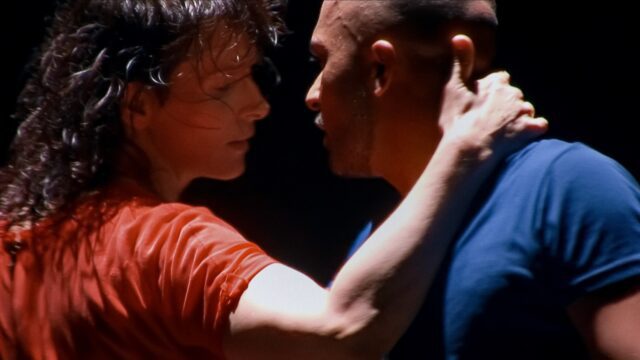
In 2007, Oscar-winning actress Juliette Binoche embarked on a bold and audacious theatrical experiment together with acclaimed British dancer-choreographer Akram Khan. For the emotionally searing stage piece In-I, both wanted to explore the boundaries of movement and acting, and so they both set out to study and inhabit each other’s area of expertise, to be the yin to the other’s yang.
Binoche didn’t want to dance, as such, she wanted to discover a form of movement that was unique to her, one that was rooted in ‘sensation,’ rather than precision. Khan wanted to communicate, not solely with his body, but primarily through words, story and reason.
Both set out to guide and mentor the other during a 6-month period of rehearsal. “If Akram took care of my body by relinquishing his own—knowing I could not match his speed, endurance, or breath—it also meant that, in terms of acting, I had to be patient with him, allowing him the time to find and reconnect with his internal bearings,” Binoche writes of the experience.
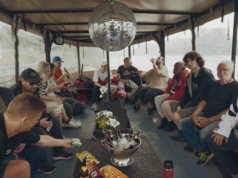
The pair had firepower support in the form of renowned African-American acting coach Susan Batson who helped them find “common ground” and to accelerate Khan’s immersion into the processes of acting. The other support was from Su-Man Hsu, whom Binoche refers to as “our compass,” a woman who was both kind and “joyful” and who knew “when to sound the alarm when time was pressing, when improvisation had to transform into concrete scenes.”
The four-way set-up led to a pronounced creative dialectic in the rehearsal room, with four continents represented by the considerable talents involved. Susan Batson was African-American while Taiwanese Su-Man Hsu had moved to Germany before moving on to London. Khan was British of Bangladeshi heritage, while the family of the ostensibly French Binoche derived from Brazil, and had lived in Morocco and Poland, she outlines.
“There were a lot of different kinds of spirits coming into that room, and that was our strength, but also a lot to deal with,” Binoche tells BDE. “Also Akram and Su-Man were coming really from the dance world, and Susan and myself coming from the acting world. Those forces had to encounter and boil and find ways to build bridges and trust each other. But also it brought conflicts and questions and patience.”
In her notes, she writes candidly about her professional relationship with Akram.
“On the surface, everything between Akram and me seemed to set us apart. Different skin colour, different religions, different artistic worlds, vastly different upbringings – he, from a close-knit family, and I, from a family of divorce. And of course, the dancer is known to work from the body first, while the actor begins from an inner life before expressing a sound,” she confides. “Throughout this encounter, we experienced seduction, fear, surprise, questions and disappointment.”
“The honeymoon phase disappeared quickly – Akram was wary of me, and I was wary of him,” she continues. “He sensed the danger of the ‘white supremacy’ I might represent; I feared the ‘male supremacy’ he embodied,” she continues. “Being an actress, did he think my creative potential was lesser than his? So many assumptions clashed between our two worlds. We were confronting our own limits, our inner walls. How would they come down? And for how long could we persevere? How many hours of sweat, improvisation, emotions – failed, shouted, silenced, spoken – did it take before we dared to step beyond our defences?”
Additionally, for Binoche, there was a philosophical dimension to the process, whereby she forcefully rejected any dualist notion of mind/body separation.
“It seems that in the Western world, we’ve been the champions of separating those two [mind and body] through medicine, or through religion, or through many kinds of other ways,” she tells Business Doc Europe. “To put [them] together is actually a task that was so, in a way, difficult, but also very exciting.”
Binoche knew she would never be a dancer per se, but she could possess a sense of “true movement coming from my story, my experience, my being, me, Juliette.” When she realised this, “we started to create.”
This process of creation derived from each embracing their new-found novice status. “To put ourselves into a ‘beginner’ situation was, of course, frightening, but very exciting at the same time.”
“We wanted to learn, we wanted to go ahead, to train, even though it was sometimes painful or frightening or felt ridiculous, or I was frustrated with myself that I was so blurry [and] I couldn’t remember movements. I was, of course, pissed off with myself, but at the same time, the patience, having faith, loving the challenge of it became all of a sudden a joyful experience.”
The film is divided into two parts. First there is the rehearsal and prep, and then there is the performance itself, which is (without exaggeration) mesmerising, and which was subsequently performed 120 times, Binoche underlines.
Not that it got easier every time. “There’s the anxiety of being vulnerable in front of an audience, of trying something new that really has never been made. And every single time before I went on stage, I thought, I’m not going to survive this one,” she tells BDE. “I survived the other ones, but not this one. All the doubts are coming up to you… [but] then you start telling the story, and you’re in it.”
During the performance, gone is her uncertainty, her earlier missteps, and the lack of fluidity we observed at the beginning of the process, replaced now by a beguiling meld of form and motion, physicality and charm, word and gesture.
Binoche returns to the subject of ‘sensation’ as an artistic spur. “For me, acting is not about learning lines. Acting for me is being in touch with a place in you that is related to the lines, but you’ve got to make a link that is very personal,” she says. “When you start from a sensation of memories that are related to a parallel life with what’s written on the page, then it becomes interesting, then it becomes personal and special because your cells have to be alive, have to be truthful. [It’s] not only just your lips saying lines.”
“So that’s why I was interested in dancing or moving,” she goes on. “How do you start from the same place, which is a sensation, a place hidden inside you, and lift it into a movement?”
When she met Robert Redford, he insisted that she should make a film of the In-I experience. She had taken an enormous risk once. Why not take another such risk with a directorial debut?
“For me, an artist has to try something new, to create something new,” she reflects. “If I can transform one person, or change someone’s life, I think, as an artist, you have achieved your task. Because the idea is to reach people’s hearts and lives, like an arrow.”
“Really, like an arrow,” she underlines, pointedly.