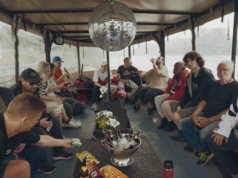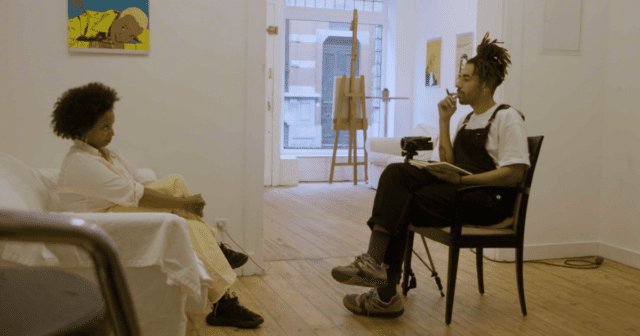
Tom Adjibi’s slyly subversive debut feature This Is Not A French Film [screening this week in Next Wave competition at CPH:DOX] exposes the bias and racism that non-white actors and artists still continually face in their careers. The director plays a version of himself – Tom, an actor so exasperated at being typecast that he decides to make a movie about it.
Sold by Odd Slice Films, this is a “fake” documentary but one which, beneath its playful exterior, is addressing some very serious themes.
In one of the most memorable scenes, we see Adjibi climbing a statue of King Leopold II, among the most notorious figures in the history of Belgian colonialism. He then sprays the statue with red paint. “I am a climber actually. That’s my sport,” he laughs when asked how easy it was it to clamber up the monument to perform his situationist-like stunt. His producers were dubious about the scene, which he did for “real.” However, it’s not a scene he wants to discuss in too much depth as it is the matter of an ongoing investigation.
Much of what the director depicts will be very familiar to those working in film and theatre. For example, Tom is shown at the start of the movie telling his film crew that making the documentary will be “a good opportunity” for them to showcase their talent. “It happens so many times and for actors as well,” Adjibi says of how, early in their careers, artists and performers are continually told that, yes, the money is very bad but that they should take the job anyway for the exposure it gives them. “Of course, this is not true.”
Adjibi portrays himself in the film as being clumsy and often a little goofy. In real life he can be, but not to the extent the film suggests. “It’s a part of me also, but I want to emphasise these parts,” he observes of his exaggeratedly offbeat persona on screen. “I have convictions, I have anger but sometimes my character is a little bit lost” is how he describes the Tom we see in the movie.
Another early scene shows Adjibi being accosted by teenagers on the street who spot his camera, realise he is making a movie, and want to become involved. He starts talking to them. Audiences may expect the kids to be obsessed with wealth, stardom and Netflix, but one suddenly starts performing a fiery monologue about the French Revolution. “Of course, it is set up, but my first inspirations for this scene was from Alice Diop’s Danton’s Death,” the director refers to Diop’s documentary about the strugglers of a young Black actor who always seems to be defined by his skin colour, not his ability.
Adjibi’s mother is French. His father is from Benin. He has continually encountered stereotyping at auditions. Sometimes, he is told he is ‘Black’ enough for a part. The Dardennes brothers gave him a small role in their 2014 feature Two Days, One Night as a doctor, a role he appreciated because, for once, it had nothing to do with his skin colour.
As his profile has risen, he has found it easier to get auditions but he is still asked to read for the same parts, often as Arab characters. “They couldn’t see me for a psychological role, just for my appearance.”
His indignation at such treatment is partly what prompted him to write This Is Not A French Film. He adds, though, that he has realised it’s not the casting agents’ fault. “It’s also a problem of the directors and the writers. I realised that when you write a story, you write about yourself.”
And, yes, most of the writers and directors are white – and they have little understanding of worlds beyond their own.
The movie features other actors from France and Belgium who’ve endured the same demeaning experiences. Directors won’t be able to pronounce their names or will tell them to change their hairstyles or will make them play stock characters, for example prisoners or drug dealers. “I chose all those actors because I wanted them to be on screen, to be seen,” he says of the rest of the cast.
Adjibi’s shooting style is loose and freewheeling, as if this really is a handheld verité documentary. This is partly because the budget was so low. It was also because he knew his cinematographer Sylvestre Vannoorenberghe (whose other credits include Mother Schmuckers) excels at this kind of grungy camera work, “very quick and with the camera on the shoulder. I had 100% confidence in him.”
The director talks of his admiration for cult Belgian movie Man Bites Dog (1992) from Rémy Belvaux, which likewise uses spoof documentary techniques for very mischievous purposes (in that case to tell a story about a serial killer).
As for being at CPH:DOX, Adjibi doesn’t even think about whether his film “is fiction or documentary” and adds that he doesn’t like his work being “put in a box.”
“I made the film in this style because I wanted to show a sense of urgency.”
He is also amused by the comments that have been popping up on the Letterboxd site from viewers saying they thought it was a doc and were non-plussed when it turned out to be something different.
Certain scenes, for example the premiere of the movie at which the white director talks in very patronising terms about minorities and “victimisation narratives,” were shot for real. He won’t reveal the identity of the director (whose face is blocked out) but says there are plenty of others like him.
Adjibi hopes that a filmmaking culture will evolve in France and Belgium where the “non-white stories won’t be talking about slavery or refugees. No, just random stories [like the ones] white people tell.”
This Is Not A French Film is produced by Joël Curtz, Walid Bekhti for CVB (Belgium and co-produced by Clothilde Bunod, La Société du Sensible (France).
“A lot that happened in the film happened in real life,” the director acknowledges that this wasn’t always a smooth production and that there were creative differences along the way. “It was a hard process. Sometimes, I felt not understood.”
Nonetheless, the combination of comic insight and polemic was successfully preserved in the completed movie. The director has been delighted with the response so far at CPH. “Now I want to share it with a room full of people who can relate [to it] even more…”