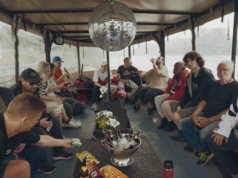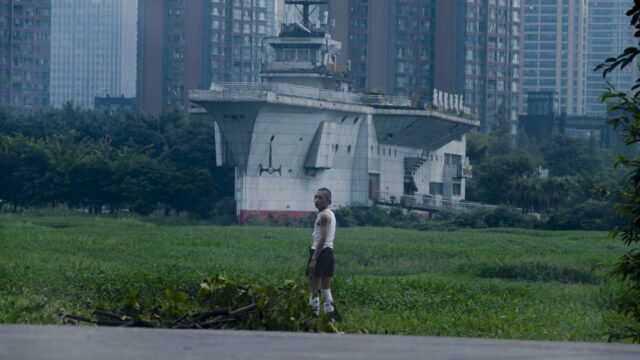
Welcome to Funky Town, the hippest club in Chengdu, China, and the centre of the city’s thriving underground party scene. It’s here that ex-pat US filmmaker Ben Mullinkosson would meet his friends to listen to techno music, drink, dance and make out. Their heady experiences are chronicled in Mullinkosson’s new feature documentary, The Last Year Of Darkness, a world premiere in Next:Wave at CPH:DOX.
“I had lived in China in 2011. When I moved back in 2017, my friends were, like, this [Funky Town] is the place to go and I immediately realised why. Every character in the film, we met at Funky Town, is drinking plum wine. Drinking was our way of meeting each other.”
Drag queens and DJs, queers and straights were all partying hard together.
Mullinkosson and his friends regarded the club as somewhere they could “find release in a society which might not understand who we are.” They were ‘not bothered by the rest of the world” and felt free to be themselves.
“It was really curiosity,” the director says of what drew him east in the first place. He was still in film school when he made his first trip to Chengdu. He was with his friend, Bobby Moser (who is editor of The Last Year Of Darkness). They were suburban kids from the US who then knew next to nothing about China.
“Chengdu was plucked a little bit randomly but I really fell in love with the city.”
In the documentary, Mullinkosson takes viewers into the heart of the city’s night life. He cites films like Kids, All This Panic and All These Sleepless Nights as influences on his freewheeling depiction of the underground party scene.
“Everyone on camera is a close friend of mine. We’ve been partying for years together…we hang out when we are not filming.”
The documentary came about after Yihao, one of Mullinkosson’s most flamboyant friends at Funky Town, discovered he was a filmmaker. “He asked when I would film him. I said how about Saturday night?”
Everyone in the film is a performer of some sort. They all love to dress up and put on a show. Nobody was camera shy. “We were not filming far away with long lenses. We’re up close with wide lenses. We’re very present.”
The filmmakers “loved to party too.” They’d start shooting at 9pm and follow their characters until they went to bed – which sometimes wasn’t until dawn. The closer Mullinkosson came to his subjects, the more they would find out about them. They would invite him to meet their families and would share stories about their private lives.
One of the main characters is Gena Baranov, a young blond-haired Russian, looking for love and adventure, and learning how to speak Mandarin at the same time.
“Gena in a lot of ways is a representation of myself. I think he’s more handsome and more queer than I am but we do represent a lot of the same things as foreigners in China who love underground partying.” Gena not only appears in the film – he’s the DP too, working alongside the other cinematographer, Yanqiu Fei, who doesn’t live in the same town and wasn’t always on set.
Mullinkosson takes Chinese lessons at the same language school as Gena. “I’m at a higher level. I don’t mean to brag. That’s actually my teacher [in the documentary]. She agreed to be a part of it.”
One of the producers on The Last Year Of Darkness is Sol Ye whom Mullinkosson met at the Slamdance Festival in 2014 when one of his student films premiered there. The documentary was a labour of love for both of them, shot over a period of more than 120 days and over the course of five years. They ended up shooting a mammoth 600 hours of footage.
Mullinkosson isn’t just showing the goings-on at Funky Town. The film is also a portrait of the city: its high rise apartments, freeways and parks.
“It [Chengdu] is a magical place. Frequently, I’ll run into situations that are very normal in China but uncommon in the US,” the director observes of moments like when he suddenly sees hundreds of locals practicing their badminton in a park. “In terms of the city, we knew that the construction site was going to finish in the next couple of years. We also knew that the construction, once it was finished, would impact Funky Town. The reason Funky Town was able to be such a thriving community was that it was hidden behind the construction site. It offered this safe, wild and fun place that the average passerby wouldn’t notice.”
The film will challenge many westerners’ preconceptions about China. Outsiders don’t realise that the Communist-led country has such a thriving underground youth culture.
“My original intention was just to make a film about my friends…less so about making some big political commentary. For me, it was more about sharing my experience and my community of underground partying – what it feels like to be 20 years old, to get fucked up and have some deep idea about the world while your friend is throwing up…it sounds really dumb to say but it’s really just my friends’ experience.”
Many of the characters featured in the documentary made it to Copenhagen this week for the CPH:DOX premiere. And, yes, of course they held a big party to celebrate.
“Around 20 people showed up. It’s really exciting for them because it’s their first time out of Asia…they’ve been having a lot of fun.” The filmmakers rented space at one of Copenhagen’s best queer nightclubs for their “after-party” following the film’s premiere. “It was a super memorable night. The protagonists DJ’d the party…”
The director divides him time between the US and China. He also works in commercials and is now hatching a feature film. “It’s going to be funny and sexy and that is all I can say about it,” he declares when asked what it will be about.