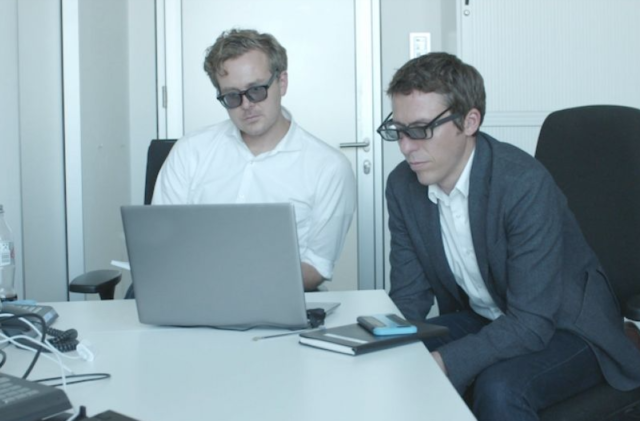
At the start of Behind The Headlines (which opened DOK.fest Munich last week) two investigative journalists at German newspaper Süddeutsche Zeitung have a rendezvous with a source in a Moscow Hotel. Meeting them is one of the world’s most celebrated and elusive whistle-blowers, Edward Snowden – and with them filming the encounter is the doc’s director, Daniel Sager.
“That was, of course, a special day that I think I won’t forget because he is really a person I look up to. I have a lot of respect for him and what he did,” says Sager, who likens Snowden to a philosopher. “I was surprised by how much charisma he had. He is such an energetic person, and very intelligent…it was very inspiring for me.”
This is just one of the strands within Sager’s documentary. The newspaper’s top investigative journalists are at work on other very big stories: everything from the killing of the Maltese journalist Daphne Caruana Galicia to the so-called ‘Ibiza Affair’, in which Austrian Vice Chancellor Heinz-Christian was caught on camera drinking vodka and Red Bull while hatching nefarious deals with a mysterious woman he presumed to be a Russian oligarch’s niece. (The ensuing scandal led to the collapse of the government).
It took Sager considerable time to win over the Süddeutsche Zeitung to the idea of being subjects in his film.
“We had lots of talks. Some of the journalists of the investigative editorial [team] were kind of sceptic,” the director remembers. These journalists were worried that the film team would get in their way and make it more difficult for them to protect their sources. “Also, there wasn’t any trust in the beginning.”
It was clear that Sager and his team wouldn’t be able to follow the journalists everywhere. The journalists, for their part, weren’t sure how he would be able to put his film together. “At the end, they said they want to try. We made this deal that they would just say ‘stop’ when we can’t follow [them] any more. We would go to a certain point and then they would leave us – to meet somebody to interview, for example.”
As the months passed by, the filmmakers and their subjects became more and more accustomed to one another. By the end of filming, when the reporters were working on the Ibiza video story, “we had a kind of relationship that works. We know how far we can go and they trusted us that we don’t go further.”
From All The President’s Men to Spotlight, several Hollywood films have been made casting investigative journalists in a heroic light. Ask Sager what surprised him most about the day to day reality of the reporters’ lives and he replies, “actually, I thought they would do more investigations outside of their office.”
Sager didn’t know how the documentary would unfold. “As we started the film, I had no clue which investigations there would be in the future…but then, very early during the finance process of the film, there was the tragic death of Daphne Caruana Galicia.” This was the assassination of a fellow investigative journalist in an EU country. It therefore had an extra resonance. The Süddeutsche Zeitung reporters were potentially putting themselves at risk by going after the story. Leading reporter Bastian Obermayer decided to work on the story.
Many of the investigations took a small eternity to come to the boil. Sager and his team knew about the Ibiza video a year before the scoop was finally published.
In recent years, documentary filmmakers have sometimes fulfilled a similar function to that of investigative journalists. With declining circulations and shrinking editorial budgets, not all newspapers can afford the time or money for the exhaustive, in-depth reporting shown throughout Behind The Headlines. However, Sager argues that there is still a major difference between documentary filmmakers working on their own and newspaper journalists like those at Süddeutsche Zeitung who have major publishers behind them.
“It’s very difficult for documentary makers to get funding for really huge investigations which take several years,” Sager says. “I feel also a difference in the role between a documentary and journalism, which is that journalism always has to show all perspectives of the story…in documentary, you can decide to show just one angle, one perspective of the story.”
The reporters from Süddeutsche Zeitung have the benefit of a patient and supportive editor, Wolfgang Grach, overseeing their work. “I think he is a very fair editor. He is very sharp in his thinking. He can express himself very well,” the director says of Grach, the man “upstairs” who is always available for “open discussion” with his reporters – and will guide and protect them as well as say ‘no’ when it’s necessary.
Sager himself is a journalist as well as a filmmaker. He works for different international broadcasters. Recent assignments have included stories about how cocaine is smuggled into Europe and about corona patients in a lung clinic beside the Baltic Sea. However, he draws a sharp distinction between these projects for TV and a feature film like Behind The Headlines which has taken years to complete.
“The whole working process [on a feature documentary] is very slow. You think about every decision. Working for the television, on reports, I don’t have the time. I have to make every decision very fast. Also in the editing, I do just one cut,” Sager notes of the demanding broadcast deadlines. By contrast, he spent “more than half a year” cutting Behind The Headlines. “But, for me, it’s very important to have both,” he says of why he continues to combine his film work and journalism. “I want to tell more stories. I like to travel and be involved in many projects. At the moment, for me, it’s not enough to tell just one story in five to seven years.”
World sales on Behind The Headlines are handled by New Docs.