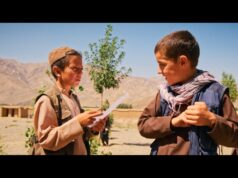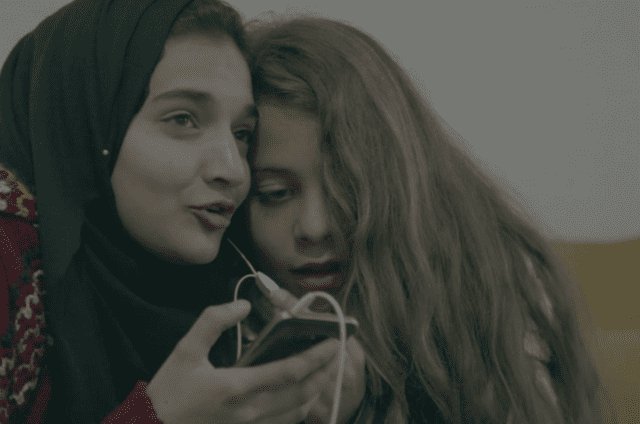
Ada Ushpiz’s Children has its world premiere in DOK Leipzig International Competition having already received huge praise from the festival’s director, Christoph Terhechte, who called it “heart-breaking.” In the film, Israeli director Ushpiz follows kids in Palestine who’ve been drawn into the insurgency against the occupying Israeli forces.
“Since the first popular uprising in the occupied territories, known as the Intifada, Palestinian children have been known to throw stones at Israeli settlers and soldiers. During the ‘knives Intifada’ that erupted in 2015/16, it was obvious that more and more children, especially girls, aged 11-14, got involved. One of them is my protagonist Dima Al Wawi, 12 years old at the time,” director Ushpiz says of how school children somehow ended up on the front line.
“She’s not a girl, she’s a terrorist,” was how Ushpiz heard a journalist characterise one of the Palestinian kids on TV during in 2016, when the ‘knives intifada’ was still ongoing. She was shocked by the way the Israeli media at the time tended to dehumanise those children and decided then and there to make the film.
Hearing that Dima was about to be released from prison, the director got in touch with the girl’s parents. She filmed the moment Dima was given her freedom, planning to use it as a trailer to raise seed money.
“It was very difficult to raise money for this film. I guess that the sensitivity of the subject did not help,” Ushpiz remembers, describing “the atmosphere of Islamophobia in Europe and America” and how that was matched by “pure hate for Palestinians in Israel.”
The word ‘terrorist’, the director realised, had become a code word for avoiding any real discussion of what was happening to these children. No-one on either side wanted to look for “any nuances and subtleties that may convey the complexity of the issue and the bigger picture.”
Ushpiz is an experienced director who has made tough movies before. Nonetheless, even she was shaken by what she witnessed.
“And yes, with all my experience, when it came to children it shocked me. I felt it is crucial to make a film of the daily life of Palestinian children under occupation and show those children for who they are, just children, victims of impossible life under occupation in a society that becomes inevitably more and more committed to fight against occupation and to defend its national ethos and narrative.”
The director was completely honest with Dima’s family. She told them she wanted to break stereotypes and “show the real life of Palestinian children under occupation.” She was equally frank with the teachers at Ada’s school.
“I had long conversations with them, with some of them I even argued about political issues. With others, I shared my belief in [the] two states solution, but with all of them, I shared my objection to any kind of censorship of the Palestinian curriculum under the pretext of incitement,” the director recalls.
“While in the Israeli schools the map of the whole Israel is the official one, the Palestinian schools are under the provision of the Israeli ministry of education. Teachers are not allowed to speak with children about their brothers and fathers who are locked in jails. Palestinian flags are usually deleted from their books. They are not allowed to discuss the destruction of Palestinian homes as collective punishment. They are not even allowed to teach the work of national protest poets or religious poets from antiquity who wrote of their love of the land.”
Children is shot very discreetly. Ushpiz films the kids at home or in the classroom with a subtlety and lyricism that is likely to remind some viewers of Nicolas Philibert’s famous film about French school children Être et avoir. “I must admit that Philibert was not on my mind when I made the film, although I appreciate his work a lot. I use this unobtrusive approach in many of my films,” Ushpiz states.
The documentary was cut together from more than 200 hours of material that the director shot. “The work with children was not easy. I had to work a lot to gain their trust. They also may lose interest all of a sudden and disappear which cost me many shooting days.” The director adds, though: “there is one great quality of kids – they feel instantly when you love them, and they pay back.”
Ushpiz has already shown the documentary to the families in the West Bank. “I cannot describe how rewarding it was for me to hear from them that the film moved them strongly and that it completely represents the pressure and the emotional lockdown of their children. I will try to ask permission from the army to invite them to the premiere at the Jerusalem Festival in December, provided it will be a hybrid festival.”
Director: Ada Ushpiz
Producer: Ada Ushpiz
Co-Producer: Philippa Kowarsky
World Sales: Philippa Kowarsky
Broadcaster: Channel 8, RTS (Switzerland)
Funder: NFCT
Cinematographer: Danor Glazer
Cinematographer: Bilal Saed
Editor: Neta Braun
Sound: Aviv Aldema
Music: Avi Balleli