

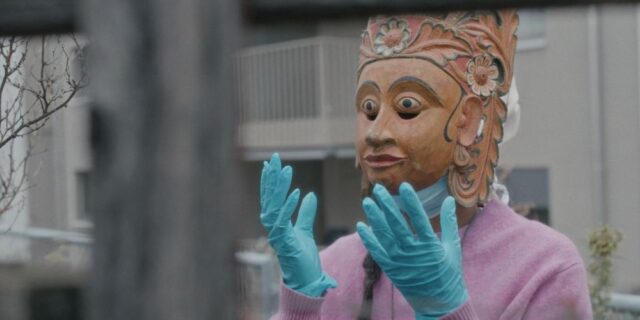
Swiss audiences may be startled by Gregor Brändli’s new feature, Elephants & Squirrels, premiering in International Competition at DOK Leipzig and sold by Filmotor. The film looks at the very troubling legacy of the Swiss naturalists Paul and Fritz Sarasin who looted huge amounts of sacred objects and even body parts from Sri Lanka in the late 19th and early 20th Century.
The Sarasin cousins were acting in the name of science. They saw themselves as following in Charles Darwin’s tradition. Their attitude toward the Sri Lankans was at best patronising, at worst, openly racist. Their plundered artefacts are still stored in museums in Basel – and the Swiss have been very reluctant to give them back.
Late last year, The Museum of Cultures and the Natural History Museum in Basel finally returned 90 aboriginal artefacts, including human bones and tools, to Sri Lanka – but this is just a tiny part of what is still held. As the film tells us, Swiss museums estimate that in their collections, there are still more than “4000 ancestral remains from a colonial context.”
“Our bodies became somebody else’s property,” Sri Lankan artist Deneth Piumakshi Veda Arachchige bluntly states in the film. She is its main protagonist, taking viewers on a disturbing and sometimes surreal journey into the dark heart of Swiss colonialism. In particular, she explains how the indigenous Adivasi (formerly known as Vedda) people of Sri Lanka were targeted by the naturalists.
The Sarasin cousins didn’t just collect ancestral remains. They were also interested in the local wildlife and wanted to bring home everything from giant squirrels to elephant embryos – hence the film’s title.
“We didn’t know each other, but in March 2020 I was listening to a radio interview about the Sarasins,” Brändli explains how he first came across Piumakshi Veda Arachchige. After listening to the interview, he contacted one of the participants, author Bernhard C . Schär, who had written about the Sarasins.
“Don’t talk to me. Talk to Deneth,” Schär recommended the director talk to the artist.
The subsequent collaboration between Brändli and Deneth Piumakshi Veda Arachchige proved remarkably straightforward. It would have been difficult to have made the movie without her, and she was happy to be the face and voice of the film rather than its director.
They were invited by the Adivasi representatives Ito visit their community. “Don’t only look at the reality of the past. Also, show our daily life,” they were advised.
In the documentary, the director also shows the massive building project underway for the new Natural History Museum and the State Archive in Basel. Brändli’s camera captures the digging and huge underground excavations. “I was thinking more and more about architecture and buildings as a manifestation of power and wealth,” he says.
Sri Lanka has its own museum – but on a far less monumental scale.
“I wanted to see the museum in Sri Lanka and I also wanted to see the museum in Basel – and to show these two realities.”
The film is a co-production between Soap Factory GMBH and SRF Schweizer Radio Und Fernsehen. It received backing from the SUISSIMAGE Cultural Fund with additional support of Federal Office Of Culture (FOC) and Fachausschuss Film und Medienkunst Basel & Basel-Landschaft, and the Ernst Göhner Foundation.
Brändli acknowledges that the project benefited from SUISSIMAGE’s “Momentum” programme for projects of pressing urgency, and that the budget came together quickly. “It was kind of a jackpot!”
There are several eerie moments in the documentary as we see Adivasi skeletons, skulls and clothing that are kept in vaults in the Swiss archives. (Disturbingly, some of the objects even seem to have been lost).
“For me, it was like a similar experience I had years ago at the Natural History Museum when I worked as a photographer and was asked to take pictures of a Mummy. They took out human remains, a mother of two or three kids…there I realised that our museums build invisible walls – but when you smell it, it is different. It becomes somehow alive,’ the director reflects on how the objects take on a strange power when you see them at close range.
Certain Swiss public figures still try to play down the scale of the looting. We hear them claim that Switzerland doesn’t have such a big problem with stolen artefacts after all. “There are only a few of them in all of our museums,” claims politician Beat Jans.
The Sarasins gathered the Sri Lankan ancestral remains and precious objects for themselves. This was originally a private collection. However, after it was donated to the Swiss State, it became publicly owned. Few Swiss citizens seem to realise that they are therefore guardians of the stolen artefacts.
“We always grew up with the narrative that we didn’t have colonies and so we’re the good guys,” the director notes. He hopes the film will spark discussions about this little-known side of Swiss history.
Even before its premiere, the documentary has had an impact. The decision to return a few of the Sri Lankan possessions appears to have been influenced by the persistent and troubling questions the filmmakers were asking about the museum holdings.
“It’s tricky to answer because there is no evidence that we can prove…but I heard many times through institutions that they were talking about the movie.”
Now, when distributor Royal Film releases the documentary in Switzerland, Swiss viewers will be confronted with a story many have preferred to ignore.
Brändli isn’t sure how audiences will react. When the Swiss national museum held an exhibition about colonialism, the public reacted with indifference. “I was quite surprised by how low the national response was – there wasn’t a big discussion, it’s still like something…far away!”
After DOK Leipzig, the film goes on to screen in Best Of Fests at IDFA. The aim then is to take the documentary to Sri Lanka, “to do a tour and to show it in the villages where we filmed.”





