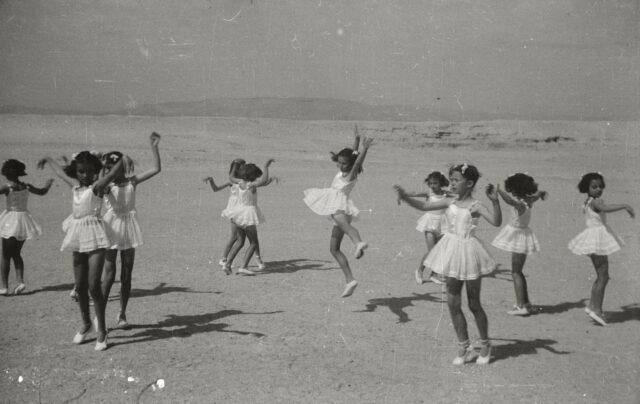
A fascinating and impressively mounted delve into a long-forgotten piece of communist history, El Shatt – A Blueprint for Utopia tells the story of El Shatt in Egypt where, in 1944, and based on a deal between the Yugoslavian partisans led by Tito and the British allies, a piece of desert became not only a refugee camp for the families of anti-fascist fighters from Dalmatia, but also where a model was created for the future Socialist Federal Republic of Yugoslavia.
Using extensive archival footage, photographs and audio testimonies from those who were there, director Ivan Ramljak tells how, after the Italian capitulation and before the arrival of German army, 28,000 Dalmatian Croats left their home villages and towns to live for two years in tents in the middle of Egyptian desert in a kind of a communist model village.
It is an engaging real-life story, handled with humour and insight, with the archive material interlinked with staged scenes played by the ensemble of a theatre that was founded in El Shatt at the time.
The film opens with footage of a man walking along a dusty desert road. At an ordered and elegant graveyard another man tidies up around the gravestones. Archival photographic material tells the unlikely story of how the Dalmatian Croats left their home villages and towns and took the uncomfortable journey across the Mediterranean Sea fleeing from the war and arrived in Egypt at this model village. As one recalls with a laugh: “I saw nothing but sand and I started crying.”
According to the synopsis, “this is where a model was created for the future Socialist Federal Republic of Yugoslavia – a state that was to build its founding narrative on the people’s liberation fight against fascism and declare collectively organised self-administration its social ideal.”
The audio memories are from many who were young when they arrived at the camp, and their recollections are often offered with warmth about this unusual adventure. From swimming in the Suez Canal through to St Nicholas arriving on a truck to deliver gifts, it was a time of adventure and a certain freedom for the younger ones. The voices of those who were children back then (and who are over 80 today) tell their stories of the struggle for survival, solidarity and lived ideology, and of a daily life that included self-organised schools, workshops, canteen kitchens, and even a newspaper.
One recalls, “I still know the Egyptian national anthem by heart,” while another adds that they sang the anthem on stage “but had no idea what the words mean.” To prove this, they give a brief rendition of it.
But it was an idealistic adventure that was not to last, and when they returned to their homelands after the war some 900 dead were left behind at El Shatt, mainly due to lack of antibiotics. The community made their own graveyard in the shape of a star, with a pillar in the middle acting as a platform for a carving of Mother of Pain – a monument that is still there, high on a pedestal.
As Ivan Ramljak writes: “I believe in the thesis that the camp in El Shatt was, among other things, a kind of model-settlement, serving the purpose of demonstrating to the Allies what Yugoslavia would look like once the war ended. It was an attempt to create a utopian community or, as (Croatian politician and one-time resident of El Shatt) Savka Dapcevic Kucar said on a couple of occasions, ‘if the idea of communism was ever realised anywhere, then it was there’. Fascinatingly, several of the survivors told me that their life in the desert was better than it is today”.
Croatia, 2023, 96mins
Dir/scr: Ivan Ramljak
Production: Kino Klub Split, Horopter filmska produkcija
International sales: Split Screen
Producer: Tibor Keser
Cinematography: Boris Poljak
Editor: Jelena Maksimović