At MIA 2023, German docmaker and producer Norbert Busè is pitching his new project, a 52-minute doc titled Jesus Goes to Hollywood. This one-off TV special asks the viewer ‘does every generation need its own Jesus?’ The fascinating film heritage about the historical figure seems to suggest just that.
After studying philosophy, education, German and theology between Heidelberg, Frankfurt and Mainz, Busè began worked as a teacher and media consultant until 1991. Then he went began to work exclusively on film projects, and has delivered over the years a number of films commissioned by public broadcasters. Some of his most recent works include Enrico Caruso – The Eternal Voice (2021, commissioned by SRF, ORF, ZDF/ARTE), Heinrich Mann – The Unknown Rebel(2021, commissioned by ZDF/3sat) and Cuba’s Long Shadow of Memory (2018, commissioned by ZDF/ARTE)
“Almost 50 years ago, Jesus was celebrated on film as a pop star, and later as an agitator and victim of a Jewish conspiracy, which caused a worldwide scandal,” Busè tells Business Doc Europe. “Famous directors such as Pier Paulo Pasolini, Jean-Luc Godard and Martin Scorsese have brought him before the camera. No life has been filmed as often as his. The Jesus film adaptations are very diverse and always a reflection of their time.”
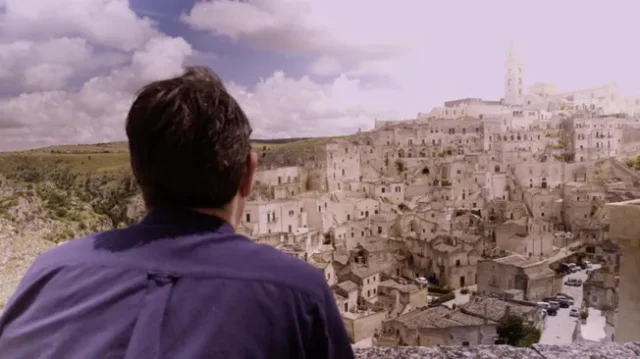
Surprisingly, over the past 60 years, it hasn’t been Bethlehem or Nazareth which has served as the location for films about Jesus. Rather, directing luminaries such as Pasolini, Mel Gibson and Milo Rau have made the pilgrimage to Matera, a small town in the Basilicata region of southern Italy (as, interestingly, does James Bond in the latest 007 opus No Time to Die).
“Sixty years ago, Pasolini filmed The Gospel According to Matthew in Matera. Since then, an astonishing amount of Jesus films have been made in this village in the South of Italy. Watching the footage of all sorts of films shot in Matera you could say that Jesus was born, grew up and died in Matera. In Jesus Goes to Hollywood we will take this literally. In one arc of our film we tell the life of Jesus with archive film material shot in Matera.”
“Jesus Goes to Hollywood is a film for believers and non-believers. With its different perspectives on the figure of Jesus, on religion, culture and society, the film takes on universal themes that appeal to a wide audience, old and young. The film excerpts – some popular, some controversial – promise a visually powerful journey through time, and tell us about cultural revolutions, the freedoms of artists or the ideological agenda of producers or filmmakers,” the producers explain.
They underline how, for director Busè, Matera is “a fascinating place where he can get to the bottom of these questions in the here and now.”
Zooming in on the themes and questions the TV special aims to explore, they add: “The film reflects on the enduring fascination with the historical Jesus and the power of his cinematic representation. We want to make a film that blends the past with the present, faith with scepticism, and portrays a village’s enduring love affair with cinema.”
“Matera’s constant expectation of the arrival of Jesus is the narrative of the present day in our film. And Matera will be our cinematic home from which we will venture to Rome to visit a costume maker, to Oberammergau and other places. What are the intentions behind the films that an atheist communist, a devout believer or comedians make about Jesus? What are the artistic ambitions or the political implications? On location, we will talk to film historians and to filmmakers.”
The protagonists starring in this TV special include Netflix series Messiah star Mehdi Dehbi (who portrays Al-Masih, a man who first appears in the Middle East and whose followers claim to be the eschatological return of ʿĪsā, the Jesus that Muslims believe in), along with hand-picked experts such as Piero Taddeo of Matera’s Museo del Cinema; costume designer Laura Nobile of Rome-based Tirelli Costumi; Pasolini expert Peppe Notarangelo (son of late photographer and journalist Domenico Notarangelo); historian Michael Mente, cultural scientist Maria Mäder and local tour guide Vito Rondinone.
Their contributions will be accompanied by a wide archive of films and interviews with filmmakers such as Martin Scorsese, Mel Gibson, Garth Davis, Eric Idle, William Dafoe, Joaquin Phoenix, Ted Neely, Enrique Irazoqui and Jim Caviezel, who played Jesus in Mel Gibson’s The Passion of the Christ.
Jesus Goes to Hollywood is produced by Corinna Dästner for Switzerland’s DokLab and the director himself for Germany’s Studio.TV.Film, in co-production with Swiss Radio and Television and ZDF/ARTE. Budgeted at approximately €290,000, the ZDF/ARTE’s commissioning editor is Sabine Bubeck-Paaz, whilst that of Swiss Radio and Television is Christian Walther.
The project’s tentative timeline sees production kicking off next year, with delivery expected over the summer/autumn period. In Rome, the team is looking for TV pre-sales, sales agents, co-producers and distributors.