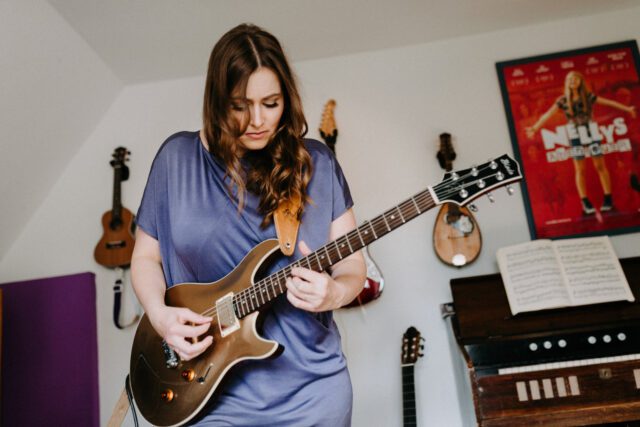
Freya Arde, photo: Juliana Socher
German Films is again promoting its talent to the world in 2021 via its Face to Face series. This year all the talents are women, and each represents a core specialism within the film industry. Freya Arde, the first composer to be selected for the programme, harmonises with Business Doc Europe.
“No I don’t necessarily like documentary more than fiction, but somehow these projects come to me,” says composer Freya Arde who, despite finishing musical studies less than 5 years ago, has already gathered a slew of nominations for her film scores, picking up the German Film Music Award as Best Newcomer for her debut film Nelly’s Adventure (2016).
Arde’s compositions are both lyrical and melodic and are often set like a jewel within an intricately designed and satisfyingly complex soundscape, such as her work on Jörg Adolph’s The Hidden Life of Trees (2020, trailer). “Film is something that you really can watch or listen to with all your senses,” says Arde. “It is very sensual – and music is too. I think music can bring out some [elements] that you cannot transport just with the picture. I add that which is not seen.”
Like other outstanding purveyors of film craft, Arde is also a keen (and ego-light) collaborator who actively welcomes her editor’s intervention and the potential effects he/she can have on her work. “I like to be involved an early stage because I really love what editors do with my music,” she says. “It can sometimes really surprise me.”
But as much as she appreciates the documentary form, she stresses how she must really “love” the film she is working on in in order to deliver her best work. She is not there to mask the inadequacies or weaknesses of a film. Rather, “the stronger that a film is in itself” the easier it is for Arde to open up the work to further layers of meaning, or to apply even greater richness or nuance, using her music. In this she cites Steven Wouterlood’s much-lauded youth feature My Extraordinary Summer With Tess (2019) for which she wrote a score which is both beautiful and wistful, and with a rising exuberance as the film approaches its summer zenith.
Arde would like to work on bigger budget projects but her aim is not to make “really epic scores.” Hers is more a minimalist approach which she applies to intelligent scores for intelligent and independent films. And never shy of applying electronic sounds to her work, Arde joins the ranks of ‘sisters with transistors’, as coined by Lisa Rovner in her 2020 documentary of the same name about pioneering female techno musicos.
“The most important thing really is that I am in love with the film. I really need that connection. [But] of course the higher the budget is the freer you are in realizing the score,” she comments. “I would really like to use larger ensembles but it’s sometimes not possible and you have to think of a solution how to do this is in an interesting way. But because I work a lot with audio processing I think I am managing to write a good score even when the budget is not too high.” (Audio Processing refers to the mechanical process of changing or enhancing the characteristics of the audio.)
She adds: “I prefer acoustic organic sounds, but I never wrote a score that only has acoustic instrumentation. I really like doing something with these sounds and experimenting with acoustic sounds. This is really my thing. I do this every day. And because I don’t have sessions musicians over every day, a lot of things I play myself.”
Arde admits to feeling more excited or “touched by” documentaries out of an inherent sense of responsibility to the real people or the victims who may be portrayed in them. “It gets closer to me when I work on something that has really happened,” she says.
She further points out how, personally, she can be very critical of her scores, not necessarily out of something she did wrong, rather the limitations that can sometimes be placed on her creativity.
“The more people discuss the music within the process, the more challenging it is for me to find a solution that makes everyone happy,’ she concedes. “Sometimes I work with young directors and it can happen that producers or commissioning editors don‘t trust them completely. So there‘s a lot of artistic involvement by others. The ideal case is when the director’s vision is supported by everyone from the team. That’s the easiest way to work for me.”
“But The Hidden Life of Trees was a very nice project that went well, very smoothly from the beginning,” she adds, pointing out how eventually watching the film at the premiere with a live audience was a “comfortable” experience. “And the editor Anja Pohl was one of the most intelligent people I’ve come across. I learned so much, both about film and editing, and of course about trees too.”
After accepting the Face to Face invitation by German Films, Arde was asked about the question of diversity in Germany. Her answer was frank but also indicative of an inherent sense of professional loyalty. “It could be better. I mean 2020 was quite a good year for female film composers. They won all the big awards and it’s great.”
“But I think there’s still a lot to be done,” she added. “We have so many young talents with different backgrounds, from different cultures, who are immensely talented. They just want to tell their story. They need to be given the opportunity to do that. Personally, I am recommending my female colleagues by promoting their work to other colleagues in the industry.”