

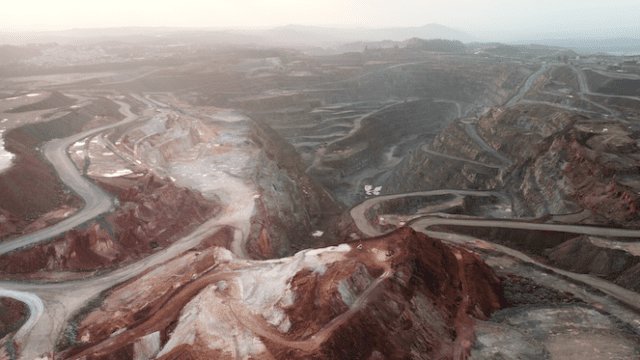
“Does Europe have to get dirty before getting green?” That’s the key question asked in Scars Of Growth, the new feature documentary from Linda Osusky and Monika Grassl screening in Competition- Focus at FIFDH Geneva this week.
One of the subjects the film explores is “green mining.” If this sounds like a contradiction in terms, that is probably because it is. The EU’s goal is to become climate-neutral by 2050 but Europe has largely stopped mining metals and has a huge shortfall of raw materials used for new technologies. That’s why mines are being re-opened across the continent.
One argument justifying the new EU emphasis on mining is that if the Europeans don’t do it, others will do it instead, and probably in an even less environmentally friendly way. However, as ever, the potential for profit continues to drive decision-making in Brussels.
“I think the European Union is a prisoner of the system. The paradigm of the political economy is that you need to grow; you need to have industry to have jobs and create wealth. This is the narrative. The politicians are not stupid. I believe they do it with good intentions,” Osusky says of the EU’s embrace of policies that seek to protect the environment even as they risk doing huge harm to it. “Mentally, I think that it is an old generation that is guiding and directing the policies…we want to show that it is the wrong way. You cannot mine yourself out of the climate crisis…you cannot destroy nature to save nature. It doesn’t make sense.”
“I think the biggest problem is also that the EU politicians go where the money is. They understand more the industry lobbyists than the real people on the ground. There is an imbalance in who they listen to,” Grassl adds.
Osusky and Grassl already knew each other before embarking on the project. Both had previously worked for maverick Austrian director Hubert Sauper. “We always had a plan to work on a project together one day,” Osusky says.
The director had been doing some research into the elections in Spain in 2019 and had been based in Barcelona. Her research took her to Extremadura, one of the poorest regions in the country. To her surprise, she discovered plans here for uranium, copper, nickel and lithium mines. This wasn’t traditionally a mining area but she was told all this exploration was going on because of the “European Green Deal.”
It was at this point she suggested to Grassl that there could be scope for a documentary.
The duo took the project through the Documentary Campus programme and pitched it at the Leipzig Networking Days.
“At the beginning, we absolutely wanted to do a cinema movie. We wanted to follow the village in Spain and see how it develops with the mine,” remembers Grassl.
However, the mine was going to take 10 to 15 years to develop. This was an urgent and timely subject that some supporters felt would be better suited for TV. Austrian outfit Dor Film came on board as producer and there was support from SWR, ARTE & ORF.
“It’s a very complicated topic and it gives you the space to go really in depth and to get on to an emotional level as well,” Osusky explains the benefits of telling their story in documentary form rather than as a piece of written investigative journalism.
“Also, the visual part is very important. If you talk about mining and you have never seen it, how it looks, how immense and how massive these holes are in the ground – if you read it, you can’t get the same impression as when you see it with your own eyes,” Grassl adds.
The filmmakers talk of the “violence” against the landscape caused by mines.
This is a story set on a very big canvas. Its subjects include everybody from Spanish goat farmers to reindeer herders in Sweden. “As it is an environmental topic, of course, we tried to do it as environmentally friendly as possible,” Grassl explains how the team kept their own carbon footprint down. They travelled by train wherever possible and shot in “blocks,” making sure they stayed a decent amount of time in each location.
Osusky focused more on the “journalistic part, the research,” while Grassl “did more of the technical part.” Both point out, though, that divisions of responsibility soon blurred.
“It was really a good collaboration and I think it was very complementary, the work. Also, I am very happy that we were a team because I think such a big project alone is not easy to handle.”
It helped that Grassl, based in Paris, was on hand to travel to Brussels whenever there were new developments in the EU’s proposals for a “Critical Raw Materials” Act.
The filmmakers are encouraged that more NGOs and critical voices are now being invited to participate in events like the European Raw Materials week. “This is a big step that was not happening before,”Osusky says.
And, yes, an impact campaign is being planned for Scars Of Growth. One idea is a website, “maybe a little bit interactive.” There are hopes to show the film at the EU Parliament, or at least somewhere in Brussels, “so it [the film] gets to the decision-makers and people involved.” Meanwhile, grassroots screenings are also being considered.
The project ended up as a TV movie but the filmmakers still tried to shoot it in as cinematic a way and possible. They show the rugged beauty of the landscapes but also the way the countryside is turned upside down by huge mining projects. There are interviews as well and a voice-over commentary. (This was something that the TV broadcaster partners were keen to include to ensure audiences could follow the sometimes complex arguments).
Among the “experts” featured is charismatic anti-growth academic, Timothée Parrique (who will be participating in the Geneva discussion accompanying the film on “A future without Capitalism.”)
“Academics are mostly boring! We saw him at an event in Brussels called ‘Beyond Growth’ and we thought, ‘wow, he is very eloquent – and it’s not boring.’ We thought he would be a good protagonist,” Osusky observes.
“We needed somebody who talks about growth in another perspective, not only how the European Union talks about growth. He is one of the few researchers in Europe who does research on that. I think the de-growth movement is about to develop. It is very young and I think it was important to put this in the film at least as a possible solution to the problem,” Grassl adds.
That said, the filmmakers refuse to be too downbeat about the shortcomings of EU environmental politics.
“Me personally, I am optimistic – but you have to fight for it. You have to go there and make yourself listened to,” Osusky states. “If you do not fight or speak up, nobody else will speak up…but I am totally optimistic that things can change – and have to change.”





