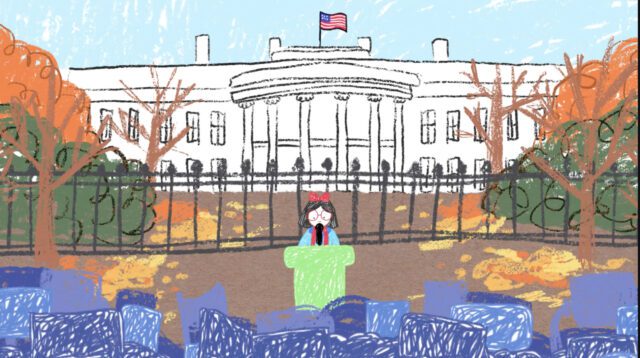
There have been many films made in recent years about the plight of undocumented immigrants, but one of the most surprising is Brinca Animation Studios’ Home Is Somewhere Else. This is a Mexican animated feature which looks at the struggles of young migrants and counts up the human cost when families are split apart. The directors were Carlos Hagerman and Jorge Villalobos.
Since its premiere at Annecy two years ago, the film has screened widely on the festival circuit. On March 11 during FIFDH Impact Days, Brinca Studios’ producer Mariana Marín Romero will present an impact case study on the documentary – and how the film has even been projected onto the Mexican-US border wall itself, as well as screened on both sides of the border.
“Not only did we do communal screenings but we went to private high schools and public high schools,” Romero says of her impact campaign. She notes that Mexico is a huge country and that most of the media companies are concentrated in Mexico City. She and her team were determined to make sure the film reached audiences across the country – and especially in the north, close to the US border.
“Actually, I am from Tijuana, on the border between San Diego in the USA and Mexico. When I first started working on this film [in 2020], I talked to them [the other filmmakers] about how the people from the north of Mexico have a different view on this topic,” Romero notes.
The impact producer was sure that audiences in the north would respond warmly to the film. She helped design a tour that saw the film screened nine times in six days in Tijuana alone.
“We did two screenings a day,” Romero remembers. Attending the screenings was José Eduardo Aguilar “El Deportee”, one the main subjects of the film. José was 16 when his father was deported to Mexico. He was later deported himself.
“In Tijuana, there is a lot of deported population. Some of them have substance abuse issues and they are also living on the streets. It is very common to see the deported community within the city,” Romero notes. She remembers that in the 80s and 90s, it was still unusual for people to be deported. When it happened, the assumption was the deportee must have committed a crime. Today, that has changed. Deportations have become more and more commonplace – but that doesn’t mean the suffering and humiliation is any the less.
Aguilar is a poet, storyteller, filmmaker and a very charismatic figure who encourages creativity among deportees. Audiences were fascinated to hear from him. They were also intrigued to see a film about migration and deportation done as a cartoon.
“For young people, it was a really different way [of engaging with the subject]. If they tell you at school that you are going to watch a documentary, you are bored already with the idea because of their experience with documentary. But when you have this animation, really nice and beautiful art, but you also have the voice of the protagonist, they engaged really quickly.”
Romero believes that young audiences also responded warmly to the film because its subjects were young people from exactly the same age and background as they were. “They have dreams, they hope to do different things in their future…I think animation helped us with audiences for them to really listen to the stories. When we did the community screenings, we noticed that they worked.”
Philanthropic organisation The Letty Coppel Foundation provided some vital funding for the community screenings. “Tijuana is really far from Mexico City and so it was an expensive thing to do but we were able to have that.” Extra financial support came via the Mexican film tax incentive, EFCINE 189.
The screenings at the Border Wall were supported by community organisation, Friends of Friendship Park. (The wall is built on the site of what used to be a park used by families on both sides of the border).
Yes, responses from audiences in Tijuana and San Diego were different to those in Geneva and Annecy. “We are really happy that we have had a really good reception within the festival circuit. They are different reactions…but there is always someone at the Q&As who can share their experiences, [saying] that they have lived the story,” Romero notes. “And this movie, it is not about migration. It’s about the uncertainty of being separated from your family.”
She adds that the film allows audiences to laugh and enjoy themselves in spite of its sometimes dark subject matter.
Romero kept a diary recording the responses at all of the different screenings. There were some workshops as well as Q&As where audience members were encouraged to write and create.
The filmmakers hope their film can help sway the attitudes of politicians and encourage more humane legal treatment of migrants. They’re not naive enough to think this will happen overnight.
“That was one of the questions we asked, can we really have an impact with legislators and with policies because this is a broad historical issue,” the Impact producer notes.
The US co-producers Shine Global helped organise a screening in Washington DC with US congresswoman Veronica Escobar at which the urgent need for immigration reform was highlighted.
Now, Brinca Animation Studios is planning further animated films.
“Mainly what we do is this, trying to make social issues accessible through animation. We live in a country that has a lot of different and difficult social issues. We think that this is a way for us to bring another way of talking about issues.”
One current project involves working with mothers who have had sons and daughters disappear in Mexico. “We are doing short films on that and talking about the possibility of doing a full-length documentary…we are still searching what will be our next [feature] project but for sure it will be about social issues in Mexico and we will be trying to do it through animation.”