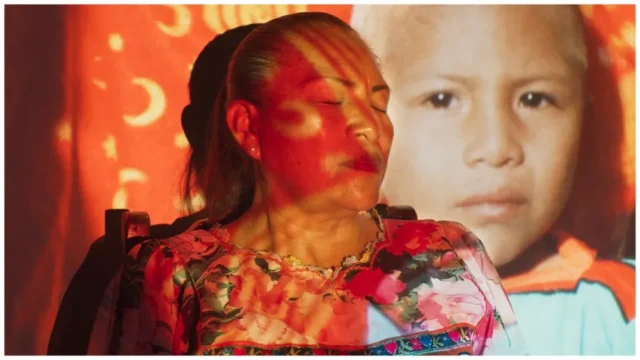
Since its premiere in Venice last autumn, Andrés Peyrot’s feature documentary God Is A Woman has been feted by critics and audiences alike and has sparked a strong debate about some of the issues it raises.
In the documentary, the Swiss-Panamanian filmmaker spends time with the Kuna community in Panama. This is a society in which women are considered sacred. While there, Peyrot hears about another documentary maker who shot a film with the community 50 years before. This was the Oscar-winning French director Pierre-Dominique Gaisseau, but Gaisseau’s film was never completed or shown. There was an uncomfortable sense that he had taken advantage of his hosts – that he had a white colonialist sensibility.
The community still spoke about the film that never was. As he made his own documentary, Peyrot met local academic and campaigner Arysteides Turpana who had long been searching for Gaisseau’s missing reels. Peyrot worked very closely with the Kuna community. One Kuna filmmaker, Orgun Wagua, became a key collaborator.
Now, Peyrot is at FIFDH (Geneva) where he is not only showing the film was taking part in a March 10 panel titled: The rights of indigenous peoples: decolonising perspectives and imaginations.
“We first went to Venice and then, when we went to Toronto [International Film Festival], we were able to have four members of the community to come to present the movie. To me, that was very special because I was able to see that they recognised themselves [in the documentary] and that they enjoyed the movie,” the director says.
After the TIFF screening, there was a Q&A with the audience. For Peyrot, it was crucial he wasn’t the only one speaking for the documentary. The Kuna were given a voice too.
In Geneva, the director was joined by Cebaldo Inawipi, an anthropologist, author and poet from the Kuna community. “He [Inawipi] was there when Gaisseau came to make the initial film in 1975. He was also a close friend with Turpana, who was Gaisseau’s right hand man for the shoot.”
Turpana died in 2020. Inawipi has continued the fight to preserve Kuna culture and identity.
Before he made God Is A Woman, Peyrot, like many other Panamanians, had only a vague knowledge about the Kuna people. “At the beginning, I was in a similar position that many other Panamanians are in. We know the Kuna community but in a very superficial way. We consider that it’s part of the rich diversity of Panama. A lot of Panamanians tend to see it as a bit of a tourist destination and as something folkloric. I certainly had that naive outlook at first,” the director admits.
Peyrot credits Orgun Wagua with changing his attitude. “He gave me the opportunity to go and meet the community, to meet his family and to start discovering so many stories. That was the start of a journey to dig deeper.”
The filmmaker began to realise just how badly the Kuna people had been treated for so long both by “colonising forces” and by the Panamanian government.
“At first, the reasons to make the movie were personal friendships and wanting to help and fulfil this need for a lost film. But as the story developed, I realised just how deep the social and political element were in telling this story.”
As for his role as an outsider telling Kuna stories, Peyrot was determined to act in good faith. “It is really about the process, the intention and the integrity {of the storytelling] more than where you come from. If the reason to make the movie is to share a story about a community that may have many other stories, are you telling it with the intention to raise questions and start conversations?”
The director originally planned to screen his film for the wider Kuna community last December. However, after a Canadian copper mining company signed a contract with the government to expand an open-pit mine project, the resulting protests and uproar made the screening impossible. A new date has now been fixed for April 9th.
In the meantime, Peyrot is continuing to work with Kuna filmmakers. He is involved in several new projects including one on Kuna gastronomy.
What is the Kuna cuisine like? “It is very centred around seafood, coconuts, herbs, spices…and a lot of vegetables. Kunas have been employed as chefs in Panama for a really long time. Through the storytelling of their cuisine, there is also a social story to be told about the Kunas who were hired by the Americans in the canal zone and that were hired across Panama. The film I’d like to help them develop tells [audiences about] the background of various Kuna chefs.”
Over the course of making God Is A Woman, Peyrot has reflected deeply on just what motivated his predecessor Pierre-Dominique Gaisseau to betray the Kunas by failing to deliver the film he had promised.
“I don’t feel that they [the Kunas] have particularly bad feelings about him [Gaisseau]. On the contrary, people have memories that are quite positive. They remember laughing with him and actually describe him as someone who was very warm and able to make friends…[but] to me it is quite a mystery (and it will remain an open question forever) why he never told them about the copy [of his film], why he never tried to let Turpana know and the fact that he didn’t even tell his own daughter about the copy.”
Peyrot believes that the French director’s intentions were positive but naive.
“It is always easy to look back at a whole other era and find naïveté, blindness or things to correct. When you look at the history of the Kuna people, one of the reasons they were able to maintain such autonomy in their territories was that they were always very interested in understanding world geo-politics, what was happening outside and forming alliances…Over time, I think they have kept this strong desire to make alliances with people from abroad and in seeking help from people on the outside. Gaisseau was certainly not the first or the last to create friends with them. In his case, it maybe flopped and backfired…”