

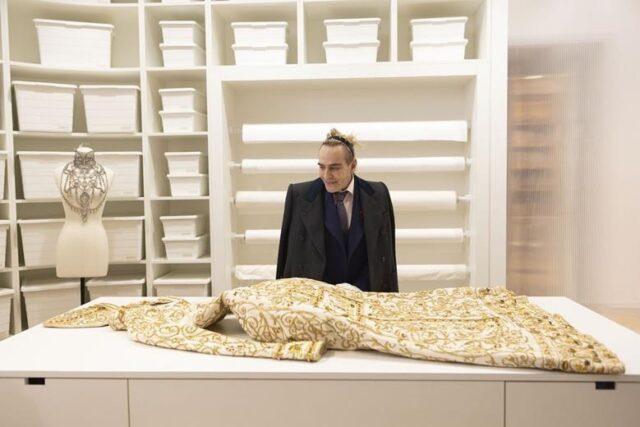
It’s the crucial question but a reductive and even unanswerable one: is the fashion designer John Galliano a racist bigot?
Early on in Kevin Macdonald’s new feature documentary High & Low – John Galliano (released in the UK by Mubi and in contention for awards), we see footage of the designer’s antisemitic rants at a Paris restaurant in 2011. Galliano was instantly disgraced, suspended by fashion label Dior (where he was creative director) and pilloried in the global press. It has been a long road back….
How does Macdonald himself feel about Galliano’s outbursts having made the film and spent so much time with his subject?
“That’s the million-dollar question…that’s what the film is answering in a way. You have to see the film to understand what I feel about it. It is complicated,” the Oscar-winning Scottish director (One Day In September) doesn’t answer directly. “John…I don’t think he is an antisemite. I think he said an antisemitic thing. If you start from that premise, why did he say that thing, then you can ask why that is so upsetting to people. As someone who lost family in the Holocaust, I obviously feel personally that it is a vile and disgusting thing to say. But then you can move on to ask people to be forgiven. I personally believe yes, they can be forgiven if they have shown remorse or done the work ,or apologised to the people who they have offended.”
Even the matter of Galliano’s forgiveness is fraught. One of Macdonald’s most perceptive interviewees, Washington Post journalist Robin Givhan, very pointedly observes that Galliano is a white man; that fashion has a short memory and that the designer has powerful friends. A suspicion remains that he wouldn’t have been treated so indulgently if he had come from a different background.
Then again, friends like Naomi Campbell, Kate Moss and Charlize Theron stood by Galliano when it would have been far easier for them to have walked away. Macdonald believes the fact that they wanted to appear in the film, talking on his behalf, “demonstrates he has loyal and deep friendships with people who feel loyalty to him because of his talent and what he has done for them.”
The director also points out that “a Black man has not been in the position of power that John was in. You could say that was because of the structural racism around fashion in general. [Fashion designer] Virgil Abloh changed that a bit. One might ask what would have happened if he had said something like that. Would he have been given as hard a time? I don’t know.”
One of the reasons Macdonald was interested in this subject was that he had been thinking hard about cancellation culture and the idea of forgiveness. “What is the point of religion if you don’t believe people can change,” a Rabbi involved in the documentary said to him – a line which fascinated the filmmaker.
On a personal level, the director got on very well with Galliano during filming. He appreciated that his subject didn’t try to interfere with the documentary in any way and never had PR execs policing the interviews, telling the director what he could and couldn’t ask.
“He [Galliano] tried to be as straightforward with me as he could,” Macdonald says. He hopes his doc is nuanced in its approach to the fashion designer. “It becomes a kind of psychological mystery story…something people will debate, discuss and argue about.”
Washington Post journalist Givhan also comments in the film that people should be capable of holding two conflicting ideas in their head at the same time, one that Galliano has said something unforgivable and the other that he is a very talented artist, without them cancelling each other out. “I agree with that level of complexity,” Macdonald says. He has been gratified by the levels of discussion and ‘deep thinking’ around the film. “He [Galliano] is a very compelling person and the mystery around him remains.”
The parallels between Galliano and his contemporary, fellow fashion designer Alexander McQueen, are very pronounced. “McQueen and he shared a lot. Obviously they both went to Saint Martins [art school]. Obviously, they’re both gay working-class men from London who went on to become British heads of major fashion houses. They shared a remarkable amount,” the director notes of the two British fashion world prodigies. McQueen died in 2010, just as Galliano was beginning his alcohol and drug fuelled descent. Both men were inspired by movies and staged fashion shows that were hugely cinematic. As Macdonald reveals in the documentary, Galliano was obsessed by Abel Gance’s classic silent biopic, Napoleon (1927). He was also passionate about Jane Campion’s The Piano (1993).
“I think cinema was at the heart of his work, the way his imagination works,” Macdonald observes of Galliano. “He sees images or poses of actresses in a film – and from that he develops a whole world himself. Whether or not he would have been a great director I don’t know. I suspect not. I think he would have been maybe a great video artist. He had no interest or understanding of narrative or of politics in its wider sense.”
Galliano was attracted to surfaces. He had a genius for staging brilliant set-pieces but, to his detractors, his work lacked depth and moral complexity. For example, when he based a show around homelessness, he didn’t seem to realise that the people living on the streets he was depicting were actually suffering real hardship.
Macdonald throws in a reference to The Red Shoes (1948), the ballet movie written, directed and produced by Michael Powell and Emeric Pressburger (the director’s grandfather). “That’s the greatest expression in cinema I know of living for your art and dying for your art and nothing else being important. That is what he [Galliano] is living in a way but, as in The Red Shoes, there is a destruction of the self that comes with that, leading a life that is purely about beauty and art and doesn’t look at the consequences of anything else.”
The film has an illustrious roster of interviewees including super models and heads of major fashion houses. “We didn’t know how much LVMH/Dior were going to cooperate because for a long time since the incident happened [Galliano’s rant] they, in an almost Soviet way, obliterated him from their history. But I think we were lucky with the timing. They had just done a Dior touring exhibition which has gone around the world and been a huge success. I think a lot of people have said to them ‘John is a genius.’”
Macdonald also conjectures that the fashion house may now feel enough time has passed for them to acknowledge that Galliano is indeed “a huge part” of their recent history. LVMH CEO (and former Dior CEO) Sidney Toledano had been “very wounded” by what happened with the designer but was keen to tell Macdonald “his side of the story.”
The director is well placed to draw comparison between the movie and fashion industries. He points out that fashion is now a huge business, “on a scale far bigger than the film business.”
“But I was very surprised by the people I met in the fashion business. I had all the clichés in my head about incredibly bitchy, superficial, uncooperative and temperamental people but we found all the people we dealt with very straightforward and pleasant,” Macdonald says.
The documentary has an abundance of archival riches, overseen by archive producer Sam Dwyer. Dior, Givenchy and Maison Martin Margiela shared their knowledge and materials.
The other specialist fashion archives (Vix Foster, Videofashion, Yoox Net-A-Porter, Bloomsbury Launchmetrics, Videopolis, La Mode en Images Conde Nast, Ken Flanagan, Mark Lebon) contributed ,as did fashion photographers and agencies, among them Robert Fairer, Roxanne Lowit’s estate, Patrice Stable, Nick Knight, Laurent Van Der Stockt, Stephane Sednaoui, Jean-Baptiste Mondino, Mario Testino, Gavin Bond, Mai Duong, The Richard Avedon Foundation, Brad Branson’s estate, Bertrand Rindoff Petroff, Jill Furmanovsky, Derek Ridgers, Peter Paul Hartnett, and Anne Leibovitz.
…………………………………………….
Macdonald has also revealed further details of his new documentary joint venture with Plan B, the US company run by actor Brad Pitt and Dede Gardner (and partly owned by French outfit Mediawan). The aim is to combine Macdonald’s knowledge of docs and Plan B’s expertise in financing to get inventive and formally arresting new docs off the ground.
“We are looking for new voices in film. We both feel there is a bit of an opportunity at the moment. A lot of traditional broadcasters are getting out of documentary. The streamers are really concentrating on celebrity in a big way. There is a need for a broader range of documentaries,” Macdonald commented.





