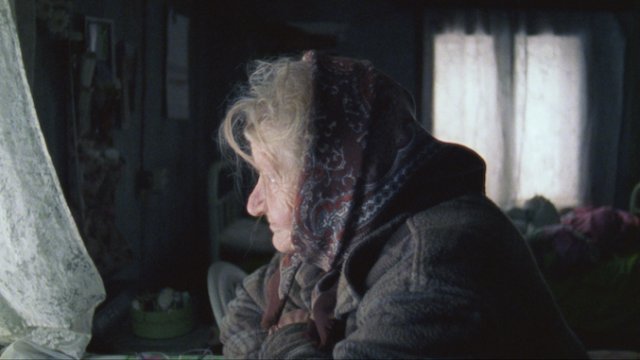
Seven or eight years ago, after her grandmother died, Estonian filmmaker Liis Nimik began to think deeply about the life the old lady had lived. “She, who was kind of the poorest of society, was living like the richest through my eyes,” Nimik observes. Her grandmother certainly wasn’t wealthy but she “always had everything she needed and peace in her heart.”
The grandmother would work in her garden. She was at one with nature, enjoying a calm and peaceful existence in the heart of the countryside.
In her new documentary Sundial (selected for the Changing Face Of Europe at Hot Docs) Nimik looks for other Estonians living in the same way as her grandma.
“We went on a journey through Estonia to find these people and every time I felt the same profound peace,” the director explains how she chose her subjects. “In many ways, we made the film together with the characters. Since we were filming in 16mm, it was very clumsy…they were kind of our partners in crime.” These country dwellers come from all over Estonia. What they have in common is their shared inner tranquility.
Sundial (made through Estonian production company Klara Films) shows different generations of folk. There are kids doing their homework or playing chess at the kitchen table with their parents. There are young men chopping wood and elderly matriarchs sitting watching them.
“The main thing that ties them together is their approach to what is around them,” Nimik says. “One of the topics of the film is that a human being is not the crown of nature. I am looking at them through this animistic perspective. They see the world around them where everything is equal – every tree, every [piece of] bark, every bird, every human, everyone is on the same level. It seemed to me that to make that point, I needed different generations.”
Nimik tried to explain in the simplest way she could what she was looking for. She spent a lot of time with all of the subjects, visiting them many times without a camera before she began shooting so they would become accustomed to her presence. “I am, until now, very good friends with everybody,” she says of the close rapport she built up with the country dwellers.
During shooting, some adjustments of expectations were needed. Nimik started off with “everything on paper” and an exact plan as to how the film would be structured. “And then, in the middle of shooting, I realised because we were shooting on film rolls, I cannot finish this plan because we do not have enough stock and our budget doesn’t allow us to buy more.”
In the end, the director decided just “to chase the feeling.” She knew what she was looking for – that sense of calmness and contentment her grandmother used to project.
“The crisis of the film rolls came. Then the crisis of Covid. Then I gave birth to a baby girl…all these big things made me realise that, wait a minute, I have the film. I just need to edit it in a certain way.”
After deliberating at great length on how she should structure the film, she eventually edited the entire thing in two or three days. It all fell together.
Nimik is a producer and editor as well as a director. She also teaches. Her other credits include Finnish doc Lynx Man (2023), which she produced, A Loss of Something Ever Felt (2020), which she co-wrote and produced (and which premiered in Hot Docs), the action comedy Jesus Shows You The Way To The Highway (2019), on which she was a producer, and the drama Portugal (2018), which she edited.
“If I have a chance to delve really deep into something, it doesn’t really matter if I am an editor or a producer or a director. Of course, [being a] director is the big game, that is why it [Sundial] took so long a time.”
Nimik admits that she got “a bit burned out” in her past life editing features. She loves editing (and is doing a PHD on the subject) but on much of the art house films on which she was working there was “not a lot of script” and the stories had to be found during the post-production. That put extra pressure on her. The films all turned out well in the end, securing berths in prestigious festivals. “But to sit there in a cubicle in a small room for years and years…somehow I felt I needed to get out.”
Her PHD is on “chance and film editing.” She describes editing as being a creative process akin to painting. “You put two things together and suddenly you have something new. It’s a really, really complicated process that is very hard to describe.” The PHD will have a historical side, looking at filmmakers like Jean-Luc Godard who edited in radical new ways. It will also include interviews with editors currently working and a section looking at editing experiments she conducts with her students. “What it all finally brings together, I have no idea yet…”
Nimik believes that editing remains “so misunderstood, even within the film community.” She gets angry when she is asked ‘which programme do you use?’ as if the computer software is more important than the craft. “In reality, 50% of good editing is working with time and chance,” she suggests. “They’re the two things that nobody really acknowledges and that don’t get any credit…in editing, we are not only working with images. We are working with rhythms within the images, we are working with sounds, we are working with music, with faces.”
As she contemplates her movie career with its breakneck schedule and many different commitments, Nimik can’t help but yearn for the simplicity of her grandmother’s life. “I am a very bad example of the opposite, doing so many things to survive because life is expensive.”
Whatever her work routine, Nimik’s summers remain sacred. In July and August, she heads off to her grandmother’s house and shuts out the outside world. She is determined that her daughter Sylvia will be abler to experience “at least a glimpse” of the life her grandmother used to live. She has also discovered that when she is in the countryside, “the moment you get quiet and obey the rhythms of nature…what I discovered is that inspiration starts to appear.”
And, yes, she admits that the winter months can be tough in the remote countryside. “That’s why I excluded summer from my film because I wanted to catch the atmosphere of these cold months…we are constantly waiting for the sun to come out!”