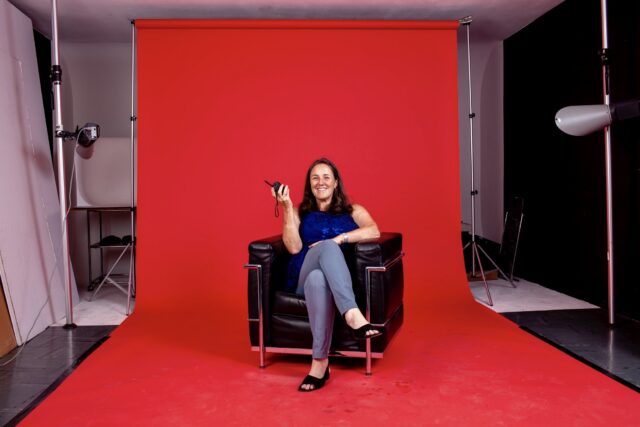
It’s 25 years since Esther van Messel founded First Hand Films, her Zurich-based world sales, distribution and production outfit, in 1998. “To be commercial and subversive at the same time, to change the world and have fun doing it,” is the van Messel mantra.
Now, partly to mark the quarter century of the company, she is launching the €25,000 First Hand Fund Diversity Call. The award is designed to be “intersectional, diversity-oriented, and particularly encourages submissions from underrepresented and discriminated people of all genders, sexual orientations, colours, physical and psychological abilities.” The award, given in cash and in kind, will be available to applicants – companies or collectives – with a diverse track record or a diverse business plan.
Van Messel is at DOK.fest Munich where she will share more details about the initiative. As she tells Business Doc Europe, the new Fund aims to be as inclusive and as flexible as possible.
“When I founded the company 25 years ago, I had the luxury to have a loan which I needed to pay back in a certain amount of time,” van Messel remembers the first steps of First Hand Films. She had quit the company she worked at previously because of the “glass ceiling” which had stopped her career progress. Instead, she struck out on her own – and she paid back the loan far quicker than expected.
“I was always curious for stories that were new but also approachable, accessible. I never liked to have ‘boring, important’ films. For me, that is an insult. We are in the entertainment industry,” the First Hand boss notes. Right from the launch of the company, she was looking to work with “stories from new, different and unheard voices, very often by and from women – and very often about women. I always like to see us more on the screen, the kind of women we are.”
This was a period when working mothers were conspicuous by their tiny numbers. When she would pick up her kids from childcare, she would be one of the few women with a proper career. “I was very privileged to be able to do both, have kids and work. My kids were 2 and 5 years old when I founded the company.”
In 2018, when she was writing a new business plan, she quickly identified what distinguished First Hand Films. “We’re small, we’re lean, we’re in the middle of Europe. We know everything about documentary around the world because we have worked with films from everywhere. We always have financiers from everywhere knocking on our doors. We have a lot of contacts, a lot of access.”
All this helped her find an investor who could help her take First Hand to the newest level. In 2019, Hansjürgen Schmölzer of BSX Austria took a minority share in the company. “We’re in a really good pole position to pick up films. He can co-produce them out of Austria and I can distribute them and give them a good home internationally. One of the things we came up with together was to put this money in a fund to celebrate this anniversary.”
In the late 80s, the documentaries First Hand supported had to be “well-made, relevant, authentic and gripping.” Exactly the same applies today.
Now, as the company turns 25, van Messel is talking in terms of giving “back to the storytellers.”
The new awards are just as likely to go to producers as to the latest much hyped director. Van Messel knows how hard the former have to work just to get a project off the ground. “Producers have earned the right for more support for their structures. They are underpaid. They’re exhausted. It is really, really hard these days to see how people are using their own resources just to make films work. There are a lot of funding schemes where they are not allowed to take a proper salary and a producer’s fee…my interest is to do something that’s more sustainable.”
Van Messel also raises the possibility that if a good application comes in, the money may just as well go toward the renovation of a cinema as the production of a new film. She wants the award to be “something that is a bit more than this one current project we are talking about.”
31st July is the deadline for applications. The awards will be announced in the autumn, possibly at one of the “fall” festivals. The company will also have a 25th anniversary party in Zurich, a July 8 sundowner on the lake on . “We don’t want to make a huge carbon footprint but we also want to celebrate.”
First Hand Films’ Polish Prayers (Hanka Nobis) premieres this week in Poland and van Messel continues to raise finance on Nobis’ next film Songs of Sisterhood.
There are plenty of other new projects on the First Hand slate, among them Sarah Rathgeb’s Conquering The Art Business, which looks at how women have come into a sphere that used to be almost entirely dominated by men; the Dutch-made doc A Way to B from Jos de Putter and Clara van Gool and which is about Catalan dance collective Liant la Troca, some of whose performers have a physical disability, and Tamar Yarom’s The Prostitution Monologues, an Israeli doc in which seven women share frank stories about their lives in prostitution. The company has also acquired an option on The Cycle Club, the Dutch interactive format about the menstruation cycle, which van Messel is looking to launch as a multi-platform program in Switzerland.
Van Messel may have misgivings about certain aspects of the current documentary market – for example, commissioning editors who are too timorous to do their jobs properly, streamers who simply don’t buy, and blinkered TV stations or public broadcasters who look only for the most obvious mainstream properties. Nonetheless, her approach to the business is much as it always has been. “Because I don’t know what the market is doing, I don’t understand it and I can’t trust it, I just follow my gut feeling,” the First Hand boss declares. “Everything I do is because I believe in these films.”